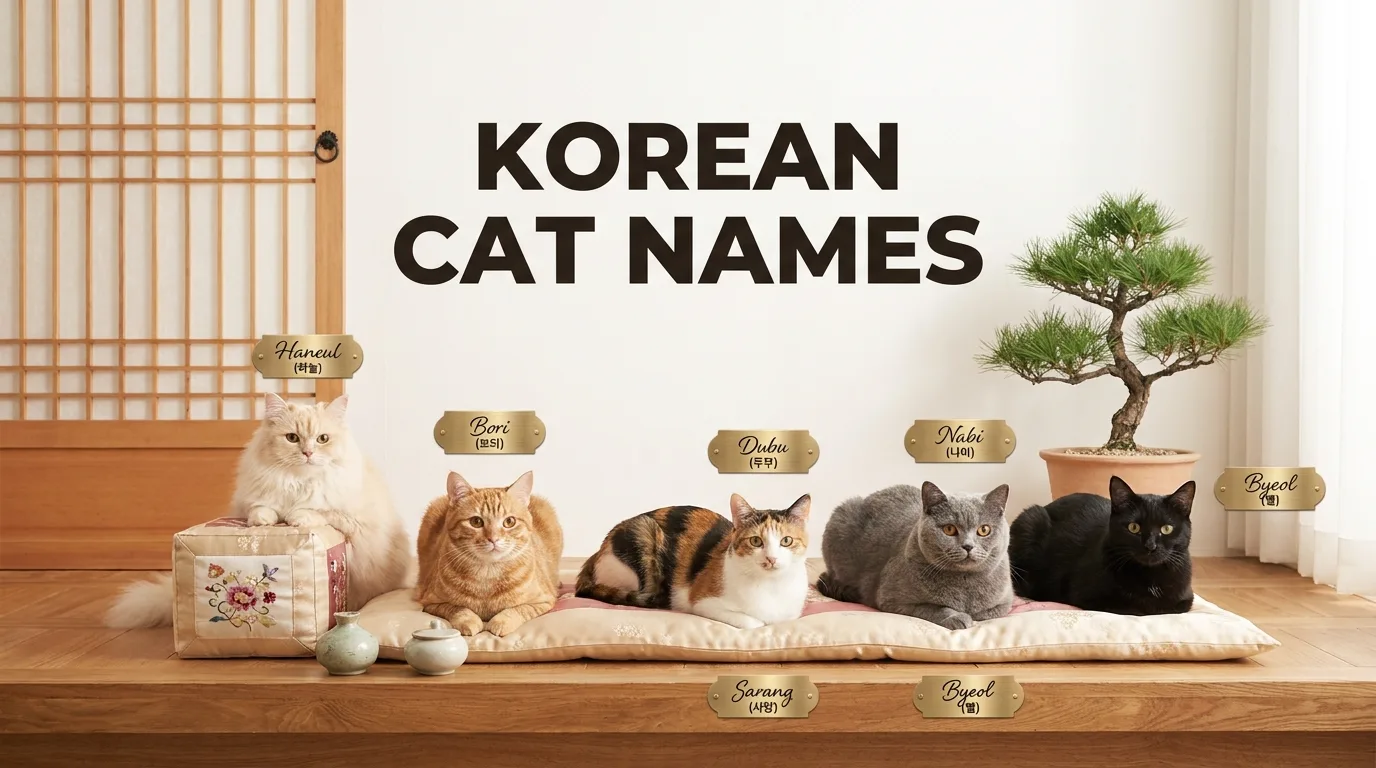
Finding the right Korean cat name can be a fun way to celebrate Korean language and culture. However, choosing an authentic name requires a little more care than copying a list of cute-sounding words from the internet.
Many lists of Korean pet names combine several completely different things: traditional Korean personal names, native Korean vocabulary, food words, modern nicknames, and names borrowed from other languages. Sometimes, they also assign a fixed meaning to a Korean name without explaining that its meaning can depend on the hanja characters used to write it.
That distinction matters.
A name such as Haneul has a direct and easily understood Korean meaning: “sky.” Sarang literally means “love.” Other names, including many traditional Korean personal names, can have different meanings depending on the Chinese characters chosen for them. Meanwhile, names such as Dubu and Bori are Korean words that have become familiar choices for pets, even though they are not necessarily traditional human given names.
This guide separates those categories clearly. Whether you want a cute Korean cat name, a meaningful Korean name for a male or female cat, a short name that is easy to call, or a name genuinely connected to Korean culture, the goal is to help you understand why each name belongs on the list.
Korean Cat Names With Exact Linguistic Meanings
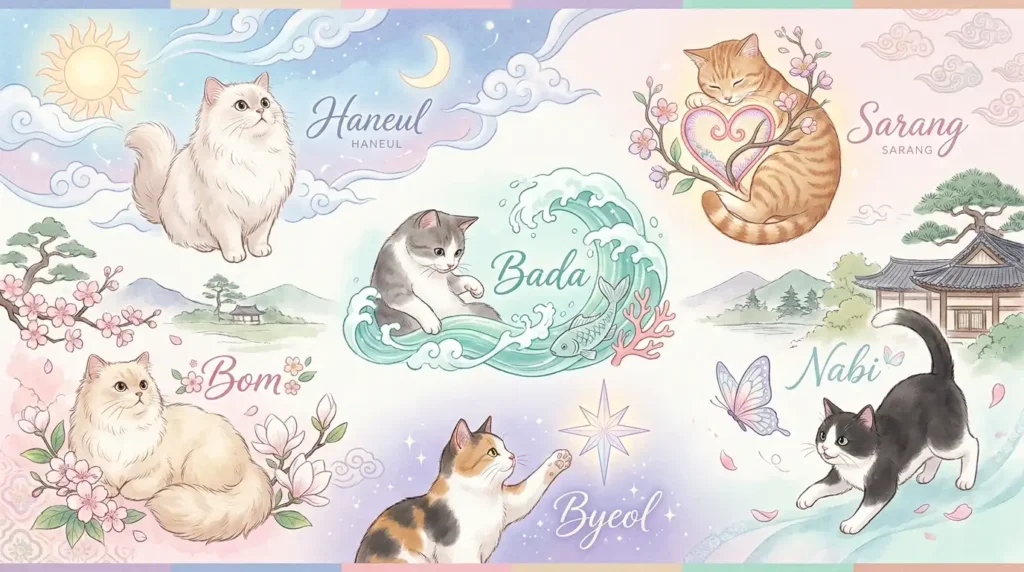
The names in this section have the most direct connection to their meanings. Each comes from a Korean word whose meaning can be translated without relying on a symbolic interpretation or an invented backstory.
Several of these words have also become established personal names in Korea, particularly as modern parents have embraced native Korean vocabulary alongside traditional names based on hanja.
| Name | Hangul | Meaning | Connection Type | Simple Pronunciation | Typical Gender Usage |
|---|---|---|---|---|---|
| Haneul | 하늘 | Sky, heaven | Exact linguistic meaning | hah-neul | Unisex |
| Sarang | 사랑 | Love | Exact linguistic meaning | sah-rang | Used as a personal name |
| Areum | 아름 | Beauty | Exact linguistic meaning | ah-reum | Primarily feminine |
| Bada | 바다 | Sea, ocean | Exact linguistic meaning | bah-dah | Unisex |
| Byeol | 별 | Star | Exact linguistic meaning | byuhl | Flexible |
| Bom | 봄 | Spring | Exact linguistic meaning | bohm | Flexible |
| Nabi | 나비 | Butterfly | Exact linguistic meaning | nah-bee | Primarily feminine in human use |
| Nari | 나리 | Lily | Exact linguistic meaning | nah-ree | Primarily feminine |
| Bora | 보라 | Purple | Exact linguistic meaning | boh-rah | Primarily feminine |
| Gyeoul | 겨울 | Winter | Exact linguistic meaning | gyuh-ool | Flexible |
| Baram | 바람 | Wind | Exact linguistic meaning | bah-ram | Flexible |
| Dalbit | 달빛 | Moonlight | Exact linguistic meaning | dahl-bit | Modern word-based use |
| Gureum | 구름 | Cloud | Exact linguistic meaning | goo-reum | Flexible |
| Nuri | 누리 | World | Exact linguistic meaning | noo-ree | Unisex |
| Iseul | 이슬 | Dew | Exact linguistic meaning | ee-seul | Primarily feminine |
Haneul — 하늘
Haneul means “sky” and can also carry the sense of “heaven” depending on context. It is one of the best-known examples of a native Korean word being used as a modern personal name.
The name has a gentle sound while still carrying a clear and expansive meaning. For a cat, Haneul can work especially well if you are drawn to nature-inspired names or simply want something that sounds distinctly Korean.
Because Haneul is associated with the open sky, some pet owners may choose it for a blue-eyed cat or a particularly adventurous one. Those are personal associations, however. The actual linguistic connection is much simpler: Haneul literally refers to the sky.
For English speakers, the pronunciation is approximately hah-neul, although the Korean vowel written as eu does not have an exact equivalent in standard American English.
Sarang — 사랑
Sarang is the Korean word for “love.”
Its connection to affection is literal, making it one of the most meaningful choices for someone who wants a Korean cat name that expresses the relationship between a pet and its owner.
Unlike names that are merely associated with love through mythology or symbolism, Sarang directly refers to the concept itself. That makes it a particularly strong choice for readers searching for a Korean name with an affectionate meaning.
Sarang also demonstrates an important feature of modern Korean naming: meaningful everyday Korean words can sometimes move beyond ordinary vocabulary and become personal names.
For a cat, the name is memorable without being difficult to pronounce. A simple English approximation is sah-rang, with the final sound softer than an English “ng” in some natural Korean speech.
Areum — 아름
Areum is connected directly with the Korean concept of “beauty.”
It is often included among native Korean-style names and has a straightforward semantic connection that does not depend on hanja.
This makes Areum useful for readers specifically searching for a Korean cat name associated with beauty. Still, it is worth avoiding the common naming-list habit of assigning personality traits to a name. Areum does not mean “a beautiful and kind soul” or “someone destined to be admired.” Its linguistic connection is to beauty.
The name itself has a soft rhythm and works particularly well for owners looking for a longer, feminine-leaning name that remains easy to say.
Bada — 바다
Bada means “sea” or “ocean” in Korean.
It is a strong option for anyone searching for Korean cat names inspired by nature. Unlike many nature-themed names that require a symbolic explanation, Bada has an immediate and literal connection to water.
The name can suit many different types of cats. A blue-eyed cat might make the ocean association visually appealing, but a cat does not need a particular appearance to carry the name well.
Bada is also short and easy for English speakers to pronounce: bah-dah.
Byeol — 별
Byeol means “star.”
This is one of the shortest Korean nature names on the list, but its pronunciation can initially be challenging for English speakers because Korean romanization does not always correspond neatly to English spelling.
A rough English approximation is byuhl.
Its literal connection to a star makes Byeol a natural choice for a cat with a bright personality or distinctive markings. Again, those are stylistic associations rather than part of the word’s original meaning.
For readers who want something genuinely Korean, short, and meaningful, Byeol is an especially strong option.
Bom — 봄
Bom means “spring,” the season.
As a name, Bom is brief, cheerful, and strongly connected with nature. The word itself refers directly to spring rather than symbolically representing renewal or youth, although those broader associations may naturally influence why someone chooses it.
Its short length can also make it practical for a pet. Cats often respond more readily to sounds that are consistently used, and a brief name can be easy for an owner to repeat naturally.
Bom is pronounced approximately bohm.
Nabi — 나비
Nabi means “butterfly.”
It is one of the most recognizable Korean vocabulary names that can work beautifully for a cat. The direct meaning gives it a connection with delicacy and movement, although those qualities are associations with butterflies rather than additional literal meanings of the word.
Nabi may be especially appealing for a quick, agile, or playful cat. In human naming usage, it tends to lean feminine, but pet names do not necessarily need to follow the gender conventions used for people.
The pronunciation is approximately nah-bee.
Nari — 나리
Nari is associated with a lily in Korean and is used as a feminine Korean name.
Floral names exist across many cultures, but Nari provides a specifically Korean-language option for readers who want that connection.
It is important not to confuse Nari with unrelated names that happen to share the same Roman spelling in other languages. The Korean form has its own linguistic and cultural context.
Nari is pronounced nah-ree, making it one of the easier Korean cat names for American English speakers to use.
Bora — 보라
Bora means “purple” in Korean.
Color names can make excellent pet names because they are short, visually memorable, and easy to pronounce. Bora is particularly useful for someone who wants a genuine Korean word with a simple and specific meaning.
It may appeal to owners of cats with gray, bluish, or otherwise unusual coloring, although purple is not a typical feline coat color. The attraction is more likely to be the sound and cultural connection of the name itself.
Bora is generally pronounced boh-rah.
Gyeoul — 겨울
Gyeoul means “winter.”
For English speakers, the spelling can look intimidating, but it represents a familiar Korean word. A rough pronunciation is gyuh-ool.
Winter names can be particularly appealing for white, silver, or gray cats, although those visual associations are modern naming choices rather than part of the word’s definition.
Gyeoul is a strong option if you want something seasonal that is less familiar internationally than names such as Bom or Haneul.
Baram — 바람
Baram means “wind.”
It is another native Korean word with a direct nature-based meaning. The name can suggest movement and freedom, but those are interpretations inspired by the concept of wind rather than separate dictionary meanings.
For a fast or energetic cat, Baram may feel especially fitting. It can also work well for owners who prefer names that are not strongly gendered.
The approximate pronunciation is bah-ram.
Dalbit — 달빛
Dalbit means “moonlight.”
The name is formed from Korean words connected with the moon and light, giving it a direct poetic meaning.
Moon-related names are common in pet naming around the world, but Dalbit offers a specifically Korean expression. It may suit a pale-colored cat, a cat that becomes active at night, or simply an owner who likes celestial themes.
The pronunciation is approximately dahl-bit.
Gureum — 구름
Gureum means “cloud.”
This name has a playful sound and a simple connection with nature. It may immediately bring fluffy cats to mind, especially those with white or gray coats, but the name itself does not describe a particular kind of cloud or appearance.
Gureum is pronounced approximately goo-reum.
For owners looking for unusual Korean cat names that remain connected to an everyday Korean word, Gureum is a particularly interesting option.
Nuri — 누리
Nuri is connected with the Korean word for “world.”
It is a short and versatile name with a broad literal meaning. Unlike names based on a narrow physical object, Nuri carries a larger conceptual connection while remaining easy to call.
Nuri has also appeared in Korean naming usage and can be treated as a flexible option rather than a strictly gender-specific name.
The pronunciation is approximately noo-ree.
Iseul — 이슬
Iseul means “dew.”
It is a delicate nature-based name associated directly with the small drops of moisture that form on surfaces.
The name has a softer and more unusual sound for English-speaking audiences, making it a good choice for someone who wants a Korean name that is meaningful without being based on one of the most obvious concepts such as love, sky, or stars.
A rough pronunciation is ee-seul, although the final vowel is closer to the Korean sound represented by eu.
Korean Personal Names With Hanja-Dependent Meanings
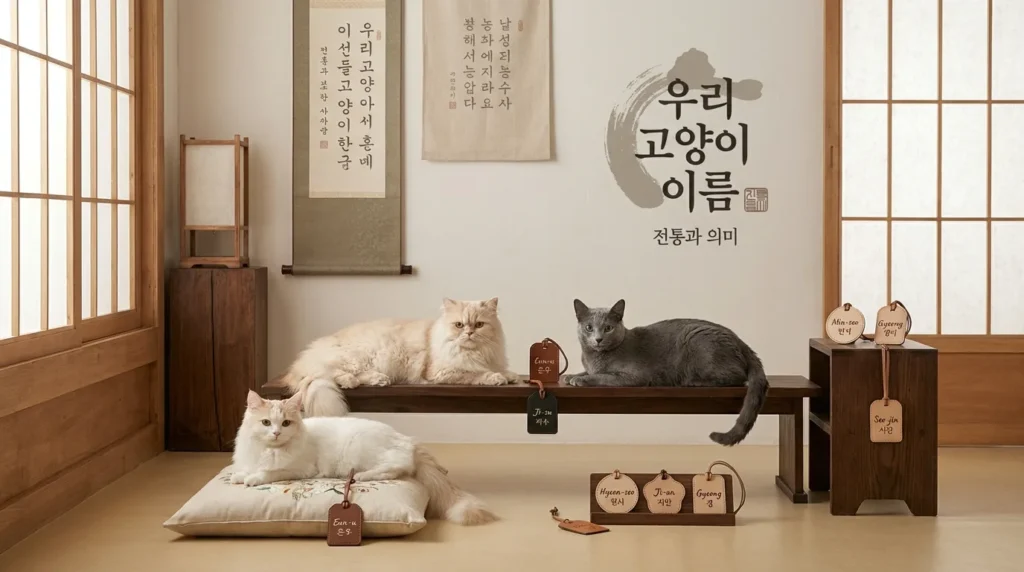
Traditional and modern Korean names often consist of syllables that can be represented using different hanja characters.
This means that two people can have the same Korean pronunciation for their names while having names written with different characters and, therefore, different meanings.
For that reason, it would be inaccurate to say that every person, cat, or fictional character called Eun-u, for example, has exactly the same name meaning.
These names are still excellent Korean-style choices for cats. They simply belong to a different category from native Korean words such as Haneul or Bada.
| Name | Meaning | Origin | Pronunciation | Gender Usage |
|---|---|---|---|---|
| Eun | Depends on hanja; can include kindness or silver | Sino-Korean | un | Unisex |
| Eun-u | Depends on hanja combination | Sino-Korean | un-oo | Often unisex |
| Ji-su | Depends on selected hanja | Sino-Korean | jee-soo | Used across genders |
| Min-seo | Depends on selected hanja | Sino-Korean | min-suh | Used across genders |
| Hyeon-seo | Depends on selected hanja | Sino-Korean | hyun-suh | Used across genders |
| Ji-an | Depends on selected hanja | Sino-Korean | jee-ahn | Used across genders |
| Gyeong | Multiple possible hanja meanings | Sino-Korean | gyuhng | Flexible |
| Seo-jin | Depends on selected hanja | Sino-Korean | suh-jin | Used across genders |
Eun — 은
Eun is a genuine Korean name, but its meaning cannot be reduced to a single English word without identifying the intended hanja.
Different characters pronounced eun can carry meanings connected with kindness, grace, mercy, charity, or silver.
This is an important example of why Korean naming research requires more than finding a Romanized spelling and copying the first meaning attached to it online.
For a cat, Eun works well because it is short and distinctly Korean. However, if you are choosing it specifically because you want a particular meaning, it is best to identify the exact character combination you intend to reference.
Eun-u — 은우
Eun-u, also written Eun-woo, is a two-syllable Korean name.
Both syllables can be represented by multiple hanja characters. Depending on those choices, the name can have several possible meanings.
This does not make Eun-u less authentic. Instead, it reflects a fundamental feature of many Korean personal names: pronunciation and meaning are not always enough to identify the exact written form.
Eun-u is particularly useful for owners who want their cat to have a name that sounds like a contemporary Korean personal name rather than a Korean vocabulary word.
Ji-su — 지수
Ji-su is another established Korean-style name with multiple possible interpretations.
The syllable Ji can be represented by characters associated with ideas such as wisdom, knowledge, purpose, or ambition, while Su can also be represented by several different characters.
As a result, assigning a single fixed translation to Ji-su would oversimplify the name.
For pet owners, this can actually be an advantage. The name sounds natural within Korean naming traditions while allowing the owner to appreciate its cultural form without relying on an invented universal meaning.
Min-seo — 민서
Min-seo is widely recognizable as a modern Korean personal name, but its precise meaning depends on the selected hanja.
Characters pronounced min and seo can represent multiple concepts. Therefore, a claim that Min-seo universally means one specific phrase should be treated with caution unless the actual characters are known.
Its sound, however, clearly follows Korean personal naming conventions.
Min-seo is a good choice for an owner who wants a longer but still easily pronounceable name for a cat.
Hyeon-seo — 현서
Hyeon-seo can be formed using various hanja characters.
Possible meanings associated with the first syllable can include concepts such as virtue, worthiness, ability, or brightness, while the second syllable also has multiple possible character forms.
Because of this variation, Hyeon-seo should be understood as a Korean personal name with potential meanings determined by its written characters.
It is pronounced approximately hyun-suh.
Ji-an — 지안
Ji-an is another name that can have several interpretations depending on the characters used.
The second syllable, an, can be associated with concepts such as peace or tranquility when represented by particular hanja. Other possibilities also exist.
The name’s connection with peacefulness should therefore be described as one possible hanja-based interpretation, rather than the universal definition of every Ji-an.
Its pronunciation, jee-ahn, is relatively accessible to English speakers.
Gyeong — 경
Gyeong is a Korean syllable associated with numerous hanja characters.
Depending on the character, meanings may include scenery, respect, honor, celebration, or other concepts.
It also appears frequently as one part of a longer Korean name.
For a cat, Gyeong is distinctive and concise, but its Romanized spelling may be difficult for Americans unfamiliar with Korean pronunciation. A rough approximation is gyuhng.
Seo-jin — 서진
Seo-jin is a well-established Korean-style personal name consisting of two syllables that can each be written with different hanja.
As with Min-seo and Ji-su, the meaning is not universal. The intended characters determine the specific interpretation.
The name is pronounced approximately suh-jin and can work for a cat whose owner prefers a recognizable Korean personal-name style.
Korean Cat Names With Cultural Associations
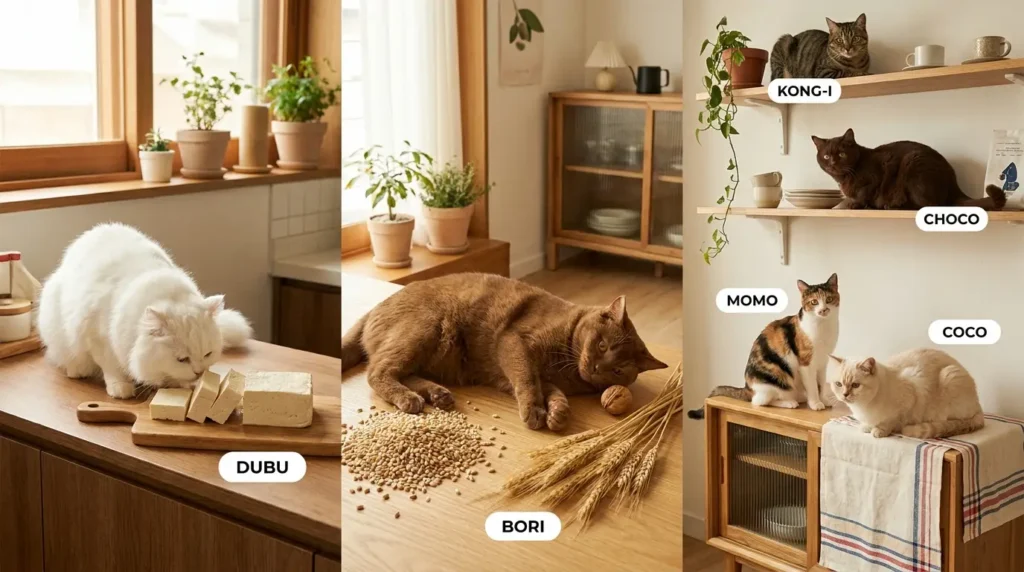
A Korean cat name does not have to be a traditional human name.
In fact, Korean pet naming frequently includes affectionate nicknames, food words, and short, memorable sounds. These choices are culturally connected to pet naming rather than being presented as ancient Korean personal names.
That distinction allows us to appreciate them for what they actually are.
Bori — 보리
Bori means “barley.”
Although it is an ordinary Korean word, Bori has a particularly strong cultural connection with Korean pet naming and has appeared among commonly used names for companion animals.
This makes Bori one of the most authentic choices in the entire guide for someone specifically looking for a Korean pet name rather than a Korean baby name.
The name is short, cheerful, and easy to pronounce: boh-ree.
Its popularity in pet culture is also an important distinction. Bori is not included merely because “barley” sounds cute. It has a genuine connection to the way animals are actually named in Korea.
Dubu — 두부
Dubu means “tofu.”
It is primarily a food word rather than a conventional Korean human name. That should be stated clearly.
However, food names are widely used for pets, and Dubu fits naturally into that cultural naming style. Its soft sound also makes it particularly suitable for an animal.
Owners sometimes choose Dubu for a white cat because tofu is pale in color. That visual connection is a modern descriptive association rather than part of the name’s linguistic meaning.
The pronunciation is approximately doo-boo.
Hodu — 호두
Hodu means “walnut.”
Like Dubu, Hodu is a food-related Korean word that can function naturally as a pet name.
It may be particularly appealing for a brown or golden-colored cat, but the literal meaning remains simply “walnut.”
Hodu demonstrates why pet names should not be judged using exactly the same standards as human given names. A vocabulary word can be culturally appropriate as a pet name even when it is not traditionally used as a person’s name.
Kong-i — 콩이
Kong means “bean,” while -i is an affectionate ending frequently heard in Korean names and nicknames.
The resulting name, Kong-i, has a playful and pet-friendly character. It is also connected to actual Korean companion-animal naming practices rather than being an arbitrary invention.
Kong-i can work particularly well for a small cat, although being small is not necessary for the name.
The pronunciation is approximately kong-ee.
Choco — 초코
Choco is associated with “chocolate” in Korean usage.
It should not be described as a native Korean word with an ancient etymological history. Instead, it represents a modern Koreanized pet-name style connected with chocolate.
Choco is often appealing for brown or dark-colored pets, but its use is broader than coat color alone.
For English-speaking cat owners who want a name that is easy to pronounce while still being genuinely recognizable in Korean pet culture, Choco can be a practical option.
Momo — 모모
Momo is widely recognizable as a pet name in Korea.
However, one important point deserves emphasis: its popularity in Korean pet naming does not automatically give it a single Korean etymological meaning.
This is exactly the type of distinction that many name lists fail to make.
Momo belongs here because of its documented cultural use as a pet name, not because it can be translated into one particular Korean concept.
Its short repetition and soft vowel sounds make it easy to call, which may help explain why similar structures are common in pet names across multiple cultures.
Coco — 코코
Coco is another name commonly found in Korean pet naming.
Like Momo and Choco, it should be classified according to its actual use rather than assigned an invented Korean meaning.
The strength of Coco as a Korean cat name comes from its contemporary cultural familiarity within Korean pet naming, not from native Korean etymology.
For an American owner, it also has the advantage of being immediately recognizable and easy to pronounce.
Korean Cat Names by Style
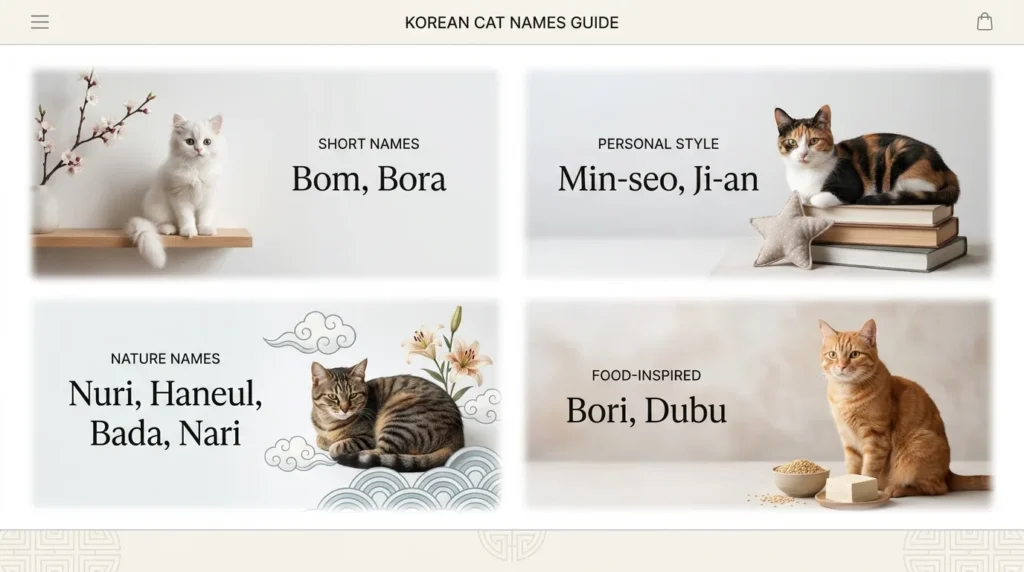
Different cat owners approach naming differently. Some want a traditional-sounding personal name, while others prefer a literal Korean word or something that reflects modern Korean pet culture.
These categories can help narrow your choices without pretending that style categories are linguistic classifications.
Short Korean Cat Names
Short names are often convenient for pets because they are easy to repeat consistently.
Some of the best short Korean cat names include:
- Bom
- Bori
- Bora
- Eun
- Nabi
- Nari
- Nuri
- Momo
- Coco
Among these, the linguistic backgrounds differ considerably. Bom, Bora, and Nuri have direct Korean vocabulary connections, while Eun is a Korean personal-name element whose meaning depends on hanja. Momo and Coco are best understood through their cultural use as pet names.
Nature-Inspired Korean Cat Names
Korean provides a rich source of nature vocabulary that can be adapted into meaningful cat names.
The strongest options include:
- Haneul — sky
- Bada — sea
- Byeol — star
- Bom — spring
- Gyeoul — winter
- Baram — wind
- Dalbit — moonlight
- Gureum — cloud
- Iseul — dew
- Nabi — butterfly
This category is especially useful because the names are connected directly to the natural concepts they represent.
Korean Personal-Style Names
If you want your cat to have a name that sounds like a Korean human name, consider:
- Eun
- Eun-u
- Ji-su
- Min-seo
- Hyeon-seo
- Ji-an
- Seo-jin
- Haneul
- Nari
- Bora
Some of these are native Korean word-based names, while others follow Sino-Korean naming traditions involving hanja.
Food-Inspired Korean Cat Names
Food-inspired pet names are a fun and culturally recognizable category.
Consider:
- Bori — barley
- Dubu — tofu
- Hodu — walnut
- Kong-i — little bean or bean-based nickname
- Choco — chocolate-inspired name
These names are particularly useful if you are looking for something playful rather than a formal Korean-style personal name.
Can Korean Cat Names Be Used for Male or Female Cats?
Yes. Many of the names in this guide can be used flexibly for pets.
Human naming traditions and pet naming traditions do not always follow the same gender conventions. A name that is primarily feminine when given to a person can still be chosen for a male cat, especially when the owner is more interested in its literal meaning.
For example, Nabi and Nari tend to have feminine associations in human naming contexts, while names such as Haneul, Bada, and Baram can feel more flexible.
Names such as Dubu, Bori, and Hodu are even less dependent on human gender conventions because they function primarily as vocabulary-based pet names.
If you are searching specifically for Korean male cat names, personal-name options such as Eun-u, Hyeon-seo, or Gyeong may appeal to you. For Korean female cat names, Nari, Bora, Areum, and Nabi may be more immediately recognizable choices.
The most culturally accurate approach, however, is to understand the actual naming background of each name instead of forcing every Korean name into a rigid English-language gender category.
How to Choose an Authentic Korean Name for Your Cat
Before settling on a name, it can help to decide which type of Korean connection you actually want.
Choose a native Korean word if meaning matters most
Names such as Haneul, Sarang, Bada, and Byeol are excellent choices because their meanings are direct and easy to verify.
Choose a Korean personal name if you want a human-name style
Names such as Eun-u, Ji-su, Min-seo, and Ji-an follow established Korean naming patterns.
Just remember that their exact meanings may depend on the hanja chosen for the name.
Choose a culturally familiar pet name for a playful option
Bori, Dubu, Kong-i, Momo, and Coco are better understood as pet-oriented names.
This does not make them less authentic. They simply have a different relationship to Korean culture than a traditional personal name does.
Consider pronunciation
A beautiful meaning is less useful if you find the name difficult to say every day.
Names such as Bom, Bada, Nari, Bora, Nuri, and Dubu are generally straightforward for American English speakers. Names such as Gyeoul, Gyeong, Byeol, and Haneul may require more familiarity with Korean pronunciation.
That does not mean the latter names should be avoided. It simply means that learning their pronunciation is part of using the name respectfully.
Best Korean Cat Names: 10 Standout Choices
Haneul
One of the best overall choices because it combines an established Korean naming tradition with a clear native Korean meaning.
Bori
A standout choice for someone specifically searching for an authentic Korean pet name because of its real-world connection with companion-animal naming.
Sarang
An excellent option when you want a name that expresses affection through its literal meaning.
Byeol
Short, distinctive, and directly connected with the Korean word for “star.”
Nabi
A memorable nature name with a literal meaning that is easy to understand.
Bada
One of the strongest Korean nature names because its connection with the sea is direct and unmistakable.
Nuri
A flexible and relatively easy-to-pronounce option connected with the concept of the world.
Dubu
A playful Korean pet name that works especially well if you prefer food-inspired names.
Bom
Simple, seasonal, and meaningful without requiring a complicated explanation.
Dalbit
An especially poetic choice for owners looking for a Korean name connected with the moon and nighttime.
A great Korean cat name does more than sound cute. It can connect your pet to a real Korean word, an established naming tradition, or the contemporary culture of pet naming in South Korea.
For a direct linguistic meaning, Haneul, Sarang, Bada, and Byeol are among the strongest choices. For a Korean personal-name style, Eun-u, Ji-an, and Min-seo offer recognizable naming forms while reminding us that hanja can influence a name’s exact meaning. And for a name rooted in modern pet culture, Bori, Dubu, and Kong-i provide playful alternatives with a genuine Korean connection.
The most important thing is to choose a name for the right reason. A literal Korean word, a hanja-based personal name, and a popular Korean pet name can all be authentic choices—but they should not be presented as if they are the same kind of name. Understanding that difference makes it easier to find a name that feels meaningful while respecting the language and culture from which it comes.