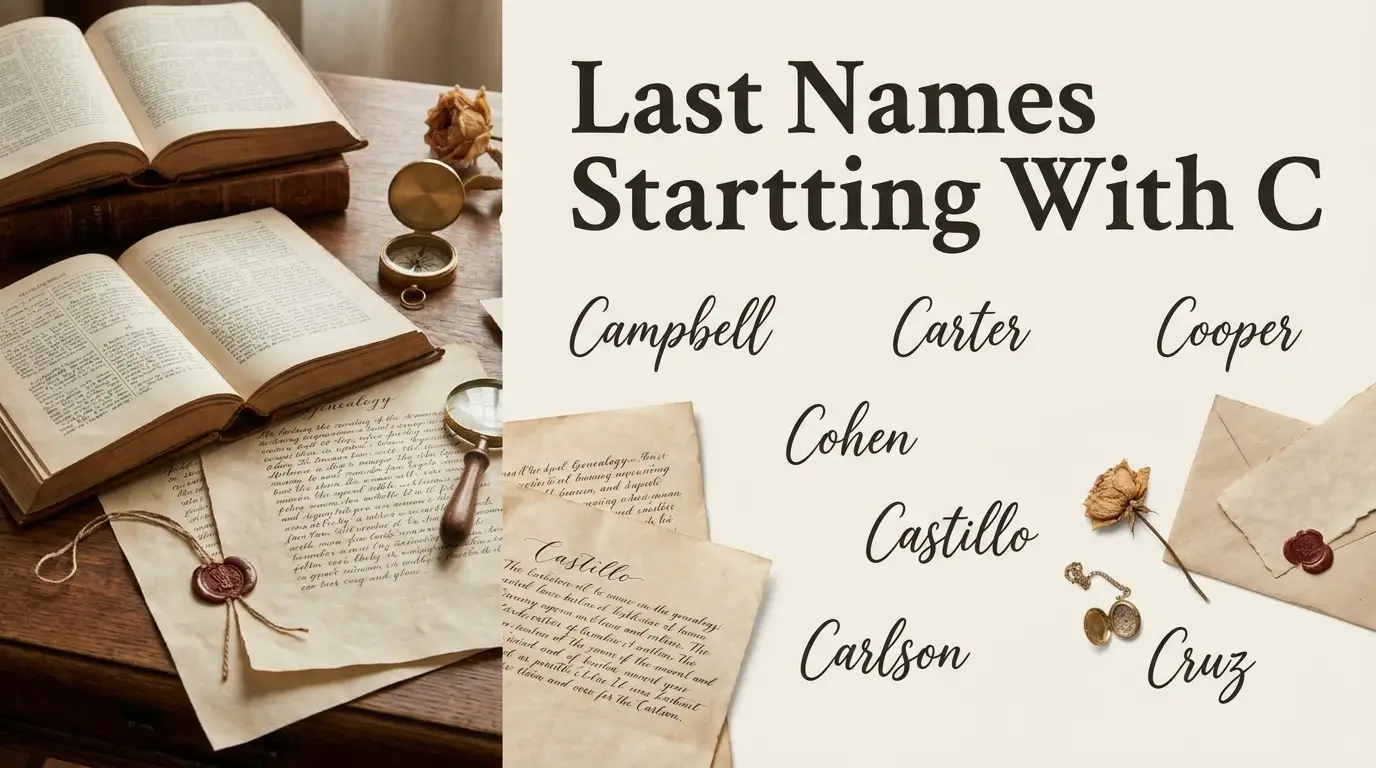
Last names beginning with C come from an exceptionally wide range of linguistic and cultural traditions. In the United States, where family histories often reflect immigration from many parts of the world, C surnames may have English, Scottish, Irish, Welsh, Scandinavian, German, French, Spanish, Portuguese, Jewish, Italian, or other origins.
That diversity makes a simple list of “C last names and meanings” more complicated than it first appears. A surname may describe an ancestor’s occupation, identify where a family once lived, preserve the name of a parent, reflect a physical characteristic, or carry an important religious or cultural association. In some cases, the same modern spelling developed independently in different places and may therefore have more than one legitimate origin.
For that reason, this guide does not treat every surname meaning as a simple one-word translation. Carter, for example, has a well-documented occupational origin connected with transporting goods by cart. Campbell developed from a Gaelic descriptive byname. Carlson preserves the Scandinavian patronymic pattern of identifying someone as the son of Carl. Cohen has a historically significant connection with the Jewish priesthood.
The names below are organized according to the type of historical connection behind them. This distinction matters. An occupational origin is not the same as a literal translation, and a religious association is not automatically the same as a surname’s linguistic meaning.
Whether you are researching your family history, choosing a surname for a fictional character, exploring cultural naming traditions, or simply looking for interesting last names starting with C, these names offer a fascinating introduction to the history carried by family names.
Last Names Starting With C by Type of Origin
Surnames are often grouped according to how they originally developed. The major patterns represented among C last names include:
- Occupational surnames, based on a person’s work.
- Descriptive surnames, based on appearance or another distinguishing characteristic.
- Patronymic or personal-name surnames, based on an ancestor’s given name.
- Topographic and habitational surnames, connected with landscapes or places.
- Cultural and religious surnames, connected with historical traditions or social roles.
These categories describe a surname’s historical development. They do not necessarily describe the occupation, appearance, religion, or location of people who carry the surname today.
Occupational Last Names Starting With C
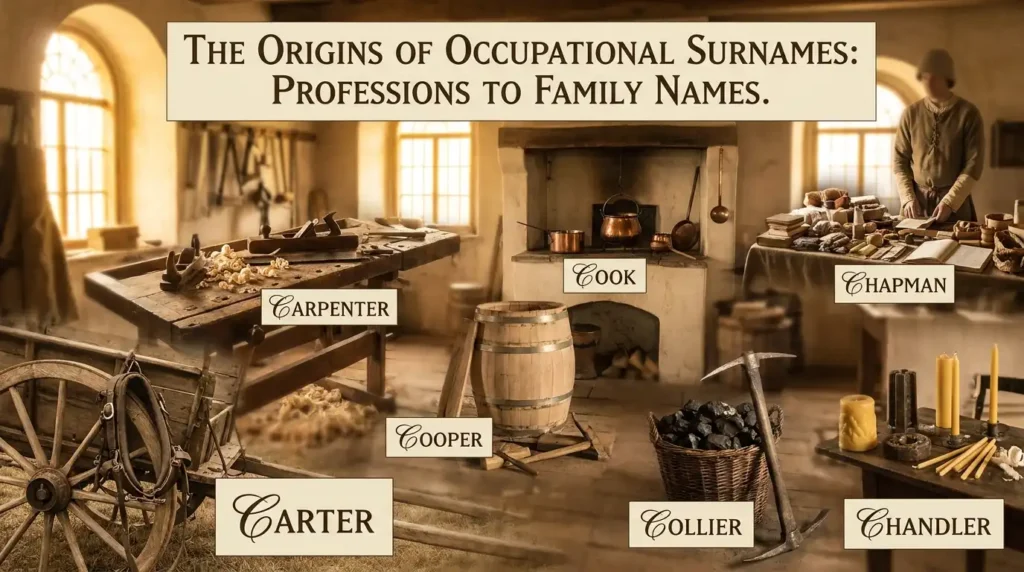
Occupational surnames became especially common in medieval Europe. In relatively small communities, identifying someone by their profession was practical. A man who made barrels might become known as the cooper, while someone who transported goods could be identified as the carter.
Over generations, these occupational descriptions could become hereditary family names.
| Last Name | Historical Meaning | Language/Origin | Pronunciation |
|---|---|---|---|
| Carter | Transporter of goods by cart | English | KAR-ter |
| Carpenter | Woodworker or builder | English/French | KAR-pen-ter |
| Chapman | Merchant or trader | English | CHAP-man |
| Clark | Cleric, clerk, or educated writer | English | KLARK |
| Cook | Professional cook | English | KOOK |
| Cooper | Maker or repairer of barrels | English | KOO-per |
| Collier | Charcoal burner or coal worker | English/French | KOL-ee-er |
| Chandler | Candle maker or seller | English/French | CHAND-ler |
Carter
Carter is one of the most recognizable occupational surnames beginning with C. Historically, it referred to a person who transported goods by cart or wagon.
Before modern transportation, moving supplies between villages and towns required specialized work. A carter might transport agricultural products, building materials, merchandise, or household goods. The occupation was sufficiently common for the descriptive term to become a hereditary surname in many families.
Today, Carter has also become an established given name in the United States. That modern development does not change its surname origin. When used as a family name, its historical connection remains occupational.
Carpenter
The surname Carpenter developed from a profession involving woodworking and construction. A historical carpenter could make furniture, construct buildings, repair wooden structures, or perform other skilled work.
The surname reached English through French linguistic influence and ultimately has deeper Latin roots. Like many occupational surnames, Carpenter could have developed independently in different communities. This means that two modern Carpenter families do not necessarily share one common carpenter ancestor.
Its meaning, however, is among the more transparent occupational origins found in English-language surname traditions.
Chapman
Chapman historically referred to a merchant or trader. The surname developed from Old English elements associated with buying, selling, and trade.
A chapman could travel between communities selling goods, making the occupation particularly important before the development of large-scale modern retail systems. In some contexts, the word referred specifically to an itinerant trader.
Chapman therefore preserves evidence of a historical commercial occupation. It is a useful example of how surnames can provide clues about the social and economic life of earlier communities.
Clark and Clarke
Clark and Clarke are historically related surname forms. The name developed from a word originally associated with a cleric or member of the clergy.
However, its history became more complex over time. During the medieval period, literacy and education were often concentrated within religious institutions. As a result, the term eventually expanded beyond its strictly religious meaning and could refer to a scholar, writer, secretary, or record keeper.
This means Clark is best understood as a historical role-based surname rather than simply translating it as “priest.”
The spelling Clarke is an established historical form of the surname. The difference between Clark and Clarke generally reflects spelling traditions rather than two entirely unrelated names.
Cook
Cook is a straightforward occupational surname referring to someone who prepared food professionally.
Historical cooks could work in private households, castles, religious institutions, inns, or other large establishments. Because cooking was an occupation found across numerous communities, surnames derived from the role could develop independently.
It is also worth noting that the surname Cook does not imply that every person carrying it is descended from one particular historical family. Like Carter and Cooper, it represents a type of occupation that could produce the same surname in multiple places.
Cooper
The surname Cooper refers to a skilled craftsperson who made or repaired barrels, casks, and other wooden containers.
Before the widespread use of modern packaging, barrels were essential for storing and transporting a remarkable variety of products. Food, liquids, agricultural goods, and trade merchandise could all be transported in containers produced by coopers.
This made the profession economically important, particularly in commercial and agricultural communities.
Cooper remains one of the clearest examples of a surname that preserves the memory of a historical craft. It has also become a popular surname-style given name in the modern United States.
Collier
Collier has historically been associated with work involving charcoal or coal. Depending on the particular linguistic and regional tradition, the name may refer to a charcoal burner, a seller of coal, or someone engaged in related work.
Because surnames often crossed linguistic borders and developed through regional spelling changes, the precise occupational background of a particular Collier family may vary.
Still, the surname’s association with charcoal and coal work is historically significant and makes it another important occupational C surname.
Chandler
Chandler developed from an occupation connected with the production or sale of candles.
In earlier centuries, chandlers played an important role because candles provided artificial light before electricity. Depending on the historical context, a chandler could also deal in other household goods and supplies.
The surname entered English through French influence and eventually became established as a hereditary family name.
Like Carter and Cooper, Chandler has moved beyond its original surname role and is now also used as a given name.
Descriptive Last Names Starting With C
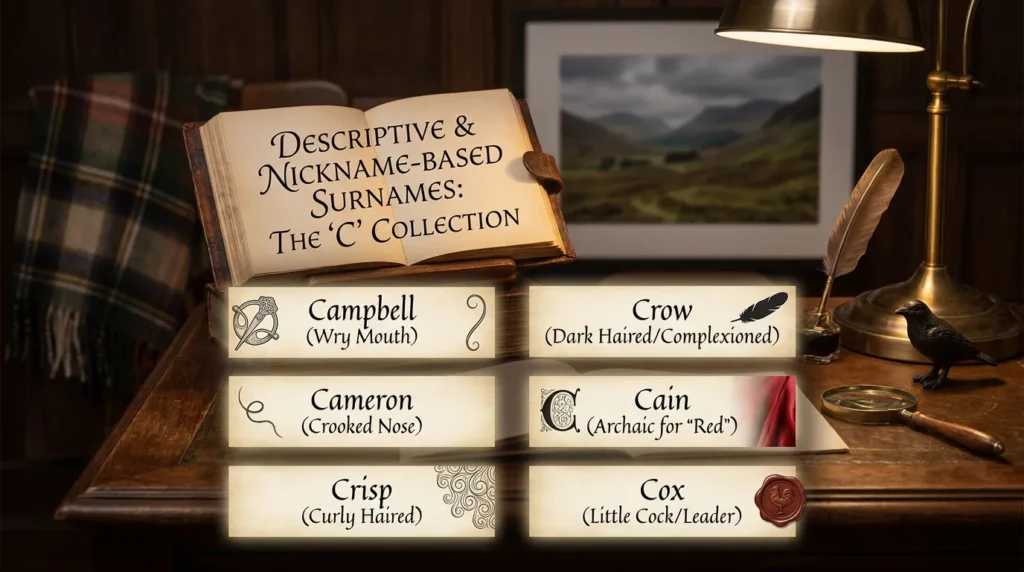
Not every surname identified a person’s occupation. Some originated as nicknames or descriptive labels.
Medieval communities frequently used distinguishing characteristics to tell individuals apart. A person might be identified according to physical appearance, location, personality, or some other recognizable feature. Over time, these descriptions could become hereditary surnames.
| Last Name | Historical Connection | Origin | Pronunciation |
|---|---|---|---|
| Campbell | Traditionally interpreted as “crooked mouth” | Scottish Gaelic | KAM-bel |
| Cameron | Traditionally interpreted as “crooked nose” | Scottish Gaelic | KAM-uh-run |
| Crisp | Associated with curly or curled characteristics | English/French/Latin | KRISP |
| Crow | Possibly derived from a bird-based nickname | English | KROH |
| Cain | Multiple possible origins | Irish/English/other | KAYN |
| Cox | Multiple possible nickname and personal-name sources | English | KOKS |
Campbell
Campbell is one of the most famous Scottish surnames beginning with C. Its traditional Gaelic analysis connects it with elements meaning “crooked” or “bent” and “mouth.”
The name is therefore often translated as “crooked mouth.” Historically, however, it should be understood as a descriptive byname rather than a modern statement about people who carry the surname.
Once such a name became hereditary, later generations inherited it regardless of whether the original physical description remained relevant.
Campbell also carries an important historical and cultural association with Clan Campbell, one of Scotland’s most prominent Highland clans. This clan association is separate from the surname’s linguistic etymology but is an important part of the name’s cultural history.
Cameron
Cameron is another well-established Scottish surname with a traditional Gaelic descriptive origin.
It is commonly analyzed through elements meaning “crooked” or “bent” and “nose.” The surname is therefore traditionally translated as “crooked nose.”
As with Campbell, this historical origin should not be interpreted literally when discussing modern families. The original description likely functioned as a byname before becoming hereditary.
Cameron has historical connections with several Scottish family and territorial traditions, and modern genealogy should not assume that every Cameron family belongs to one particular ancestral clan.
In the United States and other English-speaking countries, Cameron has also become an established given name.
Crisp
The surname Crisp has a historical connection with words meaning curly, curled, or wavy.
The descriptive surname may originally have referred to a person’s hair or another visible characteristic. It passed through a linguistic tradition involving Latin and French forms before becoming established in English surname history.
The modern English adjective crisp should not automatically be used to interpret the surname’s original meaning. Historical word development can produce similarities that appear obvious to modern speakers while obscuring the name’s actual linguistic path.
Crow
Crow may have originated as a nickname connected with the bird.
Animal-based surnames were not unusual in medieval naming traditions. A comparison with a particular animal might refer to appearance, behavior, voice, or another characteristic. However, the precise reason behind a particular historical nickname is often impossible to recover.
For that reason, it is more accurate to describe Crow as possibly connected with a bird-based nickname rather than claiming that every original bearer was named for the same characteristic.
Cain
Cain is a surname with potentially multiple origins, making a simple one-word meaning unreliable.
In some traditions, the surname has connections with personal names or Irish family-name developments. The biblical name Cain may also influence how modern readers interpret the spelling, but that does not mean every surname bearing the form Cain developed directly from the biblical figure.
This is an important example of a surname where identical spelling does not automatically establish a single origin.
Cox
Cox also has more than one proposed historical pathway. It has been associated with nickname traditions and forms derived from personal names.
Because surname development occurred over centuries and across regional dialects, researchers should be cautious about assigning one universal meaning to every Cox family.
The most accurate approach is to recognize that multiple documented origins may exist.
Patronymic and Personal-Name Surnames Beginning With C
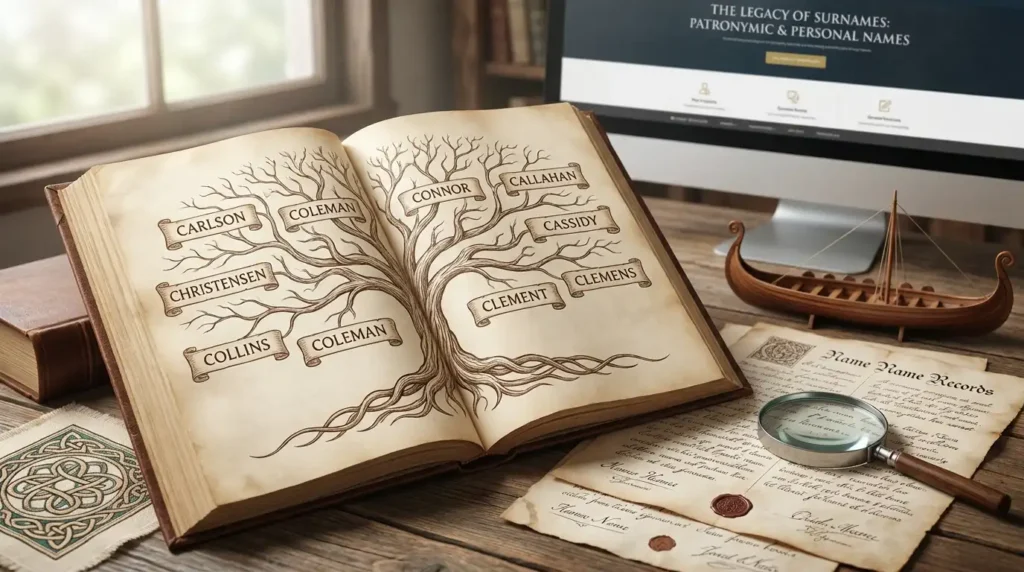
A large number of surnames developed from personal names.
A patronymic surname traditionally identifies someone through a parent or ancestor. Other surnames developed from the name of an important family founder without necessarily preserving a literal “son of” structure.
| Last Name | Historical Source | Cultural Background | Pronunciation |
|---|---|---|---|
| Carlson | Son of Carl | Scandinavian | KARL-sun |
| Christensen | Son of Christen or Christian | Scandinavian | KRIS-ten-sun |
| Collins | Multiple personal-name and Gaelic surname sources | English/Irish/Manx | KOL-inz |
| Coleman | Multiple personal-name traditions | English/Irish | KOHL-man |
| Connor | Derived from Irish personal-name traditions | Irish | KON-er |
| Callahan | Anglicized Irish family-name tradition | Irish | KAL-uh-han |
| Cassidy | Anglicized Irish surname | Irish | KAS-ih-dee |
| Clement | Derived from the personal name Clement | French/English | KLEM-ent |
| Clemens | Related to Clement naming traditions | German/European | KLEM-enz |
Carlson
Carlson is a classic Scandinavian patronymic surname meaning “son of Carl.”
Historically, Scandinavian naming systems often identified children through their father’s given name. A son of a man named Carl could therefore become Carlson.
In modern American usage, the surname is generally hereditary rather than a literal description of someone’s father.
The surname is especially useful for understanding how immigration helped preserve older Scandinavian naming patterns within the United States.
Christensen
Christensen is another Scandinavian patronymic surname. It traditionally means “son of Christen” or “son of Christian,” depending on the historical language and naming tradition involved.
Spelling patterns can vary across Danish and Norwegian traditions, and related surnames may appear with forms such as Christiansen.
These differences should not automatically be treated as unrelated names. Scandinavian surname spelling often reflects regional languages and historical record-keeping traditions.
Collins
Collins is particularly interesting because it does not have one universally applicable origin.
Some Collins families have English personal-name connections, while others trace their surname through Irish or Manx naming traditions. Certain Irish forms were Anglicized into Collins over time.
This makes Collins an excellent reminder that a surname meaning found online may apply to one linguistic tradition but not necessarily to every family carrying the modern spelling.
Coleman
Coleman has multiple historical sources as well.
Different English and Irish naming traditions contributed to surnames that eventually appear as Coleman in modern records. Some interpretations involve personal names, while others reflect distinct historical developments.
For genealogy, this means a person’s location, family history, and earliest available records are more useful than assuming a universal origin based solely on the modern spelling.
Connor
Connor is associated with Irish personal-name traditions and is historically connected with the Gaelic name Conchobhar.
The deeper etymology of ancient Gaelic names is sometimes debated or interpreted differently by linguistic sources. It is therefore better to describe Connor primarily through its documented Irish personal-name history rather than relying on oversimplified internet translations.
Connor is also well established as a modern given name in the United States.
Callahan
Callahan represents an Anglicized form within Irish surname history.
Like many Irish family names, its modern English spelling reflects centuries of interaction between Gaelic and English. Spelling changes occurred through immigration, record keeping, and the broader historical process of Anglicization.
The name therefore provides an example of how a modern surname can preserve an Irish family tradition while appearing very different from its earliest Gaelic form.
Cassidy
Cassidy is another surname rooted in Irish Gaelic naming traditions.
Its history is connected with an established Irish family-name tradition rather than an ordinary modern English vocabulary word. As a result, simplified interpretations that attempt to assign Cassidy a contemporary English meaning can be misleading.
Cassidy has also crossed into modern first-name use, particularly in English-speaking countries.
Clement and Clemens
Clement and Clemens belong to a family of names historically connected with the Latin personal name Clemens.
The Latin root is associated with the idea of being merciful or gentle, although the surname forms developed through different linguistic traditions.
Clement became established in French and English surname history, while Clemens is particularly associated with German and other continental European naming traditions.
Because these surnames are historically connected through the same personal-name tradition, their relationship is linguistic and documented rather than merely based on similar spelling.
Geographic and Place-Based Last Names Starting With C
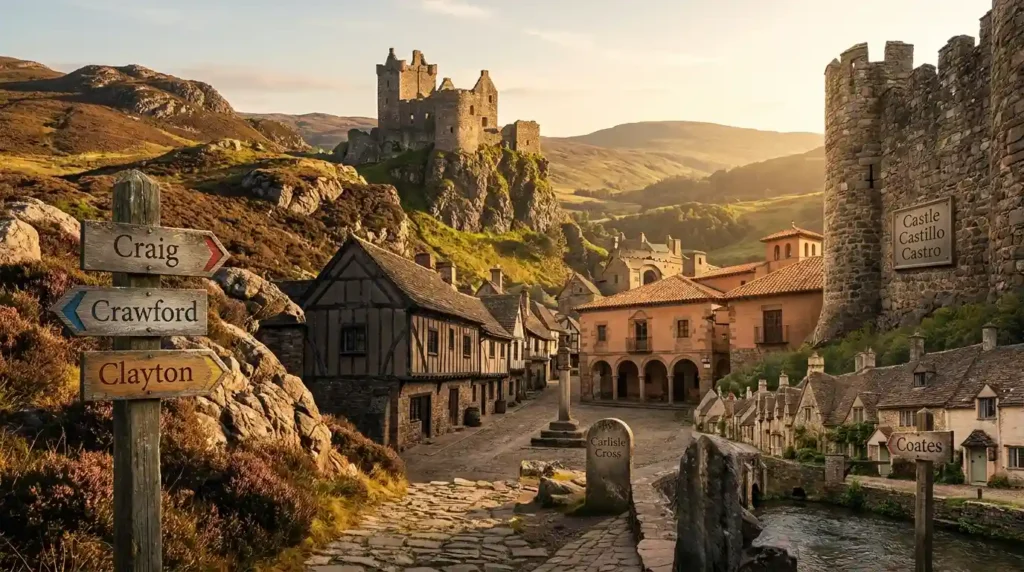
Place names provided another major source of surnames.
A person who moved from one village to another could be identified by the place they came from. Similarly, someone living near a prominent geographical feature might acquire a surname based on that feature.
| Last Name | Geographic Connection | Origin | Pronunciation |
|---|---|---|---|
| Craig | Rock or crag | Scottish | KRAYG |
| Crawford | Scottish place-name tradition | Scottish | KRAW-ford |
| Castle | Residence near a castle | English | KAS-ul |
| Castillo | Castle or castle-related place | Spanish | kas-TEE-yoh |
| Castro | Fortified settlement or castle-related place tradition | Spanish/Portuguese | KAS-troh |
| Clayton | Settlement associated with clay | English | KLAY-tun |
| Carlisle | Northern British place-name tradition | English/Scottish | kar-LYLE |
| Coates | Cottage or place-name tradition | English | KOHTS |
| Cross | Residence near a cross or landmark | English | KRAWS |
Craig
Craig comes from a Scottish word meaning “rock” or “crag.”
It likely began as a topographic surname for someone living near a prominent rocky feature or cliff.
Craig demonstrates how geographical vocabulary could become part of family identity. The name is now also used as a given name, but its surname origin remains strongly connected with the Scottish landscape.
Crawford
Crawford developed through a Scottish and northern British place-name tradition.
Like many habitational surnames, Crawford originally identified a person through a connection with a particular location. Such a surname could become especially useful when someone moved away from their original settlement and needed to be distinguished from people in their new community.
The precise linguistic analysis of old place names can involve several historical elements, so the surname is best described as place-based rather than reduced to an overly simple modern translation.
Castle
Castle could originally identify a person who lived near a castle or another prominent fortified structure.
This is a topographic or geographic connection. It does not mean that every family named Castle belonged to the aristocracy, owned a castle, or served as royalty.
This distinction is important because modern interpretations of surnames sometimes create social assumptions that historical evidence does not support.
Castillo
Castillo is an established Spanish surname connected with the Spanish word for “castle.”
Depending on the family’s historical background, the surname may have developed through a place-name tradition, a location near a castle, or another historical use of the same linguistic element.
Castillo is especially relevant when exploring Hispanic surnames beginning with C. In Spanish-speaking naming traditions, it may be used alongside another family surname rather than functioning within the traditional English-language pattern of a single inherited last name.
Castro
Castro is a widespread surname in Spanish- and Portuguese-speaking traditions.
Historically, the name is connected with a term associated with a fortified settlement or castle-like location. It often appears in place names as well.
This geographic connection is more historically defensible than modern symbolic claims suggesting that Castro inherently means “power” or “strength.” Such personality-style interpretations are modern associations rather than the surname’s original linguistic meaning.
Clayton
Clayton is an English habitational surname associated with a settlement-name tradition involving clay.
The name illustrates a common pattern in English surnames: a person could be identified according to the village or locality from which they originated.
Over time, families moved, spellings became standardized, and the original geographical connection could become increasingly distant.
Carlisle
Carlisle is associated with a historic place-name tradition from northern Britain.
As with many place-based surnames, the family name may originally have identified someone from or connected with the settlement of Carlisle.
It is important to distinguish the surname’s geographical origin from modern use. Carlisle can also appear as a given name, but its historical surname foundation is primarily place-based.
Coates
Coates is associated with English place-name and topographic traditions, often involving terms connected with cottages or small dwellings.
Because English surnames developed across numerous dialects and localities, individual family histories may require separate research to determine the precise geographical pathway.
Cross
Cross is generally a topographic surname associated with living near a prominent cross, crossroads marker, or religious monument.
Although the name has a connection with Christian symbolism in some historical contexts, the surname itself may simply have identified a person’s residence near a landmark.
Therefore, its primary historical classification is often topographic, with a possible cultural or religious landmark association.
C Surnames With Religious or Cultural Associations
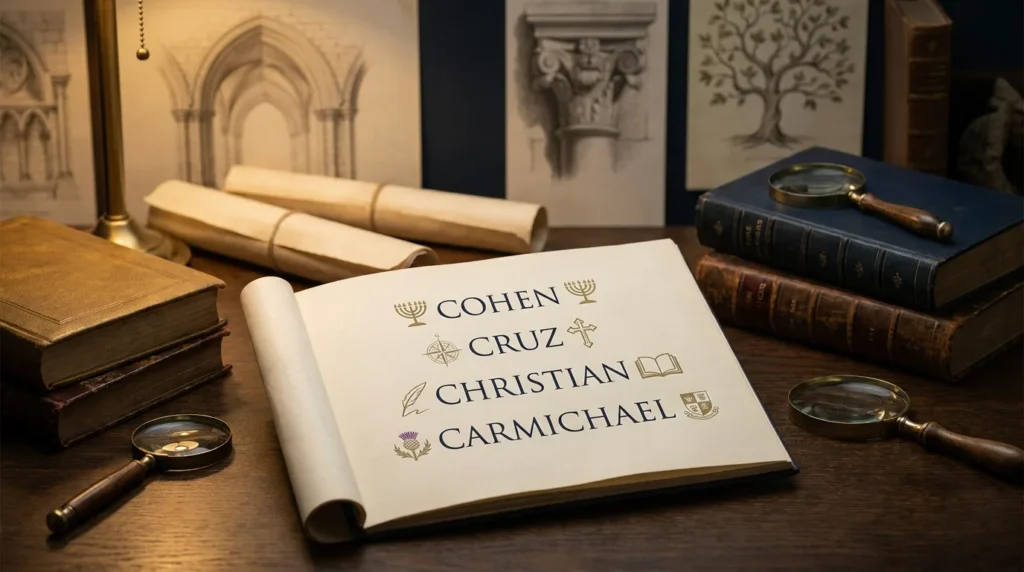
Some surnames have particular significance because of their connection with religion, sacred traditions, or historical cultural identities.
These associations should be described carefully. A religiously significant surname does not automatically reveal the personal beliefs of every modern person who carries it.
| Last Name | Historical or Cultural Association | Origin | Pronunciation |
|---|---|---|---|
| Cohen | Jewish priestly tradition | Hebrew/Jewish | KOH-en |
| Cruz | Cross in Iberian Christian naming traditions | Spanish/Portuguese | KROOZ |
| Christian | Religious and personal-name tradition | European | KRIS-chun |
| Carmichael | Scottish Gaelic surname containing Michael | Scottish | kar-MY-kul |
Cohen
Cohen has one of the most significant religious and cultural associations among surnames beginning with C.
The Hebrew word kohen refers to a priest, and the surname has traditionally been associated with families connected to the Jewish priestly tradition.
However, surname usage alone cannot always establish a person’s precise genealogical or religious status. Names can change through marriage, adoption, migration, and other historical processes.
Cohen should therefore be understood as a surname with a profound historical and cultural association, rather than as a simple label that can definitively determine every bearer’s ancestry.
Cruz
Cruz is the Spanish and Portuguese word for “cross.”
The surname therefore has a direct linguistic connection with a symbol that carries major importance within Christianity. Its development, however, also belongs to the broader history of Iberian personal and family naming.
A person named Cruz today may have a variety of cultural, ethnic, and religious backgrounds. The historical meaning of a surname should not be used to assume an individual’s present beliefs.
Christian
Christian can function as both a given name and a surname. Its history is closely connected with the religious term identifying a follower of Christianity.
As a surname, however, its presence in a family line may result from a personal-name tradition rather than directly indicating an ancestor’s religious status.
This distinction illustrates a broader principle in surname research: a word may have an obvious religious meaning while the surname itself develops through a more complicated naming process.
Carmichael
Carmichael is a Scottish surname with a connection to the personal name Michael, a name of major importance in Jewish, Christian, and Islamic traditions.
The surname itself belongs primarily to Scottish naming history and should not be treated as a direct translation of a religious concept.
Its significance lies in the historical preservation of a personal name within a Scottish family-name tradition.
Traditional British and Irish C Surnames
Readers interested in surnames with long histories in the British Isles have many choices beginning with C.
Campbell, Cameron, Clark, Carter, Chapman, Cooper, Collins, Craig, Crawford, Connor, Callahan, and Cassidy all belong to well-established naming traditions associated with England, Scotland, or Ireland.
These names do not all represent the same type of surname. Campbell and Cameron have Gaelic descriptive roots, Carter and Cooper are occupational, while Callahan and Cassidy belong to Irish family-name traditions.
This makes them culturally diverse despite their shared initial letter.
Short Last Names Beginning With C
For readers looking for concise surnames, several C options stand out:
- Cain
- Cole
- Cook
- Cox
- Craig
- Crow
- Cruz
- Cross
“Short” is simply a stylistic description based on spelling and visual length. It is not a claim about a surname’s age, importance, or frequency.
International Last Names Starting With C
C surnames reflect the multicultural history of the United States particularly well.
Campbell and Cameron bring Scottish Gaelic traditions into the list.
Connor, Callahan, Cassidy, and Collins connect with important Irish naming histories.
Carlson and Christensen preserve Scandinavian patronymic traditions.
Castillo, Castro, and Cruz represent established Spanish and Portuguese linguistic traditions.
Cohen has major significance in Jewish naming history.
Meanwhile, Carter, Cooper, Carpenter, Chapman, and Clark demonstrate the influence of English occupational and role-based surnames.
The letter C therefore does not represent one particular culture. It acts instead as a meeting point for many different naming systems.
C Surnames That Are Also Used as First Names
Modern American naming trends have increasingly transformed traditional surnames into given names.
Among the names in this guide, Carter, Cameron, Chandler, Cooper, Collins, Connor, Cassidy, Craig, and Clark have all entered first-name use.
Their gender patterns as given names can vary according to country, period, and naming tradition. That is separate from their use as surnames, which are generally not inherently gendered.
A surname does not become “male” or “female” simply because parents begin using it as a first name for one gender more frequently than another.
Best Last Names Starting With C
1. Campbell
Campbell is an outstanding choice for anyone interested in Scottish history because it combines a documented Gaelic linguistic background with an important cultural connection to Clan Campbell.
2. Carter
Carter is one of the clearest occupational surnames on this list. Its connection with historical transportation provides an easily understandable window into medieval working life.
3. Cameron
Cameron has a well-documented Scottish background and illustrates the historical transformation of a descriptive Gaelic byname into an established family name.
4. Collins
Collins is particularly interesting because its modern spelling can represent more than one naming tradition. It is a reminder that surname research often requires attention to geography and family history.
5. Cooper
Cooper preserves the history of an important craft involving the construction and repair of barrels and wooden containers.
6. Cohen
Cohen belongs on this shortlist because of its exceptional historical and cultural significance within Jewish naming traditions.
7. Castillo
For readers interested in Spanish-language surnames, Castillo provides a clear connection with a major Iberian linguistic and place-name tradition.
8. Clark
Clark offers a particularly rich historical story, evolving from associations with clerical life into broader connections with literacy and record keeping.
9. Carlson
Carlson clearly demonstrates the historical Scandinavian patronymic system and its lasting influence on American family names.
10. Cruz
Cruz is concise, internationally recognized, and linguistically connected with an important religious and cultural symbol.
Are Last Names Starting With C Male or Female?
A surname generally does not have a fixed gender.
Campbell, Carter, Cruz, Cohen, Cooper, and Castillo can all be carried by people of any gender. This differs from traditional given names, where gender usage may be historically or statistically documented.
Some surnames have become popular as first names in the United States. Carter and Cooper, for example, are widely recognized as given names, while Cameron and Cassidy have more varied gender histories depending on the period and region.
When researching male last names starting with C or female last names starting with C, it is therefore more accurate to distinguish between surnames and modern first-name usage.
How Common Are Last Names Beginning With C?
The United States has many historically widespread surnames beginning with C, including names such as Clark, Campbell, Carter, Cook, Collins, Cooper, Cox, Coleman, and Carlson.
However, surname frequency should always be discussed with a specific dataset and year. A surname’s ranking can change over time because of population growth, immigration, marriage patterns, and demographic changes.
It is also important not to confuse the popularity of a surname with the popularity of that same word as a first name.
For example, a surname such as Carter may have a particular position in surname records while separately having a different level of usage as a given name.
Choosing a Last Name Starting With C
The best surname beginning with C depends on the kind of history you want to explore.
For an occupational connection, names such as Carter, Carpenter, Chapman, Cook, Cooper, and Chandler offer clear historical foundations.
For Scottish heritage, Campbell, Cameron, Craig, and Crawford provide strong connections with Scottish linguistic and geographic traditions.
Readers interested in Irish surnames starting with C may want to explore Connor, Callahan, Cassidy, and Collins, while remembering that individual family histories may differ.
For Spanish or Portuguese naming traditions, Castillo, Castro, and Cruz offer important Iberian linguistic roots.
Those researching Scandinavian family names may find Carlson and Christensen especially useful because their structures preserve the historical patronymic system.
And for a surname with an important religious and cultural association, Cohen stands apart because of its historic connection with the Jewish priestly tradition.
A surname can be much more than a label. It may preserve a profession that disappeared centuries ago, a landscape an ancestor once lived near, the given name of a distant family member, or traces of a language that changed over generations.
That is what makes last names starting with C such an interesting field of study: behind one letter is an entire collection of occupations, landscapes, migrations, languages, and family traditions.