If you’re searching for ant names, you may be looking for more than names that simply begin with Ant-. This guide focuses on genuinely usable given names with a direct Ant- spelling connection, alongside a small number of documented names connected to the word ant itself. Rather than padding the list with loosely related insect names, these options are curated for meaning, linguistic background, pronunciation, and practical use for U.S. parents.
Classic Names Beginning With Ant
These established names offer the clearest connection to the ant names search theme while remaining familiar and usable as everyday given names.
Anthony
Meaning: The original meaning of the Roman family name Antonius is uncertain.
Origin: Roman and Latin tradition.
Pronunciation: AN-thuh-nee in common American English.
Style: Classic and traditional.
Why it appeals: Anthony has exceptionally well-documented historical use and remains among the most widely recognized Ant- names in the United States; the U.S. Social Security Administration lists it prominently among names used during the 2020–2025 period.
Antonia
Meaning: Derived from the Roman family name Antonius; its ultimate meaning is uncertain.
Origin: Roman, with long-standing use across several European languages.
Pronunciation: an-TOH-nee-uh; pronunciation can vary by language.
Style: Classic and international.
Why it appeals: Antonia provides a documented feminine form within the Antonius name family without relying on an invented insect-related meaning.
Anton
Meaning: Connected to the Roman family name Antonius; the ultimate etymology is uncertain.
Origin: Used in numerous European languages.
Pronunciation: AN-ton or ahn-TON, depending on language and region.
Style: Short and international.
Why it appeals: Its compact spelling makes it one of the most straightforward choices for parents who specifically want an unmistakable Ant- name.
Antonio
Meaning: Derived from Antonius; the original meaning remains uncertain.
Origin: Italian and Spanish usage, ultimately connected to Roman Antonius.
Pronunciation: an-TOH-nee-oh in English, with language-specific variations.
Style: Traditional and multicultural.
Why it appeals: Antonio has documented use in Spanish- and Italian-speaking cultures as well as the United States.
Antoine
Meaning: A French form associated with Antonius; the ultimate meaning is uncertain.
Origin: French.
Pronunciation: an-TWAHN in French; English pronunciations may vary.
Style: French and sophisticated.
Why it appeals: Antoine offers a documented linguistic form rather than simply a modern spelling variation.
| Name | Meaning | Origin | Style |
|---|---|---|---|
| Antony | From Antonius; ultimate meaning uncertain | Roman/English usage | Traditional |
| Antonin | Related to the Roman Antoninus name family | Latin/Czech/French usage | Refined |
| Antonino | Diminutive form within the Antonio family | Italian | Traditional |
| Antonello | Diminutive form associated with Antonio | Italian | Distinctive |
| Antonis | Greek form related to Anthony | Greek | International |
| Antal | Hungarian form of Anthony | Hungarian | European |
| Antanas | Form related to Anthony | Lithuanian | International |
Feminine Ant- Names With Established History

For parents looking for girl names beginning with Ant, these choices have stronger historical or linguistic foundations than many of the invented names commonly found on bulk baby-name lists.
Antoinette
Meaning: Feminine form associated with Antoine and ultimately Antonius; the original Roman name’s meaning is uncertain.
Origin: French.
Pronunciation: an-twuh-NET or ahn-twa-NET.
Style: Vintage and French.
Why it appeals: The name has a clearly documented French linguistic connection and a well-known historical bearer, Marie Antoinette.
Antonella
Meaning: A diminutive feminine form associated with Antonio and the Antonius name family.
Origin: Italian.
Pronunciation: an-toh-NEL-lah.
Style: Italian and elaborate.
Why it appeals: Its established Italian formation gives parents a longer, clearly feminine alternative within the Ant- name family.
Anthea
Meaning: Generally associated with the Greek word anthos, meaning “flower.”
Origin: Greek.
Pronunciation: AN-thee-uh.
Style: Classical and botanical.
Why it appeals: Unlike the Antonius-based names, Anthea offers a separate Greek linguistic tradition and a documented floral association.
Antonia
Meaning: Derived from Antonius; its ultimate etymology is uncertain.
Origin: Roman, with widespread European usage.
Pronunciation: an-TOH-nee-uh or language-specific equivalents.
Style: Classic and international.
Why it appeals: Antonia has long-established usage across multiple languages, making it one of the most versatile feminine names beginning with Ant-.
| Name | Meaning | Origin | Style |
|---|---|---|---|
| Antoinetta | Form related to Antoinette | Italian | Vintage |
| Antonietta | Italian diminutive form associated with Antonia | Italian | Traditional |
| Antonina | Feminine form within the Anton name family | Latin/Slavic usage | Classic |
| Antonie | Form of Antonia/Antonie used in several European languages | European | International |
| Antonella | Feminine diminutive associated with Antonio | Italian | Romantic |
| Anthea | “Flower,” from Greek anthos | Greek | Classical |
| Antheia | Related to the Greek word for “flower” | Greek | Mythological/classical |
Short and Direct Ant Names
These options are particularly relevant if your search for ant names is focused on a short, compact name rather than a longer formal choice.
Ant
Meaning: As a nickname, generally connected to Anthony or another Ant- name.
Origin: English informal usage.
Pronunciation: ANT.
Style: Modern and ultra-short.
Why it appeals: Ant is immediately recognizable as a short form, and its one-syllable spelling is especially direct.
Ants
Meaning: Not connected to the English insect name in its documented Estonian name origin; Ants is an Estonian form of Hans.
Origin: Estonian.
Pronunciation: approximately AHNTS.
Style: Compact and international.
Why it appeals: It is a genuine documented personal name rather than simply the English plural noun “ants.”
Anthon
Meaning: A spelling form connected with Anthony and the Antonius family.
Origin: Modern European and English-language usage.
Pronunciation: AN-thon.
Style: Contemporary alternative.
Why it appeals: The spelling makes the Ant- connection especially visible while remaining close to the familiar Anthony sound.
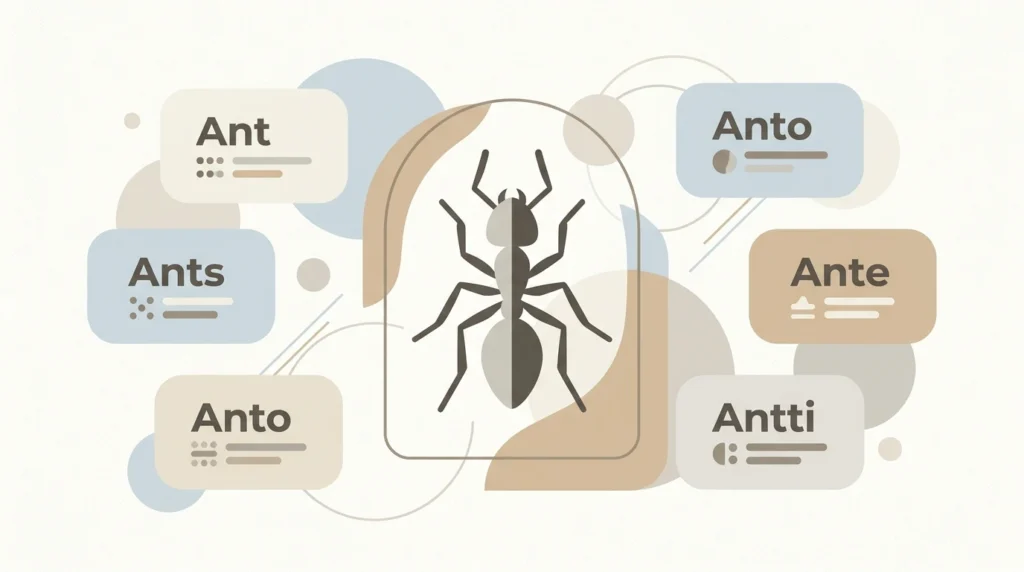
| Name | Meaning | Origin | Style |
|---|---|---|---|
| Anto | Short form associated with Antonio or Anthony | European usage | Casual |
| Antti | Finnish form of Andrew rather than a form of Anthony | Finnish | Nordic |
| Ante | South Slavic form associated with Anthony | Croatian/Serbian usage | International |
| Ants | Estonian form of Hans | Estonian | Distinctive |
Names With an Ant-Related Nature Connection

This is the smallest category because genuinely established personal names that literally mean “ant” are limited. That limitation is important: a carefully curated guide should not invent dozens of supposed insect meanings merely to reach a number.
Myrmex
Meaning: “Ant.”
Origin: Ancient Greek myrmēx.
Pronunciation: approximately MUR-meks in English.
Style: Classical and highly unusual.
Why it appeals: The Greek root has a direct lexical connection to ants, making its thematic relevance much stronger than names included solely because they contain the letters “ant.”
Ants
Although Ants belongs linguistically with the Estonian form of Hans rather than the insect, its spelling creates an unusually direct connection to this search theme. It is best understood as an international personal name—not as a conventional English word-name.
| Name | Meaning | Origin | Style |
|---|---|---|---|
| Myrmidon | Historically associated with Greek myrmēx, “ant,” though its exact naming history is complex | Greek mythology | Mythological |
| Azcatl | Associated with the Nahuatl word for “ant” | Nahuatl | Cultural/linguistic |
A note on this category: Names with literal ant meanings require especially careful verification. The strongest options are linguistic or historical references rather than conventional American baby names. Sources that merely attach symbolic traits such as “hardworking” or “team-oriented” to an unrelated name should not be treated as evidence that the name means “ant.”
How to Choose Among These Ant Names
Before making a shortlist, consider:
- Do you want a literal ant connection or simply a name beginning with “Ant”?
- Is familiar U.S. pronunciation more important than international distinctiveness?
- Would you prefer an established traditional name or a highly unusual linguistic choice?
- Does the name’s documented cultural background matter to your family?
- Are you comfortable choosing a name whose ultimate ancient meaning remains uncertain?
My Top Picks From This Collection
Here are the strongest options based on documented meaning, usability, pronunciation, and linguistic background:
- Anthony — A historically established name with extensive documented use in the United States.
- Antonia — A versatile feminine name with established usage across multiple cultures.
- Anton — Short, recognizable, and internationally documented.
- Antonio — Strong cross-cultural usage, including established use in the United States.
- Antoinette — A clearly documented French form with substantial historical recognition.
- Anthea — A distinct Greek option with a documented floral meaning.
- Ants — A genuine Estonian given name for parents specifically seeking the closest spelling match to “ants.”
- Myrmex — The most direct Greek lexical connection to the insect theme, though considerably less conventional as a personal name.
A Final Word on Ant Names
The strongest interpretation of ant names is usually names beginning with Ant-, rather than an enormous collection of names supposedly inspired by the insect. Genuine names that literally mean “ant” are limited, while the Anthony/Antonius family offers many historically established possibilities.
That is why this guide stops at 35 carefully selected options rather than forcing the list to 60. Several names in the Ant- family also have an uncertain ultimate meaning, so claims such as “Anthony means priceless” or “Antonia means flower” should be treated cautiously unless a specific scholarly etymological source supports that interpretation.
FAQ Opportunities
What are names that start with Ant?
Examples include Anthony, Antonia, Anton, Antonio, Antoinette, Antonella, and Anthea.
Are there names that literally mean ant?
A small number of linguistic and historical terms have a direct connection to the word “ant,” including names derived from the Greek root myrmēx. These are generally less conventional as modern U.S. baby names.
Is Ant a real name?
Ant is used as a short form or nickname for longer Ant- names, particularly Anthony. Its status as a formal given name is more limited.
What is the most common Ant name in the United States?
Anthony is one of the most established and widely used Ant- names in U.S. naming data. The SSA’s 2020–2025 period data lists it among the leading boys’ names.
Are Ant names only for boys?
No. While Anthony and Anton are traditionally masculine, names such as Antonia, Antoinette, Antonella, and Anthea have established feminine usage.