Finding boy cat names unique enough to stand apart from the usual Max, Oliver, or Charlie is easier when you look beyond ordinary pet-name lists. This guide focuses on masculine names with documented linguistic, historical, literary, or mythological roots, while avoiding invented meanings and weak “unique” picks. The 40 names are grouped by what makes them distinctive: mythic and celestial, nature-inspired, short and easy, literary and vintage, and biblical/Hebrew. Where a name’s etymology is uncertain, that uncertainty is stated rather than hidden.
The research also treats “unique” as a distinctive naming choice, not an unsupported claim that a name is statistically rare. U.S. naming data comes from the Social Security Administration, whose national dataset covers births in the 50 states and District of Columbia.
Mythic & Celestial Boy Cat Names
If your cat has an unusual appearance, dramatic personality, or simply seems to demand a bigger-than-life name, mythology and astronomy offer some of the strongest choices.
Atlas
Meaning: Possibly “enduring.”
Origin: Ancient Greek; Greek mythology.
Pronunciation: AT-ləs in English.
Style: Mythic, powerful, distinctive.
Why it appeals: Atlas has a concrete mythological reference: he is the Titan associated with bearing the heavens, making the name immediately recognizable without being an invented pet name.
Cosmo
Meaning: Connected historically with Cosimo; the name ultimately belongs to the Greek Cosmas family.
Origin: Italian and English.
Pronunciation: KOZ-moh in American English.
Style: Playful, cosmic, vintage.
Why it appeals: It is particularly well suited to a cat because documented name references explicitly categorize Cosmo among pet and cat names, while the spelling remains an established masculine given name.
Zephyr
Meaning: “West wind.”
Origin: Ancient Greek mythology, via the Greek Zephyros.
Pronunciation: ZEF-er in American English.
Style: Airy, unusual, elegant.
Why it appeals: Zephyr has a precise mythological meaning—the west wind—and a documented masculine usage rather than being merely a modern word-name invention.
Orion
Meaning: Uncertain; possibly connected with Greek horion, “boundary, limit.”
Origin: Ancient Greek mythology and astronomy.
Pronunciation: oh-RYE-un in English.
Style: Celestial, adventurous, dramatic.
Why it appeals: Orion combines a documented masculine mythological name with one of the best-known constellations, giving the cat name an immediately recognizable astronomical association. Its etymology should be treated as uncertain.
| Name | Meaning | Origin | Style |
|---|---|---|---|
| Odin | “Frenzied, furious, inspired” | Old Norse / Norse mythology | Mythic, bold |
| Phoenix | Linked to the mythical phoenix; ultimately Greek phoinix, “dark red” | Greek/Egyptian mythology; English modern | Fiery, dramatic |
| Merlin | Meaning uncertain; form of Welsh Myrddin | Welsh / Arthurian tradition | Magical, literary |
| Caspian | Geographic/literary name associated with the Caspian Sea | Literature / place name | Regal, adventurous |
Odin is the name of the highest god in Norse mythology and is derived from Old Norse Óðinn; Phoenix is documented as a masculine and feminine modern English name connected to the legendary immortal bird. Merlin has a firmly documented Arthurian connection, while Caspian became a literary given name through C. S. Lewis’s Chronicles of Narnia.
Nature, Animals & Earthy Names
For cats whose names should connect to animals, landscapes, plants, or the natural world, these choices have actual linguistic or cultural links rather than simply sounding “wild.”
Jasper
Meaning: Traditionally connected with “treasurer”; also associated directly with the gemstone jasper.
Origin: English and Dutch, with a complicated historical connection through Gaspar.
Pronunciation: JAS-per in American English.
Style: Gemstone, vintage, polished.
Why it appeals: Jasper works on two documented levels: it is an established masculine given name and can also directly reference the gemstone, giving a cat a distinctive natural-world association.
Ronan
Meaning: “Little seal.”
Origin: Old Irish, through Rónán.
Pronunciation: ROH-nən in English.
Style: Celtic, natural, compact.
Why it appeals: The meaning has an unusually direct animal connection: Old Irish rón means “seal,” combined with a diminutive element; the name was also borne by several early Irish saints.
| Name | Meaning | Origin | Style |
|---|---|---|---|
| Zev | “Wolf” | Hebrew | Animal, compact |
| Fox | “Fox” | English word/surname | Sharp, modern |
| Rowan | Connected with Irish Ruadhán and the rowan tree | Irish / English | Botanical, Celtic |
| Griffin | English name associated with the griffin; also form of Gruffudd | English / Welsh | Mythical, animal |
| Milo | Possibly “yew tree” in its Ancient Greek form | Ancient Greek / English | Soft, natural |
| Leo | “Lion” | Latin / Ancient Roman | Animal, classic |
Zev has the direct Hebrew meaning “wolf,” while Fox comes from the English animal word or surname. Rowan has both Irish personal-name and rowan-tree associations, and Griffin can be connected either with the Welsh personal-name tradition or the mythological griffin. Milo’s Ancient Greek form may derive from a word for the yew tree, while Leo comes directly from Latin leo, “lion.”
Short, Easy-to-Call Names
A great cat name has to work in real life. These are especially useful if you want something distinctive without a name that becomes awkward when you call it across the house.
Otto
Meaning: “Wealth, fortune.”
Origin: Germanic, through Old Frankish and Old High German name elements.
Pronunciation: AH-toh in American English.
Style: Vintage, compact, European.
Why it appeals: Otto has an exceptionally straightforward two-syllable structure and documented masculine usage across German, Scandinavian, Dutch, English, and Finnish naming traditions.
Sol
Meaning: “Sun” in its Latin/Roman-mythological use; it is also a Jewish short form of Solomon.
Origin: Latin/Roman mythology and Jewish naming tradition.
Pronunciation: sohl in American English.
Style: Minimal, warm, versatile.
Why it appeals: Sol gives you an unusually short name with more than one established naming tradition, including the Roman personification of the Sun and Jewish usage as a short form of Solomon.
| Name | Meaning | Origin | Style |
|---|---|---|---|
| Nico | Short form of Nicholas | Italian, Dutch, German, Spanish, Portuguese | Sleek, international |
| Arlo | Meaning uncertain; possibly linked to Aherlow | English | Modern, friendly |
| Axel | Form of Absalom | Danish, Swedish, Norwegian, German, French, English | Modern, crisp |
| Kit | Diminutive of Christopher or Katherine | English | Tiny, playful |
| Remy | From Rémy, ultimately linked to Latin remigis, “oarsman, rower” | French / English | Chic, compact |
| Casper | Dutch and Scandinavian form of Jasper | Dutch, Swedish, Norwegian, Danish | Whimsical, familiar |
Nico is a documented short form of Nicholas, whose Greek source means “victory of the people.” Arlo has an explicitly uncertain etymology, possibly inspired by Edmund Spenser’s The Faerie Queene, while Axel is historically connected with Absalom rather than being merely a spelling of “axel.” Kit is a documented English diminutive, and Remy has a direct French lineage through Rémy and Remigius. Casper is especially relevant to pet naming because established name references explicitly associate it with cat names and the famous cartoon ghost.
Literary, Vintage & Unusual Classics
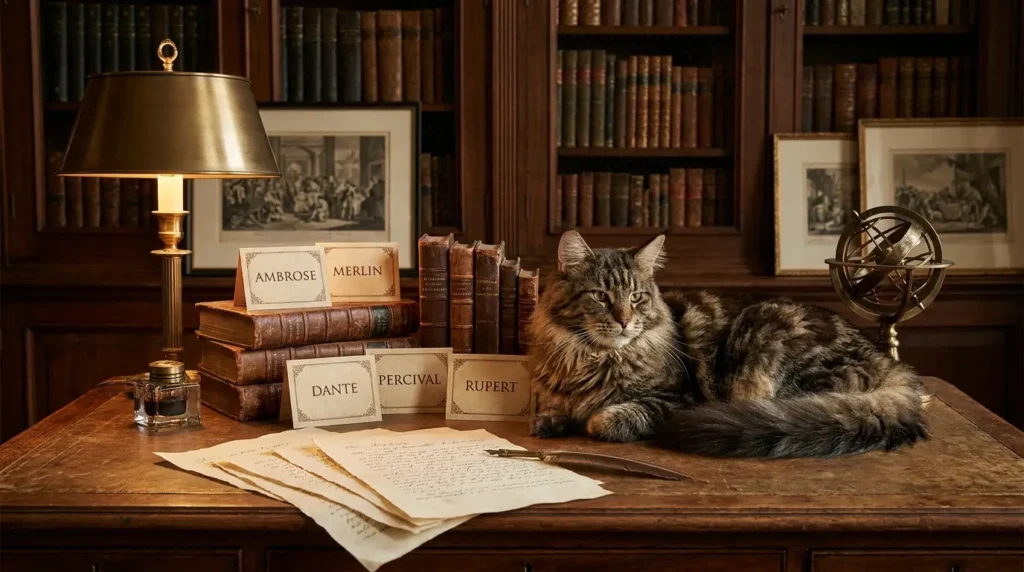
These names are useful if you want something that sounds like a character without relying on a fictional character’s name alone.
Felix
Meaning: “Lucky, successful.”
Origin: Latin; Ancient Roman.
Pronunciation: FEE-liks in English.
Style: Vintage, cheerful, refined.
Why it appeals: Felix has a documented Latin meaning and an established Roman history, and its favorable meaning also helped it spread among early Christians.
Ambrose
Meaning: “Immortal.”
Origin: Greek through Late Latin.
Pronunciation: AM-brohz in American English.
Style: Literary, vintage, distinguished.
Why it appeals: The name’s meaning comes from Greek Ambrosios, while Saint Ambrose’s historical role helped establish the name in Christian Europe.
Merlin
Meaning: The underlying Welsh name has an uncertain etymology.
Origin: Welsh, via Geoffrey of Monmouth’s Latinized form Merlinus; Arthurian tradition.
Pronunciation: MER-lin in American English.
Style: Magical, literary, unmistakable.
Why it appeals: Merlin is not a modern invented fantasy name: Geoffrey of Monmouth used it in the 12th century for the legendary adviser and magician associated with King Arthur.
| Name | Meaning | Origin | Style |
|---|---|---|---|
| Evander | “Good of man” | Ancient Greek / Roman mythology | Heroic, rare-feeling |
| Percival | Possibly “pierce the valley”; etymology uncertain | Old French / Arthurian cycle | Medieval, grand |
| Cassian | Derived from Roman family name Cassius; exact underlying meaning uncertain | Ancient Roman | Elegant, unusual |
| Soren | English form of Søren | Danish / Scandinavian | Sleek, intellectual |
| Rupert | From Germanic elements associated with fame and brightness | German / English | Vintage, eccentric |
| Dante | Medieval short form of Durante | Italian | Literary, dramatic |
Evander has a clearly documented Greek composition meaning “good of man” and a strong Roman-mythological history. Percival was created by Chrétien de Troyes for his 12th-century Arthurian literature, with the proposed “pierce the valley” interpretation remaining uncertain. Cassian comes from the Roman cognomen Cassianus, while Soren is the English form of Danish Søren. Rupert is a German form related to Robert and has documented medieval saintly and royal associations; Dante is the established Italian short form of Durante and is inseparable from Dante Alighieri in literary history.
Biblical & Hebrew Boy Cat Names
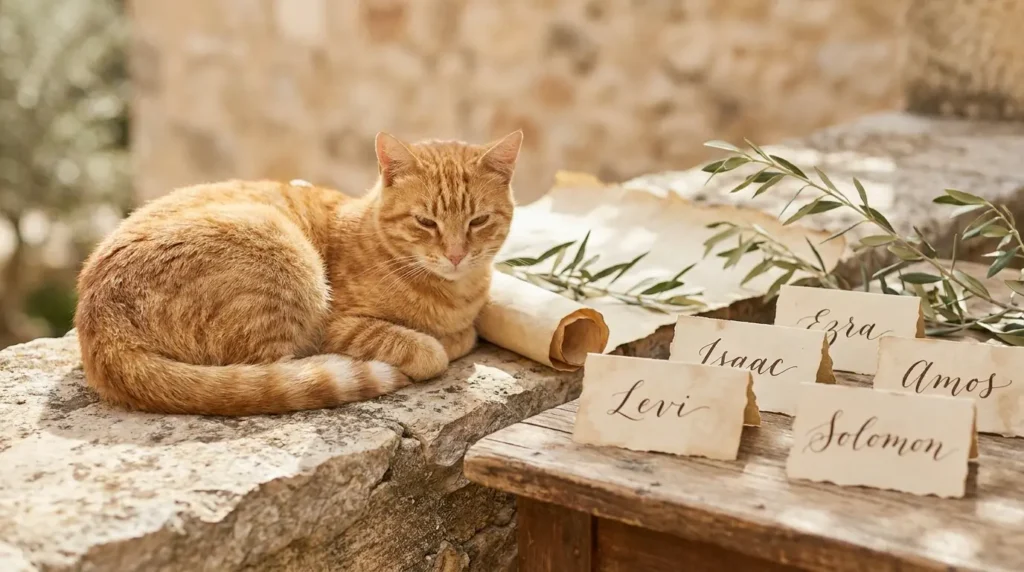
If you want a name with a documented biblical or Hebrew connection, these choices have identifiable historical sources rather than generic “spiritual” associations.
Ezra
Meaning: “Help.”
Origin: Hebrew; Biblical.
Pronunciation: EZ-rə in English.
Style: Short, biblical, contemporary.
Why it appeals: Ezra has documented English, Hebrew, and biblical usage and refers directly to Ezra, the Old Testament prophet associated with the Book of Ezra.
Isaac
Meaning: “He will laugh” or “he will rejoice.”
Origin: Hebrew; Biblical.
Pronunciation: EYE-zək in English.
Style: Traditional, warm, recognizable.
Why it appeals: Its meaning is explicitly explained within the biblical narrative, where Abraham and Sarah laugh in response to the prophecy of Isaac’s birth.
| Name | Meaning | Origin | Style |
|---|---|---|---|
| Amos | “Load, burden” | Hebrew / Biblical | Old Testament, distinctive |
| Levi | Possibly “joined, attached” | Hebrew / Biblical | Short, traditional |
| Solomon | Connected with Hebrew shalom, “peace” | Hebrew / Biblical | Regal, substantial |
| Asa | Possibly “healer” | Hebrew / Biblical | Very short, uncommon-feeling |
| Eli | “Ascension” or, in another Hebrew entry, “my God” | Hebrew / Biblical | Compact, classic |
| Abel | “Breath” | Hebrew / Biblical | Biblical, gentle |
Amos comes from Hebrew and is the name of one of the Old Testament’s minor prophets; its meaning is tied to the Hebrew verb associated with carrying a load. Levi’s etymology is traditionally given as “joined, attached,” while Solomon derives from the Hebrew Shelomo and shalom, “peace.” Asa is documented as a masculine biblical Hebrew name with the possible meaning “healer.” Eli has two documented Hebrew entries, one meaning “ascension” and another “my God,” so the exact interpretation depends on which name form is intended. Abel comes from Hebrew Hevel, “breath,” and is the name of Adam and Eve’s second son in Genesis.
How to Choose From the Categories
Before settling on one name, ask:
- Do you want the name to have an obvious meaning? Choose names such as Zev, Leo, Zephyr, Felix, Ezra, or Isaac.
- Is easy pronunciation more important than unusual origin? Otto, Sol, Fox, Nico, Kit, and Leo are particularly straightforward to call.
- Do you want mythology or literature behind the name? Atlas, Orion, Odin, Merlin, Caspian, Evander, and Percival offer the clearest documented connections.
- Would you prefer a name that works for a cat without sounding overly “pet-like”? Felix, Jasper, Ronan, Otto, Ambrose, Ezra, and Dante can function naturally as established masculine names.
- Do you want the meaning itself to connect with your cat? Animal names such as Zev, Fox, Leo, and Ronan or nature-linked choices such as Milo and Rowan provide the most direct connection.
The Shortlist: 8 Strongest Picks
- Cosmo — A standout for a cat because the documented name reference specifically connects it with pet and cat names, while its established Italian/English history prevents it from feeling invented.
- Zephyr — Excellent if you want something genuinely distinctive with a precise meaning, “west wind,” and documented Greek mythological usage.
- Atlas — Combines a short, easy English pronunciation with a firmly documented Greek mythological reference and the possible meaning “enduring.”
- Ronan — One of the clearest meaning-based choices because its Old Irish source directly means “little seal.”
- Otto — Particularly practical: it is short, masculine, internationally documented, and has a recorded meaning connected with wealth and fortune.
- Jasper — Gives you a documented masculine name plus a direct gemstone association, making it distinctive without being difficult to pronounce.
- Felix — The Latin meaning “lucky, successful” provides a clear positive association, while the name has substantial Roman and Christian history.
- Ezra — A compact choice with documented Hebrew and biblical usage and the straightforward meaning “help.”
The U.S. Social Security Administration is useful for checking whether a human given name is actually documented in American naming data rather than relying on baby-name-site labels. Its current dataset is based on a 100% sample of Social Security card applications, with data tabulated as of March 2026. The SSA also notes that its rankings separate names by sex and do not merge different spellings, which matters when evaluating “unique” names.
A Note About “Unique”
None of these names should automatically be described as rare in the United States without checking a specific SSA year and rank. “Unique” here means distinctive for a cat-name search and supported by a real naming tradition, word, historical source, or cultural reference. That is a more defensible standard than taking an arbitrary baby-name list and labeling every unusual-looking spelling “rare.”
For comparison, the SSA’s 2025 U.S. top 10 boy names were Liam, Noah, Oliver, Theodore, Henry, James, Elijah, Mateo, William, and Lucas. That makes the names above useful for readers specifically trying to move away from the most mainstream current U.S. boy-name choices, without making unsupported claims about the statistical rarity of each individual name.
FAQs
What are some unique boy cat names?
Cosmo, Zephyr, Atlas, Ronan, Otto, Jasper, Felix, Ezra, and Zev are among the strongest distinctive choices in this guide.
What male cat names have strong meanings?
Zev means “wolf,” Zephyr means “west wind,” Leo means “lion,” Felix means “lucky, successful,” and Ezra means “help.”
What are some short unique names for a male cat?
Otto, Sol, Fox, Leo, Zev, Nico, Kit, and Ezra are all compact options that are easy to call.
What are some mythology-inspired boy cat names?
Atlas, Orion, Odin, Zephyr, Phoenix, Merlin, and Evander all have documented mythological or legendary connections.
Are these names actually rare in the U.S.?
Not necessarily. The guide uses “unique” to mean distinctive rather than claiming statistical rarity; U.S. rarity should be determined from a specific SSA birth year and rank.