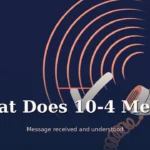
10-4 means “message received and understood.” It comes from the ten-codes used on CB and two-way radio, where each numbered code stands for a common phrase so operators can speak briefly and clearly. Today people also use it in texts and casual speech to mean “got it” or “understood, will do.”
You might hear it from a trucker on the highway, in an old police drama, or in a group chat where someone replies to a plan with a short “10-4.” The number looks like a date or a time, which is exactly why it confuses people who meet it outside radio culture.
The code belongs to a whole family of numbered shortcuts, and once you know how that system works, 10-4 becomes easy to read and easy to answer. This page covers what it means, where it came from, how it differs from similar radio terms, and when it sounds natural or out of place.
What Does 10-4 Mean?
10-4 is one of the ten-codes, also called ten-signals: a set of numbered brevity codes used on two-way radio. Each code replaces a full sentence so radio users can communicate quickly, even over a noisy channel. Within that system, 10-4 specifically means the message was received and understood. It does not, by itself, mean “yes,” although in practice it often confirms an instruction.
The first part, “10,” simply marks the phrase as a ten-code. The second number carries the meaning, and different numbers stand for different messages. A few of the best-known codes give a sense of the system:
- 10-4 — message received and understood
- 10-20 — location (“What is your 10-20?” means “Where are you?”)
- 10-33 — emergency traffic
- 10-200 — call the police at a stated location
Because the codes were designed for voice radio, people say 10-4 out loud as “ten-four.” In text messages and online chats, the meaning carries over: it is a quick, slightly playful way to say “copy that” or “understood.”
Where Did 10-4 Come From?
Radio historians credit the ten-codes to Charles “Charlie” Hopper, communications director for the Illinois State Police district office in Pesotum, who developed the first codes in 1937 so officers could communicate clearly despite weak early radio equipment. According to the Association of Public-Safety Communications Officials (APCO), the codes were designed because the first word of a transmission was often lost, so starting every code with “10” gave the receiver a moment to tune in before the meaningful number arrived.
The codes spread through police and emergency radio, and the Association published standardized versions in the following years. They reached a much wider audience in the 1970s, when citizens band (CB) radio became a popular hobby in the United States and truck drivers used ten-codes constantly. That CB boom carried 10-4 into movies, songs, and everyday speech, where it has stayed as a casual synonym for “got it.”
One caution: ten-code meanings were never perfectly uniform. Some agencies assigned slightly different meanings to the same numbers, and many public-safety agencies have since moved toward plain language. 10-4 is the exception that stayed consistent almost everywhere, which is one reason it survived in popular use.
Examples of 10-4 in Conversation
Person A: The meeting moved to 3 p.m. in the main office.
Person B: 10-4, I will be there.
Here 10-4 confirms the new time was received and understood. It reads as brisk and cooperative.
Person A: Can you grab the delivery from the front desk?
Person B: 10-4.
In this chat exchange, 10-4 also quietly accepts the task. The confirmation does the work of both “I heard you” and “I am on it.”
Person A: Convoy is stopping for fuel at the next exit.
Person B: 10-4, see you there.
This is the classic radio setting: a short acknowledgment over a shared channel, where brevity matters and extra words would slow everyone down.
How Do You Reply to 10-4?
10-4 usually ends an exchange rather than starting one, because it is itself the acknowledgment. If the other person says 10-4 to you, no reply is normally needed. If you receive an instruction and want to answer in the same style, these replies all work:
- 10-4 — the direct match, confirming you received the message
- Copy that — a plain radio-style acknowledgment
- Roger — confirms receipt, borrowed from the older phonetic alphabet
- Got it / Will do — the everyday equivalents outside radio talk
If the message was unclear, do not answer 10-4. Radio users would say “say again” or “10-9,” the code for “repeat.” In a text chat, a simple “Sorry, what was the last part?” keeps the same honest spirit: the point of the code is genuine understanding, not a reflex reply.
How Is 10-4 Different From Roger and Copy That?
These three acknowledgments overlap, and in casual use people treat them as interchangeable. Their origins and emphasis differ slightly:
| Expression | Meaning | Typical use | Key distinction |
|---|---|---|---|
| 10-4 | Message received and understood | CB radio, trucking, casual texts | A numbered ten-code; often also signals agreement to act |
| Roger | Message received and understood | Military and aviation radio | Comes from the phonetic alphabet, where R stood for “received” |
| Copy that | I heard and understood you | Radio, dispatch, everyday speech | Plain words rather than a code; flexible and widely understood |
| Over and out | My transmission is finished | Formal radio procedure | Ends the exchange; it is not an acknowledgment of a message |
The practical takeaway: if someone says 10-4, they mean the same core thing as “roger” or “copy that.” The numbered code just carries a trucking and CB flavor that the others do not.
When Should You Use or Avoid 10-4?
10-4 works well in informal settings: texts with friends, team chats where radio humor fits, gaming voice channels, and any job that actually uses radios, such as trucking, security, warehousing, and event work. It can sound efficient and friendly there.
Avoid it in formal writing, professional emails to people you do not know well, and emergency or official communication, where plain language is clearer and expected. It can also confuse readers outside the United States or younger readers who know it only as a joke reference, so in mixed company “got it” is the safer choice.
FAQs
Does 10-4 mean yes?
Not exactly. It means the message was received and understood. In practice people often send it in response to an instruction, so it functions like “yes, will do,” but the code itself is about receipt, not agreement.
What does 10-4 mean in texting?
In texts it keeps its radio meaning: “got it” or “understood.” It is informal and a little playful, so it fits casual chats better than serious or professional messages.
Why do all the codes start with 10?
According to APCO history, early radio sets often missed the first word of a transmission. Starting each code with “10” gave the receiver time to catch the part that mattered, the number that followed.
Do police still use 10-4?
Some agencies still use ten-codes, but many have shifted to plain language so different departments can understand each other during joint operations. 10-4 remains the most widely recognized code either way.
What is the opposite of 10-4?
There is no direct opposite code. If you did not understand, radio procedure uses “say again” or 10-9 (“repeat your message”) to ask for the message again.
What Should You Remember About 10-4?
10-4 is a radio ten-code meaning “message received and understood,” created for clear communication on early police radio and popularized by CB radio in the 1970s. The most important rule is that it confirms understanding, not agreement: it says the message landed, and only context tells you if the sender also meant “yes.”
If someone sends it to you, treat the exchange as complete and move on. If you want to use it yourself, save it for casual chats and radio-friendly settings, and answer honestly: if part of the message was unclear, ask for a repeat instead of sending a 10-4 you do not mean.