Some flower names are instantly familiar: Lily, Rose, Daisy, Violet. But there is another, quieter world of botanical names waiting beyond the usual garden favorites.
Rare flower names can feel like hidden treasures. They may sound antique and literary, mysterious and gothic, delicate and romantic, or surprisingly modern. A name such as Calanthe feels almost fantastical, while Anemone has an airy, windswept quality. Amarantha suggests something enduring, and Celandine feels like it belongs in an old storybook.
For parents searching for an uncommon floral baby name, a pen name, character name, username, or fantasy-inspired name, the appeal is not simply rarity. It is the combination of sound, imagery, botanical identity, history, and personality.
Featured snippet: Rare flower names are uncommon names inspired by unusual flowers, flowering plants, or botanical words. Examples include Calanthe, Anemone, Amarantha, Celandine, Freesia, Camellia, Columbine, Azalea, Marigold, and Artemisia. Their appeal comes from distinctive sounds, botanical imagery, literary associations, and the ability to create a name that feels more individual than common floral choices.
What Makes a Flower Name Feel Truly Rare?
Rarity does not always mean that nobody has ever used the name. In naming, a rare flower name can simply be a botanical name that is familiar as a plant but uncommon as a personal name.
That distinction matters.
Dahlia, for example, is recognizable as both a flower and a given name. Calanthe, on the other hand, is much more unusual as a personal name and comes directly from a type of orchid. Its Greek roots mean “beautiful flower.”
Likewise, Anemone is botanically recognizable but still listed as a rare English feminine given name. Its name ultimately comes from the Greek anemos, meaning “wind.”
The most interesting rare flower names usually have at least one of these qualities:
- an unusual botanical connection
- an uncommon sound or spelling
- an old-fashioned or literary atmosphere
- a strong visual association
- a distinctive cultural history
- an easy nickname hidden inside a longer name
There is also an important historical reason flower symbolism can feel so rich. During the 19th century, the “language of flowers” became a popular way of communicating messages through bouquets, although different sources often assigned different meanings to the same flower.
So when choosing a floral name, it is useful to separate documented botanical or linguistic meaning from the modern aesthetic feeling the name creates.
Best Rare Flower Names at a Glance

|
Name |
Flower connection |
Origin / language |
Overall vibe |
Gender |
|---|---|---|---|---|
|
Calanthe |
Orchid |
Greek |
Elegant, ethereal |
Feminine |
|
Anemone |
Anemone flower |
Greek → English |
Airy, mysterious |
Feminine |
|
Amarantha |
Amaranth |
Greek |
Romantic, enduring |
Feminine |
|
Freesia |
Freesia |
English botanical name |
Delicate, graceful |
Feminine |
|
Celandine |
Celandine flower |
Greek → English |
Literary, vintage |
Feminine |
|
Camellia |
Flowering shrub |
Botanical |
Romantic, refined |
Feminine |
|
Columbine |
Columbine flower |
English |
Medieval, whimsical |
Feminine |
|
Chrysanta |
Chrysanthemum |
Greek-derived |
Golden, dramatic |
Feminine |
|
Clematis |
Flowering vine |
Greek → English |
Botanical, artistic |
Feminine |
|
Daffodil |
Daffodil |
Dutch → English |
Sunny, storybook |
Feminine |
|
Azalea |
Azalea |
Botanical |
Bright, glamorous |
Feminine |
|
Marigold |
Marigold |
English |
Golden, vintage |
Feminine |
|
Artemisia |
Artemisia plant genus |
Ancient Greek |
Strong, classical |
Feminine |
|
Anthea |
Flower/blossom |
Greek |
Mythic, graceful |
Feminine |
|
Calfuray |
Violet flower |
Mapuche |
Exotic, poetic |
Feminine |
|
Nevena |
Marigold |
South Slavic |
Soft, distinctive |
Feminine |
|
Keziah |
Cassia |
Hebrew |
Biblical, warm |
Feminine |
|
Dalia |
Dahlia |
Spanish, Arabic |
Elegant, familiar-but-unusual |
Feminine |
|
Aubrieta |
Aubrieta flower |
Botanical |
Romantic, delicate |
Feminine |
Some names above are directly documented as flower-derived given names, while others are botanical names whose use as personal names is rarer or more modern.
Elegant and Ethereal Rare Flower Names
Calanthe
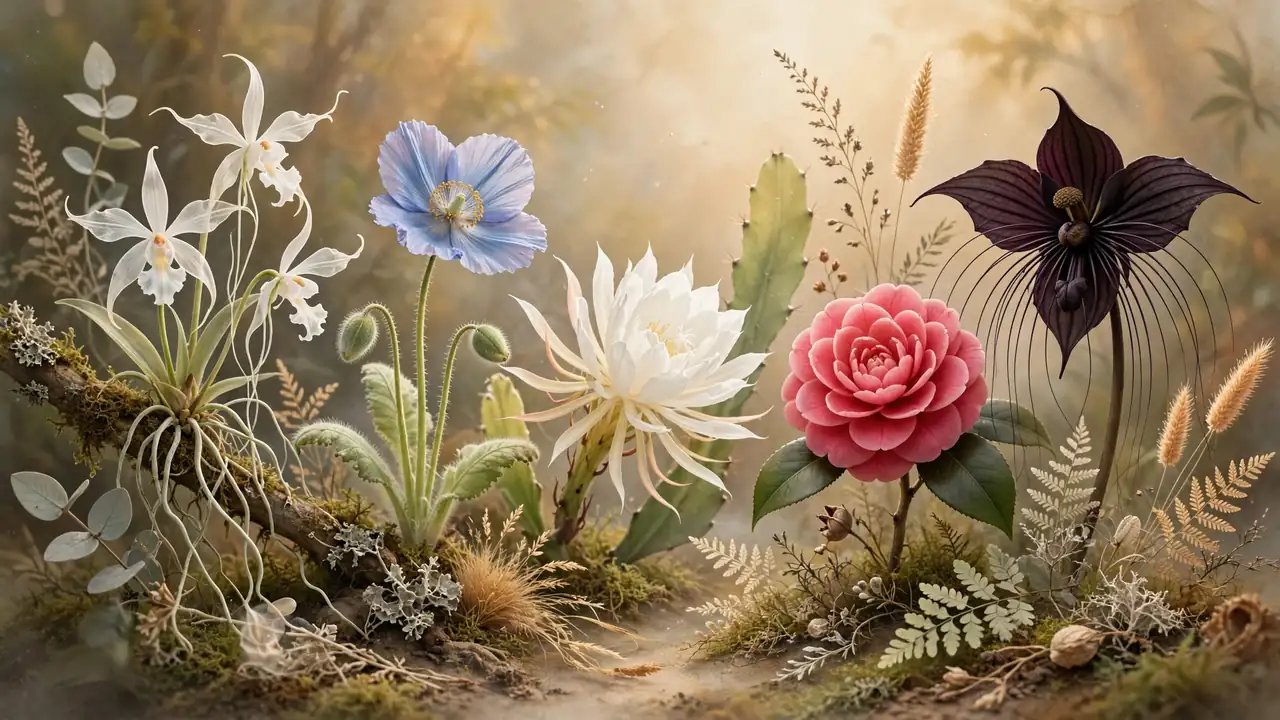
Calanthe is one of the most striking choices for someone who wants a genuinely uncommon floral name without making it feel invented.
It comes from the name of an orchid and ultimately combines Greek elements meaning “beautiful flower.”
Pronunciation: kuh-LAN-thee Gender: Feminine Origin: Greek Meaning: Beautiful flower Vibe: Ethereal, refined, intelligent, romantic Aesthetic: Botanical luxury, fairy-tale, classical Nicknames: Calla, Cally, Thea Similar names: Calista, Calla, Celeste, Elara Modern vs. classic: Rare with a distinctly classical structure Social impression: Artistic and sophisticated
Calanthe works particularly well if you want something unusual but still pronounceable and elegant.
Camellia
Camellia has the softness of a traditional floral name but enough sophistication to feel distinctive.
The flower name was given in honor of botanist and missionary Georg Josef Kamel. It is documented as a rare English given name.
Vibe: Romantic, polished, graceful Aesthetic: Old-world garden, soft luxury Nicknames: Cami, Mia, Millie Similar names: Amelia, Emilia, Calla Best for: Parents wanting a floral name that can transition easily from childhood to adulthood
Camellia feels less whimsical than some rare botanical names. It has a more established, elegant presence.
Freesia
Freesia has a light, almost musical quality.
The flower itself was named after German physician Friedrich Freese, whose surname relates to the Frisian name Friese. As a given name, Freesia is documented as a rare English usage.
Pronunciation: FREE-zhə Gender: Feminine Vibe: Delicate, cheerful, feminine Aesthetic: Spring garden, pastel, romantic Nicknames: Free, Frie, Ria Similar names: Felicia, Freya, Fiora Modern vs. classic: Rare botanical with a vintage undertone
It has a particularly appealing quality for parents who want something floral without sounding overly traditional.
Dark, Mysterious, and Gothic Flower Names
Not every flower-inspired name has to feel sweet.
Some botanical names have darker, stranger, or more dramatic personalities. They can work beautifully for gothic characters, fantasy worlds, artistic pseudonyms, or parents drawn toward unusual nature names.
Anemone
Anemone feels windswept and mysterious rather than traditionally pretty.
Its botanical name comes from Greek anemos, meaning “wind.” It is listed as a rare English feminine name.
Vibe: Mysterious, delicate, otherworldly Aesthetic: Gothic garden, dark academia, sea-and-wind fantasy Nicknames: Annie, Nemo, Mone Similar names: Anthea, Ariadne, Elowen Modern vs. classic: Ancient linguistic roots with a highly unusual modern naming feel
One practical consideration is pronunciation. Anemone is beautiful on the page but less immediately intuitive for some English speakers.
Artemisia
Artemisia has a completely different energy.
The personal name is an Ancient Greek feminine form connected with Artemisios, and the name has a long historical association with Artemisia of Caria, who lived in the 4th century BC. The plant genus Artemisia shares the name but does not mean that the personal name itself originated from the plant.
Vibe: Powerful, scholarly, historical Aesthetic: Dark academia, classical Greece, botanical manuscript Nicknames: Artie, Missy, Mia Similar names: Aurelia, Octavia, Olympia Modern vs. classic: Strongly classical
It is especially appealing if you want a name that connects botany and ancient history without pretending that the botanical connection is its original etymology.
Amarantha
Amarantha sounds like a name from a fantasy novel, but its botanical connection is genuine.
It comes from amaranth, ultimately from Greek amarantos, meaning “unfading.”
Vibe: Eternal, romantic, dramatic Aesthetic: Fantasy, gothic romance, enchanted garden Nicknames: Mara, Ranta, Amara Similar names: Amara, Ariella, Seraphina Modern vs. classic: Rare and elaborate
The “unfading” meaning gives this name an especially beautiful emotional layer: something that continues rather than disappears.
Soft, Romantic, and Vintage Flower Names
Marigold
Marigold is rare enough to feel distinctive while remaining immediately understandable.
The name comes from the flower and combines Mary + gold.
Vibe: Warm, sunny, wholesome Aesthetic: Cottagecore, vintage, autumnal, storybook Nicknames: Goldie, Mari, Margo Similar names: Magnolia, Primrose, Clementine Modern vs. classic: Vintage revival
Marigold also benefits from strong literary and pop-culture familiarity, including associations with Downton Abbey and other fictional works.
Celandine
Celandine is one of those names that feels as though it has been waiting inside an old botanical book.
It comes from the name of the flower and ultimately traces to Greek chelidon, meaning “swallow,” referring to the bird.
Vibe: Delicate, scholarly, antique Aesthetic: Victorian garden, cottagecore, literary Nicknames: Celly, Celia, Dine Similar names: Celeste, Celia, Clementine Modern vs. classic: Very rare, old-world
It is particularly attractive for anyone searching for rare vintage girl names with a botanical connection.
Columbine
Columbine has an unusual double identity.
It is the name of a flower, but it is also associated with Colombina, a character from Italian theatre traditions. Behind the Name lists it as a rare English feminine name.
Vibe: Whimsical, theatrical, romantic Aesthetic: Renaissance, masquerade, fairy tale Nicknames: Col, Lumi, Bina Similar names: Clementine, Cosima, Coralie Modern vs. classic: Antique and theatrical
This is a particularly good choice for writers because the name already carries a subtle stage-like quality.
Rare Flower Names With Mythology and History
Flower names become even more memorable when the botanical word has a cultural story behind it.
Anthea
Anthea comes from the Greek Antheia, derived from anthos, meaning “flower” or “blossom.” It was also an epithet of the Greek goddess Hera.
Vibe: Mythic, graceful, feminine Aesthetic: Greek mythology, classical beauty Nicknames: Thea, Annie Similar names: Athena, Althea, Antonia Modern vs. classic: Classical but still wearable
Daffodil
Daffodil is much rarer as a given name than Rose or Lily, but it has considerable cultural history.
The name ultimately derives from Dutch de affodil, referring to the asphodel. The flower has appeared in mythology, literature, art, and folklore for centuries.
Its botanical name, Narcissus, is strongly connected with the Greek myth of Narcissus, while daffodils have also been associated with spring, renewal, hope, and joy.
Vibe: Bright, poetic, unconventional Aesthetic: English countryside, spring, classic literature Nicknames: Daffy, Daff, Daffi Similar names: Daisy, Daphne, Delphine Modern vs. classic: Old-fashioned botanical revival
Keziah
Keziah is not technically a flower name in the same way as Calanthe or Freesia, but it belongs in this conversation because it is connected to cassia, the spice tree.
It is a Biblical name meaning “cassia, cinnamon” and appears as one of Job’s daughters in the Old Testament.
Vibe: Biblical, warm, elegant Aesthetic: Vintage Biblical, earthy luxury Nicknames: Kez, Kizzy, Kia Similar names: Keturah, Kezia, Azariah Modern vs. classic: Ancient name with renewed appeal
Rare Flower Names With Exotic or Global Roots
A good rare flower name does not have to come from English.
Calfuray
Calfuray is especially distinctive because it is a Hispanicized Mapuche name meaning “violet flower,” formed from elements meaning purple/blue and flower.
Vibe: Poetic, colorful, unusual Aesthetic: Wildflower, South American-inspired, artistic Gender: Feminine Best suited to: Families who have a meaningful connection to the relevant cultural tradition and want to honor that heritage accurately.
Nevena
Nevena comes from the South Slavic word neven, meaning “marigold.” It is used in Bulgarian, Macedonian, and Croatian naming traditions.
Vibe: Soft, European, romantic Aesthetic: Meadow flowers, Eastern European folklore Nicknames: Neve, Nevi Similar names: Neva, Elena, Nela Modern vs. classic: Traditional in its cultural setting, unusual internationally
Dalia
Dalia is especially interesting for multilingual families. It is documented as a Spanish and Arabic form of Dahlia, the flower named after Swedish botanist Anders Dahl. The dahlia is also the national flower of Mexico.
Vibe: Elegant, colorful, cosmopolitan Aesthetic: Latin floral, modern romance Nicknames: Dali, Lia Similar names: Dahlia, Delia, Daliah Modern vs. classic: Familiar across several linguistic environments
Rare Flower Names That Feel Modern
Not every unusual botanical name needs to sound antique.
Some have the clean, fashionable quality that works well with today’s short-name and nature-name preferences.
Calla
Calla is short, polished, and visually elegant.
The name comes from two plants, including the true calla and calla lily, both associated with white flowers and marshy environments. Its use may also have been influenced by the Greek word kallos, meaning “beauty.”
Vibe: Minimalist, elegant, clean Aesthetic: Quiet luxury, white florals, modern classic Nicknames: Usually unnecessary Similar names: Cora, Clara, Cala, Callie Modern vs. classic: Modern and highly wearable
Azalea
Azalea has a more glamorous personality than many botanical names.
It is recognizable as a flower name and has a strong modern pop-culture association through Australian rapper Iggy Azalea. At the same time, the botanical name remains independently recognizable.
Vibe: Bold, feminine, colorful Aesthetic: Maximalist floral, pink garden, modern glamour Nicknames: Aza, Zalie, Lea Similar names: Azaria, Aurelia, Dahlia Modern vs. classic: Botanical with contemporary cultural recognition
Rare Flower Names by Aesthetic
|
Aesthetic |
Names to explore |
|---|---|
|
Soft & delicate |
Freesia, Celandine, Calanthe, Anemone |
|
Dark & gothic |
Artemisia, Amarantha, Anemone, Narcissus |
|
Vintage |
Marigold, Daffodil, Columbine, Camellia |
|
Fantasy-inspired |
Calanthe, Amarantha, Anthea, Celandine |
|
Modern luxury |
Calla, Azalea, Camellia, Dahlia |
|
Mythological |
Anthea, Artemisia, Narcissus |
|
Cottagecore |
Marigold, Celandine, Columbine, Daffodil |
|
Botanical scholar |
Artemisia, Calanthe, Celandine, Clematis |
|
Colorful & dramatic |
Azalea, Dahlia, Chrysanta, Marigold |
|
Unusual international |
Nevena, Calfuray, Dalia, Keziah |
Rare Flower Names With the Most Personality
If the goal is not simply “rare,” but memorable, these names have particularly distinct personalities.
Calanthe — the ethereal intellectual
Calanthe feels like someone who belongs in a greenhouse filled with orchids and old books. It is elegant without being overly sweet.
Artemisia — the strong historical heroine
Artemisia carries a scholarly and commanding presence. Its historical associations give it more weight than a purely botanical name.
Amarantha — the immortal romantic
The “unfading” root makes Amarantha especially attractive for someone who wants a symbolic name associated with endurance.
Marigold — the golden optimist
Marigold feels warm rather than mysterious. It has a vintage quality but remains approachable.
Anemone — the mysterious dreamer
The wind connection gives Anemone an almost elemental quality, although its pronunciation may require occasional explanation.
Calla — the minimalist
Calla is the opposite of elaborate. It is short, clean, botanical, and visually elegant.
Lucky Numbers, Colors, Stones, and Zodiac Associations
This is an area where naming websites often present folklore or numerology as though it were established fact. It is better to keep the distinction clear.
There are no scientifically verified lucky numbers, gemstones, colors, weekdays, or zodiac signs inherent to botanical names.
For that reason, the table below separates documented name information from optional modern naming symbolism.
|
Name |
Verified meaning/origin |
Optional modern symbolic association |
|---|---|---|
|
Calanthe |
Greek; “beautiful flower” |
Pearl, silver, moonlight |
|
Anemone |
Greek-rooted; associated with wind |
Air, pale blue, moonstone |
|
Amarantha |
Greek-rooted; “unfading” |
Deep red, garnet |
|
Freesia |
Flower-derived; flower named for Friedrich Freese |
White, pale yellow, pearl |
|
Marigold |
Mary + gold |
Gold, amber, Sunday |
|
Artemisia |
Ancient Greek personal name |
Silver, sage green |
|
Anthea |
Greek; “flower/blossom” |
White, rose quartz |
|
Calla |
Botanical; possibly reinforced by Greek “beauty” |
White, pearl |
|
Azalea |
Botanical flower name |
Pink, rose quartz |
|
Dalia |
Spanish/Arabic form of Dahlia |
Burgundy, ruby |
These symbolic associations should be treated as creative aesthetic interpretations, not traditional facts or guaranteed luck.
How to Choose a Rare Flower Name That Still Works in Real Life
A beautiful botanical name can look perfect on a Pinterest board and still be difficult in everyday conversation. Before committing, test it outside the aesthetic bubble.
Say it with the surname
A long floral first name may pair better with a short surname, while a compact name such as Calla can accommodate a longer family name.
Test the nickname
If you love Calanthe but dislike Calla or Cally, consider whether you are comfortable with the full name being used most of the time.
Check the first-impression effect
Ask what the name sounds like before explaining its meaning.
Calla sounds minimalist and polished.
Marigold sounds warm and vintage.
Artemisia sounds scholarly and historical.
Amarantha sounds romantic and fantastical.
Anemone sounds delicate but may require pronunciation help.
Consider cultural fit
A beautiful name borrowed from another language or culture deserves more than aesthetic appreciation. Check the actual linguistic meaning, pronunciation, cultural usage, and whether the name is genuinely used as a personal name.
Think about adulthood
A name can be whimsical for a baby and still need to feel credible on a résumé, university application, professional profile, or author’s book cover.
This is where names such as Calla, Camellia, Artemisia, Anthea, and Marigold can offer different balances between botanical uniqueness and adult usability.
Rare Flower Names for Siblings
Sibling names do not need to match perfectly. In fact, choosing flowers that share an atmosphere rather than the same sound usually creates a more natural combination.
With Rose
Rose & Artemisia Rose & Calanthe Rose & Marigold
With Lily
Lily & Calla Lily & Camellia Lily & Freesia
With Violet
Violet & Celandine Violet & Anthea Violet & Dahlia
With a non-floral classic
Emma & Marigold Clara & Calanthe Eleanor & Artemisia Arthur & Daffodil
The key is deciding whether you want the sibling set to feel coordinated or merely compatible.
Flower Symbolism: Beautiful, but Not Always Universal
Flower meanings are useful when they add emotional depth, but they should not be treated as universal definitions.
The Royal Horticultural Society notes that Victorian flower language developed through different books and traditions, and the meanings could vary significantly between sources.
For example, the RHS gives meanings including strength of character for gladiolus, thoughtfulness for pansy, hope for snowdrop, fidelity for Veronica, and true love for forget-me-not.
That makes flower symbolism wonderful for inspiration—but it also explains why two websites may give slightly different “meanings” for the same flower.
For a baby name, the linguistic meaning of the name is generally more reliable than an internet list of flower symbolism.
Rare Flower Names in Literature and Pop Culture
Botanical names often gain a second life through stories.
Anemone, for instance, appears as a character name in Wings of Fire, giving it a recognizable association for some fantasy readers.
Buttercup became permanently associated with The Princess Bride after William Goldman used it for Princess Buttercup in the 1973 novel and its 1987 film adaptation.
Marigold has appeared in several pieces of popular culture, including Downton Abbey.
Artemisia also has a strong historical and artistic identity, including the famous Baroque painter Artemisia Gentileschi.
This is worth considering if you are naming a fictional character. A rare flower name can immediately establish personality before the character even speaks.
Rare Flower Names for Fantasy Characters
If you’re naming a fantasy heroine, floral names can communicate character design almost instantly.
For a magical heroine: Calanthe, Amarantha, Anthea
For a mysterious sorceress: Artemisia, Anemone, Celandine
For a royal character: Camellia, Calanthe, Marigold
For a woodland character: Columbine, Freesia, Celandine
For a fierce character: Artemisia, Azalea, Amarantha
For an innocent character: Daffodil, Freesia, Marigold
The trick is not choosing the rarest possible botanical word. It is choosing a name whose sound matches the character’s emotional architecture.
FAQs About Rare Flower Names
What are some truly rare flower names?
Some unusually distinctive flower-inspired names include Calanthe, Anemone, Amarantha, Celandine, Freesia, Columbine, Chrysanta, Clematis, Daffodil, and Artemisia. Several are documented as rare given names or botanical-derived names.
What is a rare flower name for a girl?
Calanthe, Anemone, Freesia, Celandine, Marigold, Anthea, Artemisia, and Camellia are strong options for an uncommon feminine botanical name.
What flower name means “unfading”?
Amarantha comes from the amaranth flower, whose Greek root amarantos means “unfading.”
What flower name means “beautiful flower”?
Calanthe ultimately means “beautiful flower,” from Greek elements meaning “beautiful” and “flower.”
Is Anemone a real name?
Yes. Anemone is documented as a rare English feminine given name and comes from the name of the anemone flower. Its deeper linguistic root is Greek anemos, meaning “wind.”
Is Artemisia a flower name?
Artemisia is the name of a large botanical genus, but the personal name Artemisia itself has an Ancient Greek personal-name history. It should therefore not be described as though the human name originated from the plant.
Is Marigold an old-fashioned name?
Marigold has an unmistakably vintage character, but it is also used as a modern English given name. The name comes from the flower name formed from Mary and “gold.”
Are flower meanings historically reliable?
Not completely. Historical “language of flowers” dictionaries often disagree with one another. The tradition itself was particularly popular in Britain and America during the 19th century, but meanings changed between sources.
What is a rare flower name with an international connection?
Dalia is an especially interesting example because it is documented as a Spanish and Arabic form of Dahlia. Nevena, meaning marigold, comes from South Slavic naming traditions. Calfuray means “violet flower” in Mapuche in its Hispanicized form.
Final Thoughts on Rare Flower Names
The best rare flower names do more than sound unusual.
They create an image.
Calanthe feels like an orchid in a hidden greenhouse. Anemone feels like wind moving across water. Artemisia feels scholarly and formidable. Amarantha feels eternal and romantic. Marigold feels warm and golden. Celandine feels like an illustration in an antique botanical book. Calla feels clean, modern, and quietly luxurious.
And that is the real beauty of botanical naming: you are not simply choosing a word. You are choosing a visual world, an emotional atmosphere, and a story.
For the most distinctive choices, look beyond the obvious roses and lilies and explore the enormous vocabulary of orchids, wildflowers, flowering vines, historic plant names, and culturally specific botanical names. The rarest gem may be the one that feels unfamiliar at first—but becomes unforgettable after you hear it a few times.