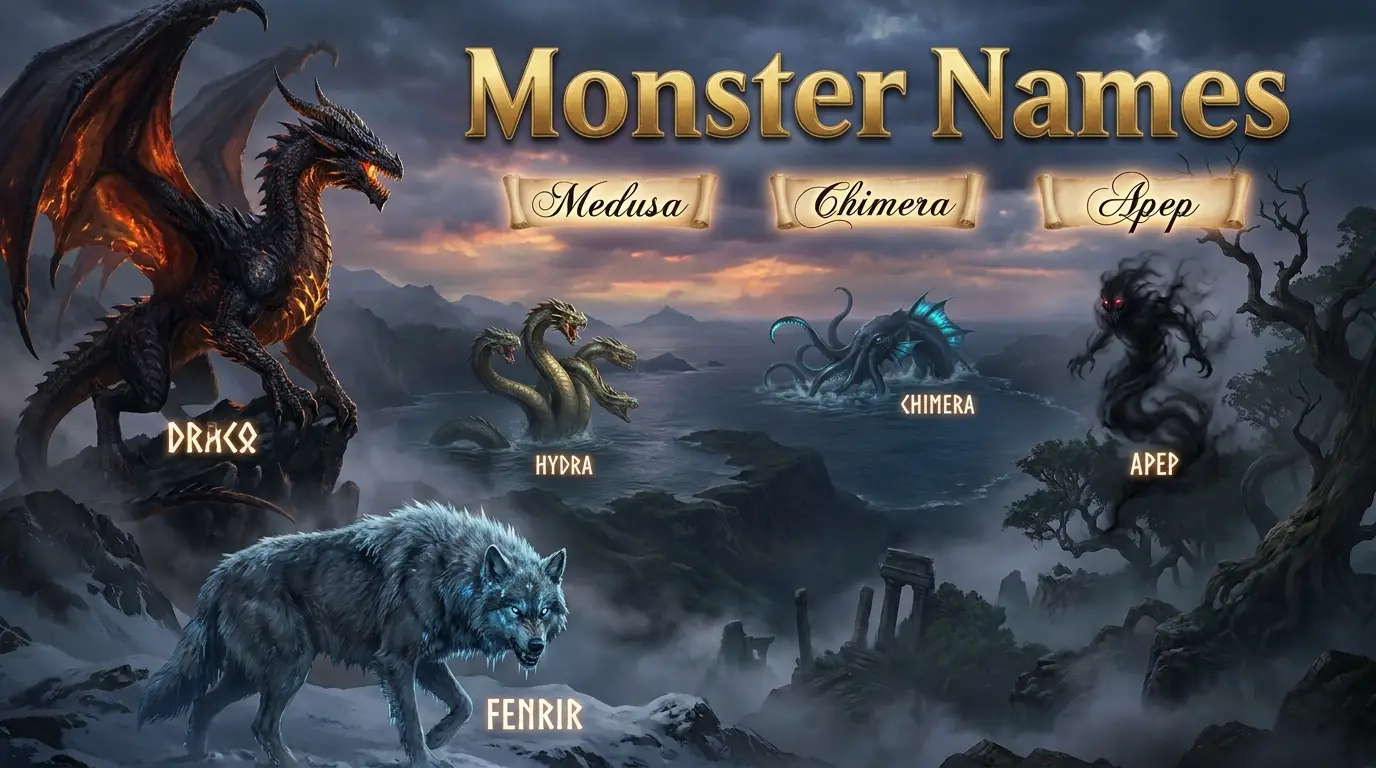
Monsters have existed in human stories for as long as stories themselves. They appear as giant serpents, wolves, dragons, sea creatures, supernatural guardians, undead beings, and forces of chaos. Yet a monster is not always simply an evil creature. Across mythology and literature, monsters can guard sacred places, represent natural disasters, test heroes, or embody humanity’s fear of the unknown.
That history makes finding the right names for monsters more interesting than choosing a word that merely sounds dark or intimidating. A meaningful monster name can have several different kinds of connections. It might literally derive from a word associated with dragons or wolves. It might carry a closely related meaning, such as darkness, storms, or death. Or its connection may come from mythology, folklore, religion, or famous works of fiction.
This guide separates those categories rather than treating them as interchangeable. Some of these names have direct linguistic connections to creatures or dark concepts, while others are established names of legendary monsters. The result is a carefully curated collection for writers, gamers, world-builders, and anyone searching for a name with a genuine story behind it.
Names for Monsters With an Exact Linguistic Connection
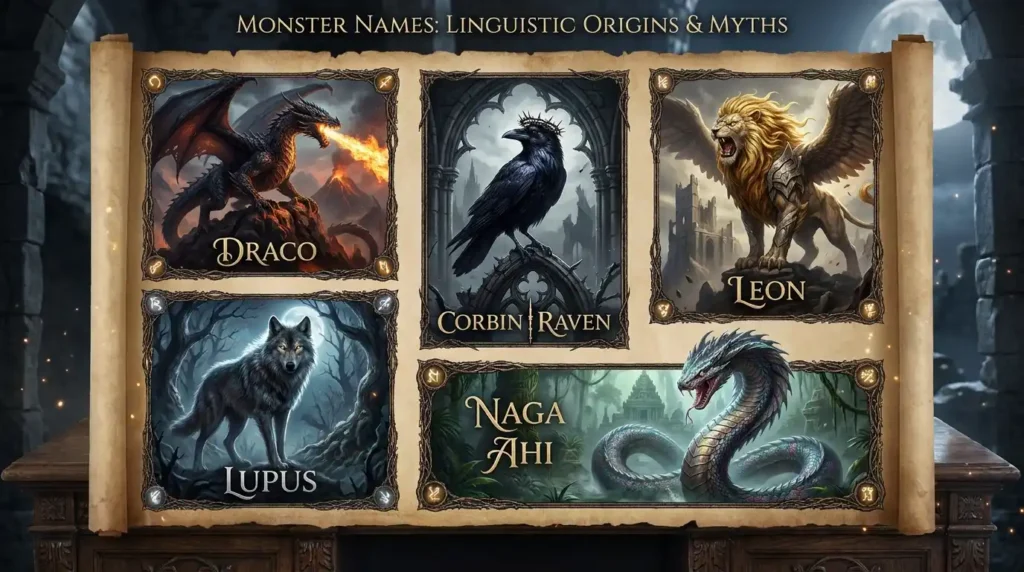
These names have a direct etymological connection to an animal, creature, supernatural concept, or other idea commonly associated with monsters. That does not necessarily mean that the name itself translates as “monster.” Instead, its linguistic roots provide a documented connection to the theme.
| Name | Documented Meaning or Connection | Language/Origin | Pronunciation | Gender Usage |
|---|---|---|---|---|
| Draco | Dragon or serpent | Greek/Latin | DRAY-koh | Masculine |
| Lupus | Wolf | Latin | LOO-pus | Masculine historical form |
| Corbin | Raven | Old French | KOR-bin | Primarily masculine |
| Raven | The bird | English | RAY-vən | Primarily feminine/unisex |
| Leon | Lion | Greek | LEE-on | Masculine |
| Kali | Black/dark, depending on context | Sanskrit | KAH-lee | Primarily feminine in Hindu tradition |
| Naga | Serpent being | Sanskrit | NAH-gah | Cultural/mythological usage |
| Ahi | Serpent or snake connection | Ancient Iranian tradition | AH-hee | Mythological usage |
Draco
Draco is one of the strongest choices for a dragon-like monster because its linguistic connection is unusually direct. The name comes through the Latin draco, ultimately related to the Greek drakōn, a word used for a dragon or large serpent.
Connection type: Exact linguistic meaning.
Dragons in ancient traditions were not always identical to the winged, fire-breathing creatures familiar from modern fantasy. The Greek drakōn could refer more broadly to a large, powerful serpent or dragon-like creature. This actually gives Draco considerable flexibility as a fictional monster name.
A character named Draco could therefore be a traditional dragon, a giant serpent, a reptilian guardian, or an ancient creature inspired by classical mythology. For a writer looking for a relatively short and recognizable name, Draco combines an authentic historical connection with easy pronunciation for an American audience.
Lupus
Lupus is the Latin word for “wolf.”
Connection type: Exact linguistic meaning.
A wolf is not inherently a monster, of course. However, wolves occupy an important place in the history of supernatural storytelling. Werewolves, shapeshifters, giant wolves, and wilderness spirits have appeared in folklore across many cultures.
Lupus is especially appropriate for a wolf monster or a character capable of transforming between human and animal forms. The name can also work for a creature that leads a pack or represents the dangerous, untamed side of nature.
The important linguistic distinction is that Lupus means “wolf,” not “werewolf” or “monster.” Its monster connection comes from the many supernatural traditions involving wolves.
Corbin
Corbin is historically connected with the Old French word corbeau, meaning “raven.”
Connection type: Exact linguistic meaning.
Ravens have accumulated a remarkable range of symbolic associations in mythology and folklore. Depending on the tradition, they can represent prophecy, intelligence, warfare, death, the spirit world, or communication with supernatural forces.
That makes Corbin an interesting alternative to an obviously frightening monster name. It has a real historical meaning while still fitting a dark fantasy setting.
A raven-like monster, shape-shifting creature, supernatural messenger, or gothic villain could all plausibly bear the name.
Raven
Unlike Corbin, Raven is a direct English word name referring to the bird itself.
Connection type: Exact meaning with symbolic cultural association.
The raven has an especially rich place in mythology. In Norse tradition, the god Odin is associated with the ravens Huginn and Muninn. Ravens also appear in folklore and literature involving prophecy, battle, death, and the supernatural.
Modern readers may also associate ravens with gothic fiction and dark fantasy. For this reason, Raven works naturally as a name for a winged creature, witch-like character, shapeshifter, or mysterious supernatural monster.
As a modern given name, Raven has been used primarily for girls in the United States, although it can also be used across genders.
Leon
Leon comes from the Greek word leōn, meaning “lion.”
Connection type: Exact linguistic meaning.
Lions have played an important role in stories about legendary creatures. The Greek Chimera, for example, is traditionally described as having a lion component, while many mythological monsters combine human features with those of powerful animals.
Leon itself is a traditional masculine given name rather than a monster name. Its usefulness comes from its direct animal meaning and long historical use. It could suit a lion-like creature, a beastly guardian, or a monster whose appearance combines feline and supernatural features.
Kali
Kali must be approached carefully because it is often placed on internet lists of “dark” or “evil” names without sufficient cultural context. Kali is the name of a major Hindu goddess and has profound religious significance.
The linguistic background of the name is connected with Sanskrit words involving concepts such as blackness, darkness, and time, depending on the grammatical and theological context.
Connection type: Exact or closely related linguistic meaning, with an important religious association.
Kali should not simply be described as a monster or an “evil goddess.” Hindu traditions surrounding Kali are complex, and she is associated with destruction but also transformation, protection, and divine power.
For fictional naming, this distinction matters. The name may suit a character inspired by darkness or powerful divine imagery, but it should not be casually borrowed merely because a list labels it “scary.”
Naga
Naga refers to a class of serpent beings found in South Asian religious and mythological traditions.
Connection type: Exact cultural association.
Nagas may be portrayed as powerful serpents, semi-divine beings, or creatures with both human and serpent characteristics. Their roles vary considerably across Hindu, Buddhist, and Jain traditions.
This makes Naga particularly relevant for a serpent monster or fantasy creature. However, the term represents a specific cultural and religious concept rather than a generic synonym for “monster.”
A fictional writer using the name can benefit from understanding that background rather than treating Naga as simply another exotic-sounding fantasy word.
Ahi
Ahi has a connection with serpentine creatures in ancient Iranian mythology. The ancient Iranian tradition of Aži Dahāka includes a famous destructive and dragon-like figure.
Connection type: Linguistic and cultural connection.
The name is particularly useful for a serpent monster or ancient dragon-inspired creature. Its historical background also gives it a distinctive alternative to the more familiar Greek and Norse mythology names found in many fantasy stories.
Because transliteration from ancient languages can vary, spelling and pronunciation may differ between academic and popular sources.
Monster Names With Closely Related Meanings
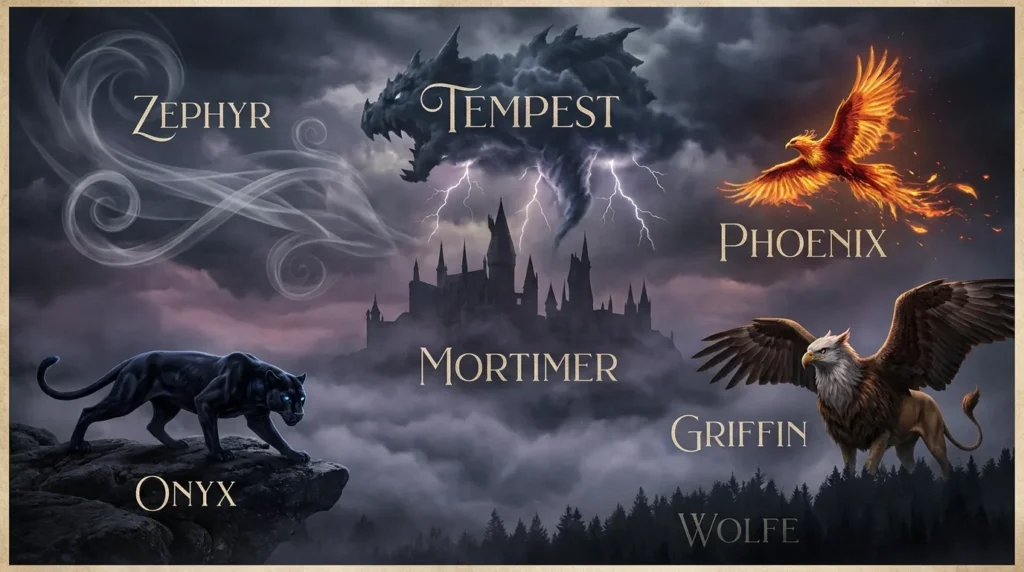
Some of the best names for monsters do not literally translate as “monster,” “demon,” or “beast.” Instead, their meanings connect with forces, animals, or conditions commonly represented by supernatural creatures.
| Name | Meaning or Connection | Origin | Pronunciation | Gender Usage |
|---|---|---|---|---|
| Mortimer | Associated with “dead water” | Old French/Germanic elements | MOR-ti-mer | Masculine |
| Zephyr | West wind | Greek | ZEF-er | Primarily masculine |
| Tempest | Violent storm | English | TEM-pest | Modern unisex |
| Onyx | Gemstone; ultimately connected with “claw” | Greek | ON-iks | Modern unisex |
| Phoenix | Legendary bird | Greek | FEE-niks | Unisex |
| Griffin | Connected with the legendary griffin | Welsh/English | GRIFF-in | Primarily masculine |
| Wolfe | Wolf | Germanic surname tradition | WOOLF | Primarily masculine |
Mortimer
Mortimer has one of the most naturally gothic histories among established names. It comes from Old French elements commonly interpreted as relating to a “dead” or “still” body of water.
Connection type: Closely related semantic meaning.
Mortimer does not literally mean “monster,” and it should not be falsely presented as a name meaning “death demon.” However, its documented connection with death-related language gives it a natural place in gothic fiction.
It can work particularly well for an undead creature, vampire, necromancer, graveyard guardian, or other character connected with death and decay.
The name has also appeared throughout English-speaking literary and cultural history, making it recognizable without feeling as obviously fantastical as a name such as Cerberus or Jörmungandr.
Zephyr
Zephyr comes from Greek Zephyros, associated with the west wind.
Connection type: Closely related meaning and mythological association.
Wind itself is not monstrous, but powerful air creatures, storms, and supernatural weather beings are recurring features of mythology. Zephyr can therefore suit an elemental creature, flying monster, or spirit associated with the sky.
The name has become an established modern given name, particularly for boys, although usage can vary.
For a monster with a less traditionally dark personality, Zephyr provides a supernatural atmosphere without relying on death or horror imagery.
Tempest
A tempest is a violent or severe storm.
Connection type: Exact vocabulary meaning and modern naming interpretation.
Tempest is an English word that has been adopted for occasional use as a name. Its relationship to monsters is thematic: a destructive creature may be compared to a storm because of its uncontrollable power.
The name can suit a lightning creature, sea monster, elemental being, or supernatural villain capable of manipulating weather.
Unlike ancient mythological names, Tempest has a more contemporary and dramatic character. It works especially well in modern fantasy, comics, gaming, and science fiction.
Onyx
Onyx is a gemstone name. The word ultimately comes from Greek ónyx, meaning “claw” or “fingernail,” although modern usage primarily associates the name with the stone.
Connection type: Modern semantic association.
Onyx does not historically mean “black monster.” Its connection to the theme comes from the dark appearance commonly associated with black onyx and the name’s popularity in modern fantasy and alternative naming culture.
For a shadow creature, dark dragon, black-furred beast, or mysterious supernatural character, Onyx creates an appropriate visual association without requiring an invented etymology.
Phoenix
The phoenix is a legendary bird famous for its association with death, fire, destruction, and renewal.
Connection type: Symbolic and cultural association.
The phoenix is not a monster in the traditional sense. It is better understood as a supernatural or mythical creature. However, for readers searching broadly for names of fantastical creatures, Phoenix is an important option.
The name is particularly effective for a fire-based creature or an immortal being capable of regeneration. It is also an established modern unisex personal name.
Its association with rebirth can make it especially suitable for a monster that repeatedly returns after being defeated.
Griffin
Griffin is an established given name with Welsh and English naming connections. Its spelling is also closely associated in English with the griffin, or gryphon, the legendary creature traditionally combining features of an eagle and lion.
Connection type: Closely related cultural and linguistic association.
A griffin is not simply a generic monster. It is a specific legendary creature with a long history in art and mythology.
The personal name Griffin is therefore an appealing choice for a hybrid beast, winged guardian, or creature combining multiple animals.
Wolfe
Wolfe developed primarily as a surname connected with the word “wolf” and has also seen use as a given name.
Connection type: Exact animal connection.
For a fictional monster, Wolfe can offer a more human-like name than Lupus or Fenrir. It is particularly appropriate for werewolves and characters whose monstrous nature is concealed beneath an ordinary identity.
Monster Names With Mythological and Cultural Associations
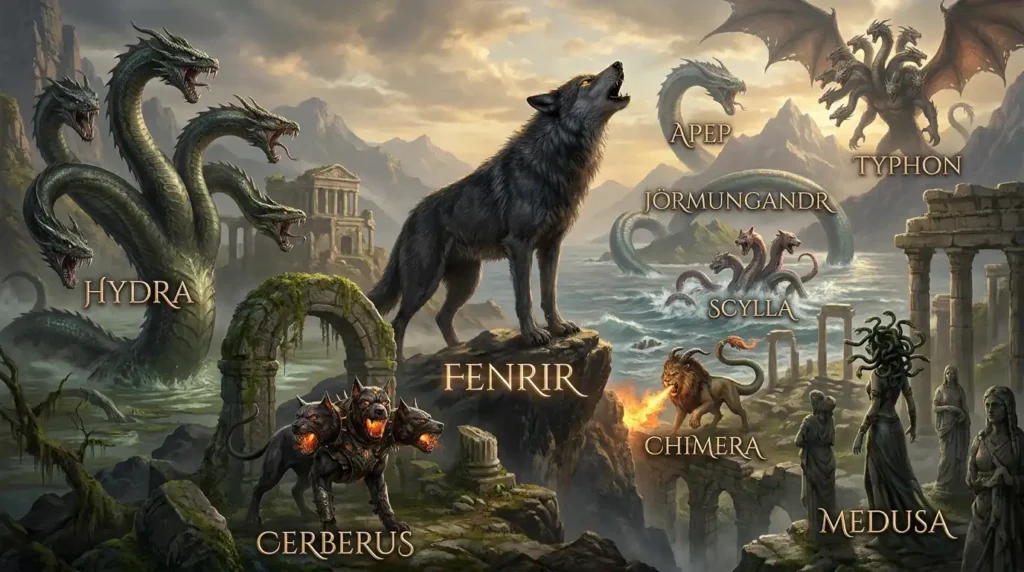
The following names belong directly to famous monsters or supernatural creatures. Their connection to the theme comes from mythology, folklore, or literature rather than their literal linguistic meaning.
| Name | Monster or Creature | Tradition | Pronunciation |
|---|---|---|---|
| Cerberus | Multi-headed underworld guardian | Greek mythology | SER-bər-us |
| Fenrir | Enormous wolf | Norse mythology | FEN-reer |
| Hydra | Multi-headed serpent | Greek mythology | HY-druh |
| Medusa | Gorgon with a petrifying gaze | Greek mythology | meh-DOO-suh |
| Chimera | Composite fire-breathing creature | Greek mythology | ky-MEER-uh |
| Scylla | Dangerous sea creature | Greek mythology | SIL-uh |
| Typhon | Gigantic destructive creature | Greek mythology | TY-fon |
| Jörmungandr | The Midgard Serpent | Norse mythology | YOR-moon-gahn-dr |
| Apep | Primordial serpent of chaos | Ancient Egyptian religion | AH-pep |
| Grendel | Monster from Beowulf | Old English literature | GREN-del |
| Dracula | Famous vampire figure | Gothic literature | DRAK-yuh-luh |
Cerberus
Cerberus is the multi-headed dog that guards the entrance to the underworld in Greek mythology.
Connection type: Symbolic or cultural association.
Cerberus is among the most recognizable monster names in Western mythology. His role as a guardian makes the name especially suitable for a creature protecting a forbidden location, magical object, prison, or supernatural realm.
The number of Cerberus’s heads varies in ancient accounts and artistic traditions, so the popular image of a universally three-headed dog should not be treated as the only historical version.
Fenrir
Fenrir is one of the most powerful creatures in Norse mythology. He is an enormous wolf and the son of Loki. The gods eventually bind him because they fear his destructive potential.
At Ragnarök, Fenrir is destined to break free and play a catastrophic role in the destruction of the old world.
Connection type: Symbolic and mythological association.
Fenrir is an exceptionally strong name for a giant wolf, werewolf, supernatural predator, or apocalyptic creature.
Unlike a name that merely sounds intimidating, Fenrir brings a complete mythological history with it. A writer can use that history directly or simply borrow the imagery of an enormous wolf associated with fate and destruction.
Hydra
The Hydra is one of the most famous creatures of Greek mythology. It is commonly portrayed as a serpent-like monster with multiple heads.
In the famous story of Heracles, the creature becomes especially difficult to defeat because severed heads can be replaced or multiplied.
Connection type: Symbolic or cultural association.
Hydra is a particularly effective name for a regenerating monster or one with multiple bodies, personalities, or heads.
The creature’s story has also made “hydra” a powerful metaphor for problems that seem to multiply when attacked.
Medusa
Medusa is one of the three Gorgons in Greek mythology and became particularly famous for her petrifying gaze and serpent imagery.
Connection type: Symbolic and mythological association.
Medusa’s story exists in multiple ancient and later versions. The popular modern retelling in which she was originally a beautiful woman transformed as punishment comes primarily from later classical literature rather than representing every surviving Greek tradition.
For a monster name, Medusa is best suited to a gorgon-inspired character or a creature capable of turning enemies to stone.
The name is also used as a feminine personal name, making it one of the few mythological monster-associated choices that can function naturally in both fictional and real-world naming contexts.
Chimera
The Chimera is a legendary composite creature from Greek mythology. Classical descriptions generally combine features of several dangerous animals and associate the creature with fire.
Connection type: Symbolic or cultural association.
Chimera is one of the best names for a hybrid monster. A creature created from the traits of multiple animals can immediately evoke the mythological concept.
The word has also entered scientific and figurative vocabulary, referring to a being or object composed of genetically or structurally distinct elements. Those modern meanings developed separately from the original creature’s role in mythology.
Scylla
Scylla is a dangerous sea creature from Greek mythology, famously associated with the voyage of Odysseus.
Connection type: Symbolic or cultural association.
Scylla is often discussed alongside Charybdis, another maritime danger. The phrase “between Scylla and Charybdis” survives as an expression for being forced to choose between two dangerous alternatives.
For a sea monster, Scylla offers a historically grounded choice with a distinctive sound and strong mythological identity.
Typhon
Typhon is an enormous and destructive figure in Greek mythology, frequently portrayed as a terrifying opponent of Zeus.
Connection type: Symbolic and mythological association.
Typhon is especially suitable for an elemental monster, giant creature, or villain representing catastrophic destruction.
The name’s similarity to the modern weather word “typhoon” can strengthen its contemporary appeal, but the historical relationship between the mythological name and the English weather term is linguistically complex and should not be reduced to a simple one-source derivation.
Jörmungandr
Jörmungandr is the enormous serpent of Norse mythology commonly known in English as the Midgard Serpent or World Serpent.
According to Norse mythology, the creature is so large that it encircles the world.
Connection type: Symbolic or cultural association.
Jörmungandr is one of the strongest choices for a cosmic serpent or world-threatening monster. The name immediately carries ideas of enormous size, ancient power, and apocalyptic mythology.
The original Norse spelling can be challenging for English-speaking readers. Anglicized spellings such as Jormungandr are common, but they should be understood as spelling adaptations rather than entirely separate traditional names.
Apep
Apep, also known by the Greek-influenced name Apophis, is the great serpent associated with chaos in ancient Egyptian religion.
The creature is famously connected with opposition to the solar god Ra and the cosmic struggle against disorder.
Connection type: Symbolic and religious-cultural association.
Apep is an excellent choice for a primordial serpent or a monster representing chaos, darkness, and the threat of cosmic destruction.
Because the name belongs to a specific ancient religious tradition, its cultural background should be preserved rather than treating Apep as merely another fictional demon.
Grendel
Grendel is the infamous monster of the Old English epic Beowulf.
He terrorizes the hall of Heorot and becomes the target of the hero Beowulf. Grendel’s story has fascinated readers for centuries and has inspired numerous modern reinterpretations.
Connection type: Literary association.
Grendel is one of the most historically important monster names in English-language literature. Its connection is therefore exceptionally direct for a fictional creature.
The original poem leaves some aspects of Grendel’s nature open to interpretation, which has contributed to the creature’s enduring mystery.
Dracula
Dracula is one of the most recognizable names in horror literature because of Bram Stoker’s famous vampire character.
Connection type: Literary and cultural association.
The historical background of the name is more complicated than many popular name lists suggest. Bram Stoker’s character was influenced by vampire traditions and historical material associated with Vlad III of Wallachia.
The Romanian word dracul has had associations with both “dragon” and “devil” in different historical contexts. Therefore, it is inaccurate to reduce Dracula’s linguistic history to the simple statement that the name exclusively means “son of the devil.”
For vampires and classic gothic monsters, however, Dracula remains one of the strongest literary choices available.
Modern Monster Names and Contemporary Associations
Not every monster name comes from ancient mythology. Modern literature, cinema, and fantasy have created some of the world’s most recognizable creatures.
These names belong in a separate category because their monster connection is primarily cultural and contemporary rather than etymological.
Godzilla
Godzilla is the English rendering of the Japanese monster name Gojira.
Connection type: Modern cultural association.
Since the character’s cinematic debut, Godzilla has become an international symbol of the giant monster genre. The name is particularly suitable for an enormous, destructive, or dinosaur-like creature.
Godzilla is best understood as a fictional monster name rather than a conventional personal name.
Kong
Kong is internationally associated with the giant ape of King Kong.
Connection type: Modern literary and cinematic association.
The name Kong also exists independently as a surname and name element in different real-world linguistic traditions. Its fictional monster association should therefore not be treated as the origin of every real-world use of the name.
For a giant ape, powerful beast, or monster designed around enormous physical strength, Kong offers an instantly recognizable cultural connection.
Smaug
Smaug is the dragon from J. R. R. Tolkien’s The Hobbit.
Connection type: Literary association.
Unlike names inherited from ancient mythology, Smaug was created for a fictional world. Its association with dragons, greed, treasure, and destruction comes directly from Tolkien’s story.
Smaug is particularly appropriate for a treasure-hoarding dragon or an intelligent monster capable of speaking and manipulating other characters.
Cthulhu
Cthulhu is a fictional cosmic entity created by H. P. Lovecraft.
Connection type: Literary and modern cultural association.
The name has become a major symbol of cosmic horror, a genre concerned with beings and forces that are vast, ancient, and fundamentally beyond human understanding.
Cthulhu works best for a creature designed to feel alien rather than traditionally demonic. It suggests tentacles, ancient civilizations, forbidden knowledge, and supernatural horror on a cosmic scale.
Gamera
Gamera is a giant turtle monster from Japanese cinema.
Connection type: Modern cultural association.
Although less universally recognized than Godzilla, Gamera has an established history within Japanese monster cinema.
The name works best when the intended creature is explicitly inspired by the giant-monster tradition rather than when the goal is to create a historically traditional personal name.
Exploring Monster Names by Style
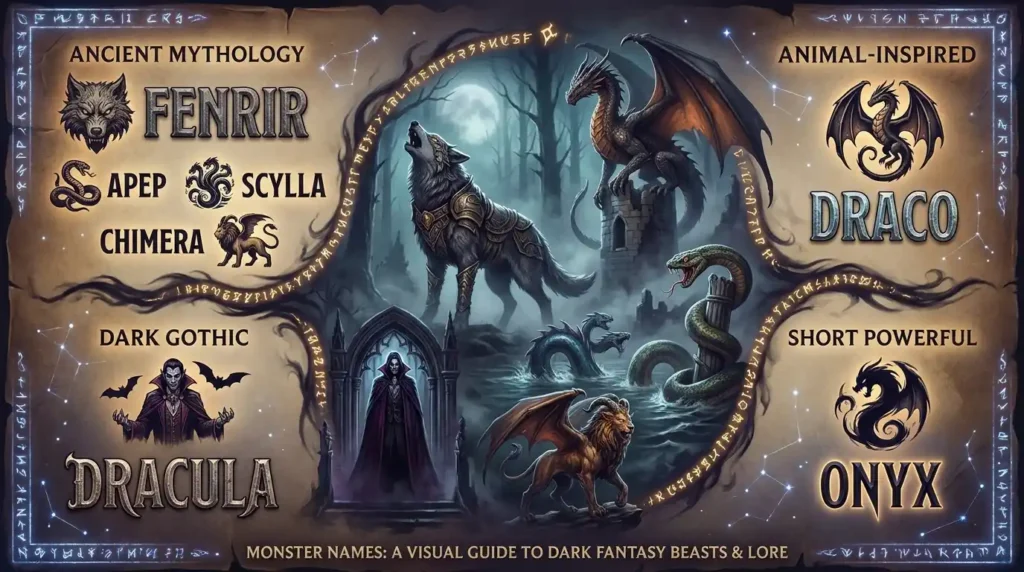
Ancient Mythology-Inspired Monster Names
For a monster rooted in ancient mythology, Fenrir, Hydra, Cerberus, Chimera, Medusa, Scylla, Typhon, Apep, and Jörmungandr are particularly strong choices.
These names already belong to documented mythological traditions. That gives them an advantage for world-building because they arrive with historical symbolism and narrative depth.
A giant wolf naturally connects with Fenrir. A many-headed serpent connects with Hydra. A dangerous sea creature connects with Scylla. Using these associations thoughtfully can help establish a monster’s identity immediately.
Short Monster Names
Some mythological names are memorable but difficult to pronounce. If you need something shorter for a game, story, comic, or character dialogue, Draco, Raven, Ahi, Kali, Leon, Onyx, and Kong may be easier options.
Short names can also create a stronger impact when a monster is repeatedly mentioned in a fast-moving story.
Animal-Inspired Monster Names
Animals have provided the foundation for many legendary monsters. Wolves, serpents, lions, ravens, and giant birds appear repeatedly in folklore.
For wolf-inspired creatures, Lupus, Fenrir, Lycaon, and Wolfe offer different historical and stylistic possibilities.
For serpentine monsters, Draco, Ahi, Apep, Hydra, Naga, and Jörmungandr provide especially strong cultural or linguistic connections.
For winged creatures, Raven, Corbin, Griffin, and Phoenix offer associations with birds and legendary flying beings.
Dark and Gothic Monster Names
Readers searching for names that feel appropriate for horror or gothic fiction may prefer Mortimer, Dracula, Grendel, Raven, Medusa, Onyx, or Tempest.
These names do not all share the same type of connection. Mortimer has a semantic relationship with death-related imagery. Dracula and Grendel come from famous literature. Raven and Onyx rely partly on symbolic and modern visual associations.
That variety can be useful because a gothic monster does not need to have the same cultural background as an ancient mythological creature.
Best Picks for Names for Monsters
If you want a carefully selected shortlist rather than a large collection, these names stand out for particularly clear and well-documented connections.
Draco
Draco is an excellent choice for dragons and serpentine monsters because its linguistic history directly connects it with those creatures.
Fenrir
For a giant wolf or apocalyptic beast, Fenrir offers one of the strongest mythological foundations in the entire collection.
Hydra
Hydra is especially effective for a creature with multiple heads or regenerative powers because the name immediately recalls its mythological story.
Apep
Apep is a compelling choice for a primordial serpent or a creature representing cosmic chaos.
Medusa
Medusa is ideal for a gorgon-inspired monster or a creature whose supernatural power involves petrification.
Grendel
Grendel provides a direct connection to one of the most famous monsters in early English literature.
Chimera
A hybrid creature made from several animals is an especially natural match for Chimera.
Typhon
Typhon works well for a giant, destructive monster associated with elemental chaos and catastrophic power.
Jörmungandr
For a truly enormous serpent or world-threatening creature, few mythological names offer a stronger established association.
Dracula
Dracula remains one of the most recognizable choices for a vampire or classic gothic monster because of its lasting literary influence.
Choosing a Monster Name Based on the Creature
The easiest way to narrow down a monster name is to begin with the creature’s defining characteristic.
A dragon or giant serpent might suit Draco, Ahi, Apep, Hydra, Naga, or Jörmungandr.
A wolf monster or werewolf may fit Fenrir, Lupus, Lycaon, or Wolfe.
A sea creature could take inspiration from Scylla, while a hybrid beast naturally connects with Chimera or Griffin.
For a vampire or undead character, Dracula and Mortimer offer very different possibilities: one brings an unmistakable literary vampire association, while the other provides a subtler gothic atmosphere.
Female monster names require the same attention to historical context. Medusa and Scylla are names of specific Greek mythological beings. Raven is an established English word name with extensive supernatural symbolism. Kali, however, belongs to an important living religious tradition and should not be inaccurately treated as a generic monster name.
Male monster names similarly range from traditional personal names with relevant meanings, such as Leon and Draco, to names of famous mythological beings such as Fenrir and Typhon.
A Monster Name Does Not Need to Literally Mean “Monster”
There is no large, historically established collection of personal names from different languages that all literally translate as “monster.” Online lists often solve this problem by stretching meanings or assigning frightening interpretations to names with no genuine etymological connection.
A better approach is to decide what kind of connection matters most to you.
If you want a literal linguistic relationship, Draco and Lupus offer direct creature meanings.
If you prefer a closely related concept, Mortimer, Zephyr, Tempest, and Onyx provide connections to death, wind, storms, and dark imagery.
If mythology matters most, Fenrir, Hydra, Medusa, Chimera, Apep, and Cerberus have established histories as supernatural creatures.
For modern horror and fantasy, Dracula, Smaug, Godzilla, and Cthulhu bring instantly recognizable literary or cinematic associations.
The strongest choice ultimately depends on the monster itself. A name with an authentic connection to the creature’s appearance, powers, mythology, or fictional world will usually feel more memorable than a randomly selected word designed simply to sound frightening.