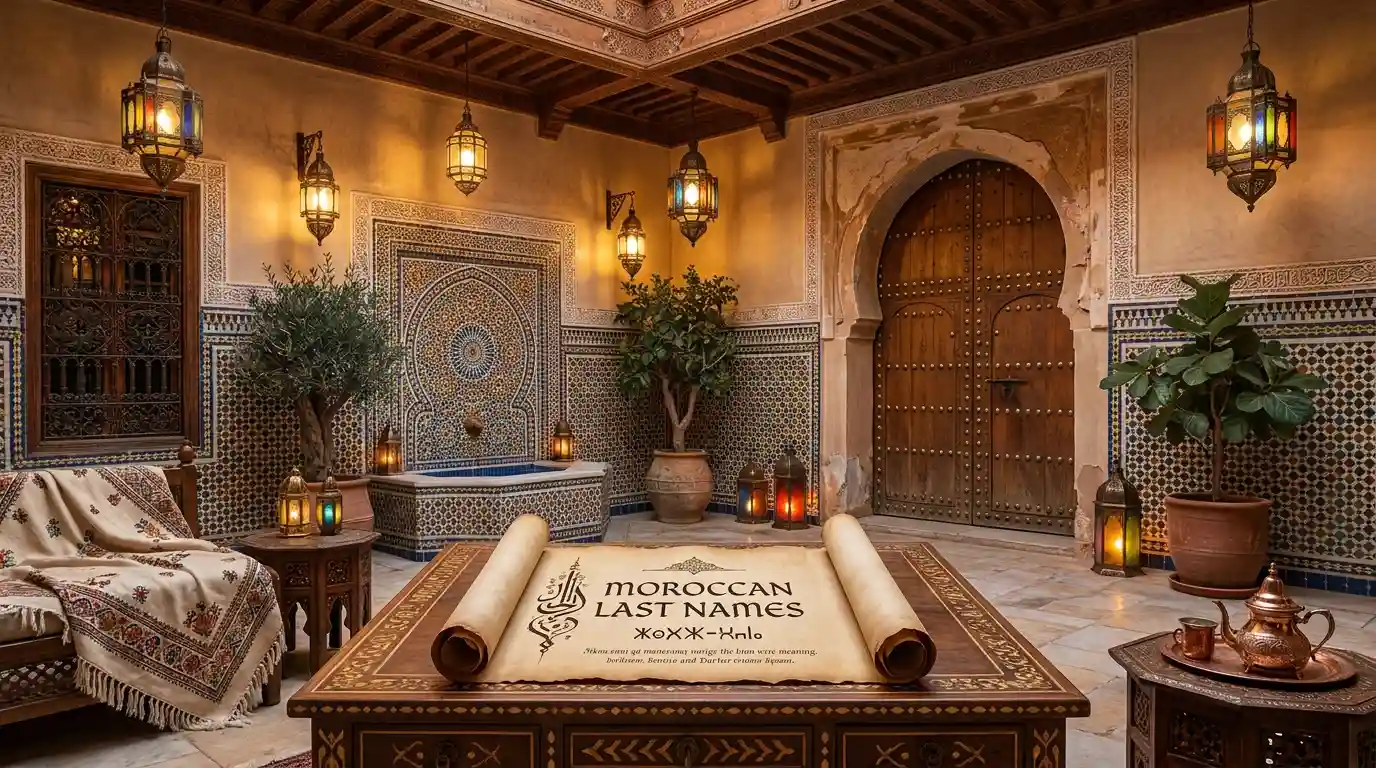
Moroccan last names can carry far more than a family label. They can hint at ancestry, geography, language, occupation, tribal connections, religious history, or the city where a family once lived. That is part of what makes Moroccan surnames so fascinating: a single name can feel like a small piece of family history.
For parents choosing a culturally inspired character name, writers building believable Moroccan characters, genealogy researchers, gamers, or anyone simply exploring Moroccan naming traditions, the right surname should sound natural as well as meaningful.
Featured Snippet
Moroccan last names are family surnames used in Morocco and among the Moroccan diaspora. They reflect the country’s Amazigh (Berber), Arabic, Andalusian, Jewish, African, and other historical influences. Some surnames are associated with places, occupations, ancestors, physical characteristics, tribes, or religious and cultural traditions.
Moroccan Last Names at a Glance
| Surname | Common association | Vibe | Style |
| Alaoui | Alawi/Sharifian lineage | Noble, traditional | Classic |
| El Fassi | Fez | Scholarly, historic | Classic |
| Marrakchi | Marrakesh | Warm, distinctive | Geographic |
| Meknassi | Meknes | Refined, historic | Geographic |
| Tazi | Taza | Short, elegant | Geographic |
| Idrissi | Idris/Sharifian lineage | Noble, prestigious | Traditional |
| Bennani | Family/patronymic tradition | Strong, established | Classic |
| Amrani | Amran/Imran tradition | Familiar, dignified | Traditional |
| Chraibi | Moroccan family surname | Sophisticated | Classic |
| Berrada | Moroccan family surname | Distinctive | Traditional |
| Zniber | Moroccan surname | Memorable, polished | Distinctive |
| Aït Lahcen | Amazigh naming tradition | Ancestral, strong | Amazigh |
| Aït Said | Amazigh naming tradition | Warm, familial | Amazigh |
| Ouhaddou | Moroccan/Amazigh surname | Unique, earthy | Amazigh |
Surname origins can be complex, and the same surname may have different family histories. A surname alone does not necessarily prove a person’s ancestry or tribal affiliation.
Classic Moroccan Last Names
Some Moroccan surnames have an established, almost timeless quality. They work especially well when you want a name that sounds connected to history rather than deliberately modern.
Alaoui
Alaoui is strongly associated with Morocco’s Alawi dynasty and with families identifying with Alawi or Sharifian lineage. Its sound is formal and dignified.
Vibe: noble, historic, composed
Gender: surname, gender-neutral
Pronunciation: commonly rendered approximately as ah-lah-WEE in English contexts
Aesthetic: royal, traditional, elegant
Modern vs. classic: strongly classic
It is particularly effective for historical fiction or a character whose family background is important to the story.
Idrissi
Idrissi is associated with the Idrisid tradition and the name Idris. The Idrisids played an important role in the early history of Morocco.
Vibe: scholarly, noble, historical
Gender: surname, gender-neutral
Aesthetic: classical, refined, heritage-rich
Similar surnames: Alaoui, Alami, Amrani
Idrissi has a polished sound without feeling overly elaborate, which makes it useful for both real-world-inspired and fictional characters.
Bennani
Bennani is a well-established Moroccan surname. Like many surnames beginning with Ben, it belongs to a broader Maghrebi naming pattern connected with descent or family lineage.
Vibe: established, confident, traditional
Aesthetic: classic Moroccan
Social impression: respectable and familiar
Modern vs. classic: classic with contemporary usability
Moroccan Last Names Based on Cities and Places
Geography is one of the most interesting routes into Moroccan surnames. Several surnames identify a person’s connection with a particular city or region.
El Fassi
El Fassi literally indicates an association with Fez (Fès). It is one of the clearest examples of a Moroccan nisba, a surname or descriptor connected to a place.
Vibe: intellectual, cultured, historic
Aesthetic: old-city elegance
Association: Fez
Best for: historical characters, scholarly characters, heritage-focused naming
The name has a particularly strong literary feeling because Fez itself has long been associated with scholarship, craftsmanship, religious learning, and historic urban culture.
Marrakchi
Marrakchi indicates an association with Marrakesh.
Vibe: colorful, confident, cosmopolitan
Aesthetic: warm, atmospheric, Moroccan
Association: Marrakesh
Modern vs. classic: traditional origin with modern appeal
For fiction, Marrakchi immediately gives a character a sense of geographical identity.
Meknassi
Meknassi is associated with Meknes.
Vibe: refined, historic, understated
Aesthetic: traditional North African
Association: Meknes
Best use: characters with an old-city or heritage-oriented background
Tazi
Tazi is associated with Taza, a historic Moroccan city.
Its short structure makes it particularly appealing if you want a surname that is easy to remember.
Vibe: concise, sophisticated, distinctive
Aesthetic: minimalist, classic
Pronunciation: commonly approximated as TAH-zee in English
Amazigh Moroccan Last Names
Morocco has a deep Amazigh heritage, and Amazigh naming traditions contribute substantially to the country’s diverse surname landscape.
A particularly recognizable element is Aït, commonly used in Amazigh names and traditionally associated with a group, clan, or descendants.
Aït Lahcen
Aït Lahcen is an example of an Amazigh-style family or group name.
Vibe: ancestral, grounded, strong
Aesthetic: earthy, heritage-focused
Cultural association: Amazigh
Best for: historical fiction, cultural storytelling, genealogy-inspired naming
Aït Said
Aït Said follows the same broad Amazigh naming pattern.
Vibe: familial, traditional, warm
Aesthetic: North African heritage
Modern vs. classic: strongly traditional
Ouhaddou
Ouhaddou is another surname encountered in Moroccan naming contexts, particularly within Amazigh-associated communities.
Its unusual structure gives it a distinctive visual identity for fictional characters.
Vibe: rugged, memorable, ancestral
Aesthetic: earthy and regional
Uniqueness: high
Important: Amazigh surnames vary considerably by region and family. It is better to treat a surname as a clue to cultural or geographic context rather than automatically assigning a specific tribe to everyone who carries it.
Elegant Moroccan Last Names
If your goal is a surname that sounds graceful, sophisticated, and almost cinematic, these are strong choices.
| Last name | Emotional impression | Aesthetic |
| Idrissi | Noble and intellectual | Elegant classic |
| El Fassi | Cultured and historic | Old-world |
| Alaoui | Prestigious and formal | Royal |
| Tazi | Refined and concise | Minimalist |
| Alami | Polished and familiar | Classic |
| Chraibi | Sophisticated and distinctive | Modern classic |
| Marrakchi | Warm and cosmopolitan | Atmospheric |
| Meknassi | Historic and composed | Heritage |
Alami
Alami is a widely recognizable Moroccan surname and is associated with the Arabic word ʿālamī, meaning “worldly” or “universal” in its Arabic lexical sense, although individual family histories should not be reduced to a dictionary meaning.
Vibe: educated, worldly, polished
Aesthetic: elegant, understated
Social impression: sophisticated but approachable
Strong Moroccan Last Names
Some surnames have a firmer sound because of their consonant structure or historical associations.
Berrada, Bennani, Amrani, Chraibi, Zniber, and Ouhaddou can all work well when you want a character surname that feels substantial and memorable.
For a powerful fictional character, however, avoid assuming that a surname itself determines personality. The strength should come from the complete character: their first name, background, behavior, and story.
Moroccan Last Names for Fictional Characters
Choosing a surname for a character is slightly different from choosing one for genealogy. A fictional surname needs to sound believable while also supporting the character’s atmosphere.
| Character type | Suitable surname style | Examples |
| Scholar | Historic/geographic | El Fassi, Idrissi |
| Royal or aristocratic character | Sharifian-associated | Alaoui, Idrissi |
| Marrakesh character | Geographic | Marrakchi |
| Meknes character | Geographic | Meknassi |
| Traditional family | Classic Moroccan | Bennani, Amrani |
| Amazigh character | Amazigh naming tradition | Aït Lahcen, Aït Said |
| Mysterious character | Distinctive surname | Zniber, Ouhaddou |
| Modern professional | Short/classic | Tazi, Alami |
Example full names
Yasmin El Fassi feels elegant and scholarly.
Adam Idrissi feels polished, contemporary, and culturally grounded.
Samira Marrakchi has a warm, distinctly geographic identity.
Nadir Tazi feels short, modern, and memorable.
Lina Aït Lahcen carries a stronger ancestral and Amazigh character.
Moroccan Surnames by Aesthetic
Sometimes the meaning matters less than the feeling a name creates.
Royal and Noble
Alaoui
Idrissi
Alami
These have a formal, heritage-rich quality.
Old-World and Scholarly
El Fassi
Meknassi
Idrissi
These work particularly well for characters connected to education, literature, history, or traditional cities.
Modern and Minimalist
Tazi
Alami
Bennani
Shorter surnames can pair beautifully with longer first names.
Earthy and Ancestral
Aït Lahcen
Aït Said
Ouhaddou
These are useful when Amazigh cultural context is central to the character.
Distinctive and Memorable
Zniber
Berrada
Chraibi
These have strong visual identities and can stand out in fiction, usernames, or character naming.
How Moroccan Last Names Work With First Names
The best combination usually comes from balancing rhythm rather than simply matching meanings.
A long first name often pairs beautifully with a shorter surname:
Mohammed Tazi
Abdelrahman Alami
A short first name can carry a more elaborate surname:
Lina El Fassi
Adam Idrissi
You can also create contrast intentionally. A soft first name with a strong surname can produce a memorable character identity, while two historically styled names can create a more traditional impression.
For real-world naming, cultural and family considerations should take priority over aesthetic matching.
Moroccan Last Names and Name Meanings: An Important Distinction
One common mistake on naming websites is assigning a neat personality meaning to every surname.
Real surnames are messier and more interesting.
A surname may come from a place, ancestor, occupation, tribal or clan connection, religious lineage, nickname, or an older linguistic form whose original meaning has changed over time.
That means descriptions such as “this surname means powerful” or “this surname gives you a lucky personality” should not be presented as historical facts unless they are actually documented.
The emotional labels in this article, such as elegant, mysterious, or strong, are modern aesthetic interpretations, not traditional meanings of the surnames.
Lucky Numbers, Colors, Stones and Zodiac Associations
Readers often encounter surname websites assigning lucky numbers, gemstones, colors, days, and zodiac signs to names. These can be fun for modern naming inspiration, but they are not inherent properties of Moroccan surnames.
There is no reliable cultural rule saying that a Moroccan surname has a particular lucky number, gemstone, color, or zodiac sign.
For that reason, it would be misleading to present invented numerology as Moroccan tradition.
If you enjoy numerology, you can treat it as a personal or entertainment-based layer rather than an established etymological or cultural fact.
For example:
| Attribute | Best way to interpret it |
| Meaning | Researchable linguistic or historical information |
| Origin | Language, place, family or historical tradition |
| Religion | Relevant only where documented |
| Pronunciation | Linguistic/phonetic information |
| Lucky number | Modern numerology, not surname history |
| Lucky color | Personal or aesthetic association |
| Lucky gemstone | Modern symbolic association |
| Lucky day | Numerological/astrological tradition |
| Zodiac | Modern astrological association |
| Personality | Aesthetic interpretation, not proof |
| Trend status | Depends on current usage and region |
How to Choose the Right Moroccan Last Name
If you’re selecting a surname for a baby, character, pen name, username, or fictional family, start with cultural fit.
If you want a historically grounded Moroccan identity, research the particular regional or family context rather than choosing a surname simply because it sounds exotic.
Next, say the complete name aloud. A surname can look beautiful on a screen but feel awkward when spoken.
Then consider pronunciation. If the audience is international, a simpler surname such as Tazi may be easier for English speakers than a less familiar spelling.
Finally, think about the emotional impression. Ask yourself whether you want the complete name to feel royal, scholarly, modern, warm, mysterious, traditional, or distinctly Amazigh.
That final emotional check is often what turns a merely acceptable name into one that feels right.
FAQs About Moroccan Last Names
What is a common Moroccan last name?
Morocco has no single surname that represents all Moroccan families. Surnames such as Alaoui, Idrissi, Bennani, Alami, El Fassi, and Amrani are recognizable Moroccan surnames, but surname frequency varies by region and community.
What do Moroccan last names mean?
Moroccan surnames can derive from places, ancestors, occupations, nicknames, religious traditions, tribal or clan affiliations, and linguistic histories. Their meanings therefore vary considerably.
Are Moroccan surnames Arabic or Amazigh?
They can be either, and many reflect Morocco’s broader multicultural history. Moroccan naming traditions include Arabic and Amazigh elements alongside influences from Andalusian, Jewish, African, French, Spanish, and other historical communities.
What does “El” mean in Moroccan surnames?
El is an Arabic definite article meaning roughly “the.” In surnames, it can appear as part of a geographic, occupational, descriptive, or family name. Its presence alone does not establish a particular social status or ancestry.
What does “Ben” mean in Moroccan names?
Ben generally means “son of” in Arabic naming traditions. It appears throughout the Maghreb and broader Arabic-speaking world in patronymic and family names.
What does “Aït” mean in Amazigh names?
Aït is a prominent element in many Amazigh names and is broadly associated with a group, clan, or descendants. Its exact interpretation and naming context can vary between Amazigh communities.
Are Moroccan last names passed down through families?
Yes. Modern Moroccan surnames are generally inherited family names, although naming practices have historical complexity and can differ between families and periods.
Can I use a Moroccan surname for a fictional character?
Yes, but context matters. If the character is specifically Moroccan, choosing a surname connected to the character’s intended region or cultural background will usually produce a more believable result than selecting one solely for its sound.
Are all people with the same Moroccan surname related?
No. A shared surname does not automatically prove close biological or family relationship. Different families can have the same or similar surnames.
Which Moroccan last names sound elegant?
For an elegant, heritage-focused feeling, Idrissi, El Fassi, Alaoui, Alami, Tazi, and Meknassi are appealing choices. The best option depends on the first name and the cultural context.
Final Thoughts on Moroccan Last Names
Moroccan surnames are compelling because they rarely tell just one story. A name can point toward a city, an ancestor, a language, a community, or a centuries-old naming tradition.
If you’re choosing one for a character or creative project, El Fassi gives you a scholarly old-city atmosphere, Alaoui feels formal and prestigious, Idrissi carries historical depth, Marrakchi immediately suggests geographic identity, and Amazigh forms such as Aït Lahcen bring a stronger ancestral dimension.
The most meaningful choice is not necessarily the rarest surname. It is the one whose history, sound, cultural context, and emotional impression all work together.





1 thought on “Moroccan Last Names: Beautiful Surnames, Meanings & Origins”