“Meta” most often means self-referential: something that refers to itself or to its own kind. A meta joke is a joke about jokes, and a meta conversation is a talk about how you talk. The word also appears as a gaming term for the best current strategy, and as the name of Facebook’s parent company.
Someone describes a movie scene as “so meta,” a gamer says a character is “not in the meta anymore,” and the largest social media company in the world renames itself Meta. Same four letters, three conversations, and they are not really about the same thing.
The good news is that all the everyday uses grow out of one old idea, self-reference, and the gaming and company uses make more sense once you see that root. Here is what the word means in each setting, and how to tell which one a speaker intends.
What Does Meta Mean?
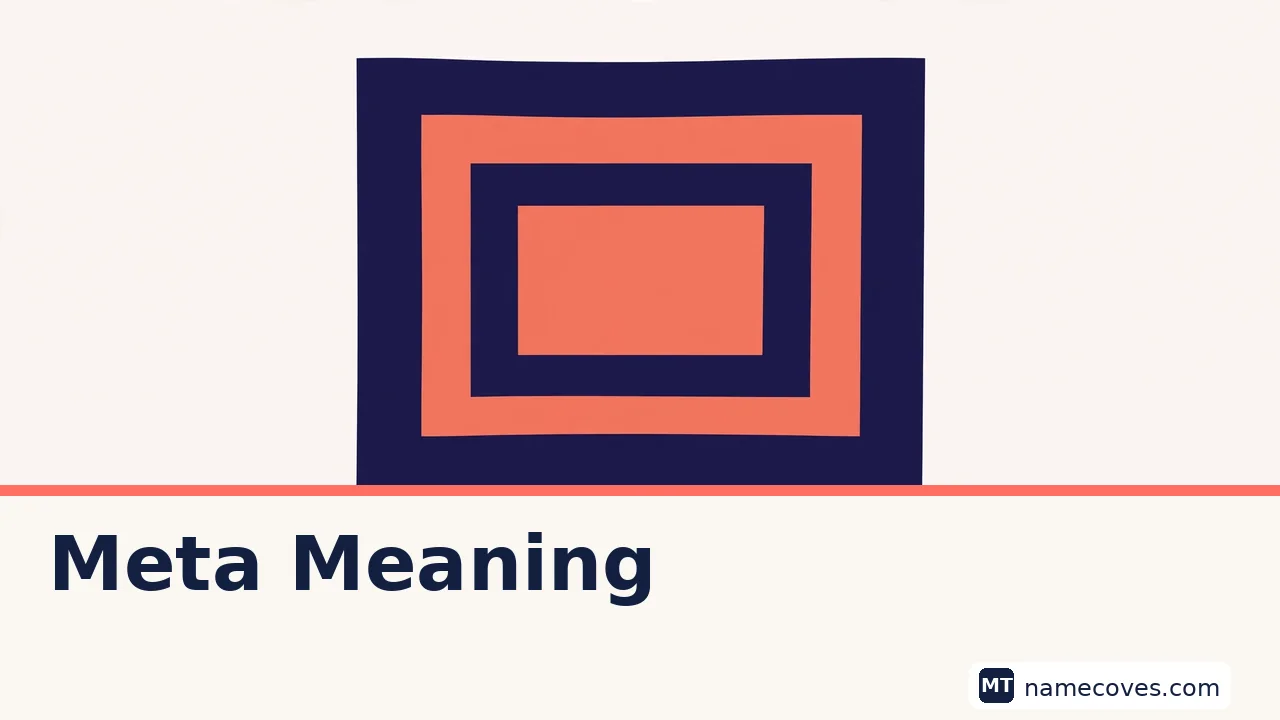
In everyday English, meta is an adjective meaning self-referential or self-aware. Something is meta when it steps outside itself and comments on its own category. A film about filmmaking is meta. A meeting held to discuss why the team has too many meetings is meta. A post that jokes about how everyone posts the same kind of content is meta.
According to Merriam-Webster, meta in this sense means showing or suggesting an explicit awareness of itself or of the conventions of its own form. The core test is simple: does the thing point back at itself? If a song is about songwriting, a book is about how books get written, or a meme mocks the format of memes, you are looking at something meta.
Used this way, meta is informal but widely understood, and it usually carries a playful or clever tone rather than a negative one. People also use it for a kind of higher-level view: to “go meta” on a problem is to stop arguing about the details and start examining the discussion or system itself.
Where Did “Meta” Come From?

Meta began as a Greek prefix meaning “after,” “beyond,” or “about,” as Merriam-Webster and dictionary references note. It survives in many English words. Metadata is data about data, such as a photo’s file details. Metacognition is thinking about your own thinking. A metamorphosis goes beyond one form into another.
The most famous example is “metaphysics.” The works of the Greek philosopher Aristotle were traditionally arranged so that his writings on the nature of reality came after his writings on physics, and they were labeled with the Greek for “after the Physics.” Over time, that shelving label became the name of the subject itself, and “meta” picked up its flavor of “one level above the thing itself,” which is exactly what the modern slang sense still carries.
What Does Meta Mean in Gaming?

In gaming, “the meta” is a noun, and it means the set of strategies, characters, weapons, or team setups that are considered most effective in the game right now. It comes from “metagame,” the game around the game: the layer of choices players make based on what everyone else is playing and what recent updates have strengthened or weakened.
When players say a character “fell out of the meta,” they mean it used to be a top pick and no longer is, often after a balance patch. When they say a strategy is “meta,” they mean it is currently the standard, effective way to play. You may also see the expansion “Most Effective Tactics Available.” That phrase is a backronym, a fitting explanation invented after the term already existed. It describes the idea well, but it is not where the word came from.
This gaming sense is community-specific. Outside gaming and esports conversations, “the meta” will puzzle people, so with a general audience it is clearer to say “the current best strategy.”
What Does Meta Mean as a Company Name?
Meta is also the name of Meta Platforms, the parent company behind Facebook, Instagram, and WhatsApp. The company, originally called Facebook, Inc., renamed itself Meta in 2021 to signal a focus on building the “metaverse,” a set of shared virtual spaces, rather than on one social network. The apps kept their own names; only the parent company changed.
The name was a deliberate play on the same Greek root: the company wanted a word meaning “beyond.” In news and finance, “Meta” with a capital M almost always refers to this company, and context, such as stock prices, apps, or virtual reality, makes that reading clear.
Examples of Meta in Conversation
“The show had the actors complain about the script, it was so meta.” The speaker means the show referred to itself: the characters commented on the very thing they were part of.
“Let’s go meta for a second: why do our planning meetings always run long?” Here meta means stepping up a level, examining the meeting itself instead of the items in it.
“After the update, that weapon is the meta.” In a gaming chat, this means the weapon is currently among the most effective choices, not that it is self-aware.
FAQs
What does it mean when someone says something is “so meta”?
They mean it refers to itself in a clever or self-aware way, such as a joke about jokes or a movie that comments on moviemaking. It is usually a compliment about cleverness, said informally.
Is meta a real word or just slang?
Both. Meta is a long-established Greek prefix found in words like metadata and metaphysics, and its use as a standalone adjective meaning self-referential is now standard informal English recorded by major dictionaries.
What does meta mean in gaming?
It means the currently most effective strategies and picks in a game, shaped by updates and by what other players are using. It comes from “metagame,” not from an acronym.
Why did Facebook change its name to Meta?
The parent company renamed itself in 2021 to reflect ambitions beyond one social network, centered on the “metaverse” idea of shared virtual spaces. Facebook, Instagram, and WhatsApp kept their names as apps.
Can meta mean something bad?
Not by itself. Tone decides. Calling an idea meta is usually neutral or positive; in an argument, “stop being meta” might mean someone is over-analyzing the discussion instead of the topic, which is a complaint about style, not about the word.
What Should You Remember About Meta?
Meta, at its root, points one level up: something aware of, about, or beyond itself. A meta joke comments on jokes, metadata describes data, and the gaming meta describes the strategy layer above ordinary play. Even the company name trades on that same idea of going beyond. If you check what the word is pointing back at, the intended sense almost always falls into place.
In your own writing and conversation, use meta freely in informal settings where self-reference is the idea, and spell out the plainer version, “self-referential” or “the current best strategy,” when your audience mixes gamers, general readers, and people who will picture a company logo first.