Greek last names carry more than a distinctive sound. Many preserve a clue about an ancestor, occupation, place, religious role, or family relationship. Some feel unmistakably traditional, while others have the polished, dramatic quality that makes them perfect for fictional characters, genealogy projects, or modern naming inspiration.
A surname such as Papadopoulos immediately feels recognizably Greek, while names such as Nikolaidis, Georgiou, Karagiannis, and Papadakis reveal different naming traditions and regional influences.
What makes Greek surnames especially interesting is their endings. Forms such as -opoulos, -idis, -akis, -ou, and -atos can offer clues about linguistic history and, sometimes, geographic connections. They are not perfect maps—families migrate and names travel—but they provide fascinating starting points.
If you’re searching for common Greek last names, this guide brings together well-known examples, meanings, pronunciation help, cultural context, aesthetic impressions, and useful naming comparisons.
Quick Answer
Among the most frequently occurring surnames in Greece are Papadopoulos, Papadopoulou, Papageorgiou, Oikonomou, Papadimitriou, Georgiou, Papaioannou, Pappas, Vasileiou, and Nikolaou. Current surname databases consistently place Papadopoulos at or near the top of Greek surname rankings.
Greek surnames commonly come from:
- Patronymics — names based on an ancestor’s given name
- Religious roles — especially surnames beginning with Papa-
- Occupations and titles
- Physical characteristics
- Places and regions
- Older Greek, Byzantine, Latin, Turkish, and Italian influences
The Oxford-based Lexicon of Greek Personal Names notes that modern Greek surnames frequently use patronymic endings such as -opoulos and -ides, while other surnames developed from occupations, physical characteristics, and geographical influences.
50+ Common Greek Last Names
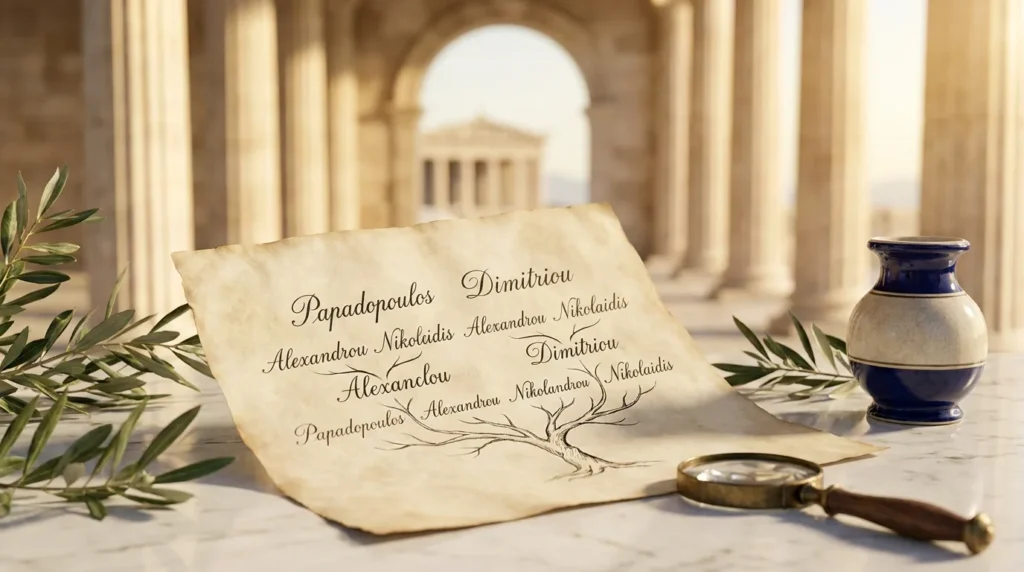
The following collection focuses on recognizable Greek family names rather than obscure names chosen merely to make the list longer.
| Greek Last Name | Meaning / Origin | Pronunciation Guide | Overall Feel |
|---|---|---|---|
| Papadopoulos | “Son of the priest” | pah-pah-do-POO-los | Traditional, strong |
| Papadopoulou | Feminine form of Papadopoulos | pah-pah-do-POO-loo | Elegant, traditional |
| Papageorgiou | “Son of Georgios the priest” | pah-pah-yeh-OR-yee-oo | Classic, distinguished |
| Oikonomou | From oikonomos, steward/housekeeper | ee-ko-NO-moo | Refined, scholarly |
| Papadimitriou | “Son of Dimitrios the priest” | pah-pah-thee-mee-TREE-oo | Historic, formal |
| Georgiou | From Georgios/George | yeh-or-YOO | Classic, polished |
| Papaioannou | “Son of Ioannis the priest” | pah-pah-ee-o-AH-noo | Traditional, graceful |
| Pappas | “Priest” | PAH-pas | Short, memorable |
| Vasileiou | From Vasileios/Basil | vah-see-LEE-oo | Regal, classic |
| Nikolaou | From Nikolaos/Nicholas | nee-ko-LAH-oo | Familiar, elegant |
| Karagiannis | Kara- + Giannis/Ioannis | kah-rah-YAH-nees | Strong, distinctive |
| Vlachos | Refers historically to a Vlach | VLAH-khos | Old-world, regional |
| Antoniou | From Antonios/Anthony | an-toh-NEE-oo | Smooth, classic |
| Makris | Associated with “long/tall” | MAH-krees | Sharp, minimalist |
| Papanikolaou | “Son of Nikolaos the priest” | pah-pah-nee-ko-LAH-oo | Formal, heritage-rich |
| Dimitriou | From Dimitrios | dee-mee-TREE-oo | Classic, graceful |
| Ioannidis | Patronymic from Ioannis | ee-o-ah-NEE-dees | Strong, historic |
| Georgiadis | Patronymic from Georgios | yeh-or-yee-AH-dees | Distinguished |
| Triantafyllou | From Triantafyllo, “rose” | tree-an-ta-FEE-loo | Romantic, floral |
| Papadakis | From papas, priest; Cretan form | pah-pah-DAH-kees | Friendly, regional |
| Petridis | From Petros/Peter | peh-tree-DEES | Clean, classic |
| Nikolaidis | Patronymic from Nikolaos | nee-ko-lah-EE-dees | Noble, strong |
| Dimitriadis | Patronymic from Dimitrios | dee-mee-tree-AH-dees | Traditional |
| Athanasiadis | From Athanasios | ah-thah-nah-see-AH-dees | Ancient, formal |
| Angelopoulos | Patronymic from Angelos | an-yeh-lo-POO-los | Soft, literary |
| Panagiotopoulos | From Panagiotis | pah-nah-yee-o-TOO-los | Traditional |
| Stamatopoulos | From Stamatis | stah-mah-to-POO-los | Strong, established |
| Anagnostopoulos | Patronymic from Anagnostis | ah-nah-gno-sto-POO-los | Scholarly, historic |
| Konstantinou | From Konstantinos | kon-stan-tee-NOO | Sophisticated |
| Papakonstantinou | “Son of Konstantinos the priest” | pah-pah-kon-stan-tee-NOO | Formal, grand |
| Papanastasiou | From Anastasios through Papa- | pah-pah-nah-stah-see-OO | Traditional |
| Papathanasiou | “Son of Athanasios the priest” | pah-pah-thah-nah-see-OO | Historic |
| Theodorakis | From Theodoros | theh-o-do-RAH-kees | Artistic, Cretan |
| Mitsotakis | Cretan-style surname ending in -akis | mee-tso-TAH-kees | Modern, political association |
| Androulakis | Cretan-style -akis surname | an-droo-LAH-kees | Distinctive |
| Katsaros | Greek surname with occupational/descriptive history | kah-TSAR-os | Bold, energetic |
| Vrettos | Greek family surname | VREH-tos | Short, vintage |
| Christodoulou | From Christodoulos | khree-stho-THOO-loo | Religious, formal |
| Christopoulos | Patronymic from Christos | khree-sto-POO-los | Familiar, strong |
| Alexopoulos | Patronymic from Alexios/Alexandros | ah-lek-so-POO-los | Powerful, polished |
| Nikolopoulos | Patronymic from Nikolaos | nee-ko-lo-POO-los | Traditional |
| Giannopoulos | Patronymic from Giannis | yah-no-POO-los | Familiar, warm |
| Karamanlis | Greek surname with historical Turkish linguistic influence | kah-rah-man-LEES | Political, historic |
| Metaxas | Associated with silk weaving | meh-TAH-ksas | Sophisticated, old-world |
| Petalas | Traditionally associated with blacksmithing | peh-TAH-las | Rustic, occupational |
| Kephalas | Associated with “head” | keh-FAH-las | Strong, unusual |
| Marinatos | Surname associated with Cephalonia’s -atos pattern | mah-ree-NAH-tos | Island, artistic |
| Laskaratos | Cephalonian -atos form | las-kah-RAH-tos | Literary, aristocratic |
| Theodoropoulos | Patronymic from Theodoros | theh-o-do-ro-POO-los | Elegant, formal |
| Vasilopoulos | Patronymic from Vasileios | vah-see-lo-POO-los | Regal, traditional |
Several of these etymologies are documented in surname references, including Papadopoulos, Papageorgiou, Papadimitriou, Papaioannou, Pappas, Papadakis, Oikonomou, and related forms.
Why So Many Greek Surnames Begin With “Papa-”?
This is one of the most recognizable patterns in Greek family names.
The Greek word papas refers to a priest. As a result, surnames beginning with Papa- could identify a family through an ancestor who was a priest. This produced names such as Papadopoulos, Papageorgiou, Papadimitriou, Papaioannou, Papanikolaou, and Papakonstantinou.
It is important not to interpret every Papa- surname as meaning the same thing. The second element can connect the surname to a different personal name.
For example:
- Papadopoulos → priest + -poulos
- Papageorgiou → priest + Georgios
- Papadimitriou → priest + Dimitrios
- Papaioannou → priest + Ioannis
- Papanikolaou → priest + Nikolaos
That pattern makes these surnames particularly interesting for genealogy and historical naming research.
Greek Surname Endings and What They Can Reveal
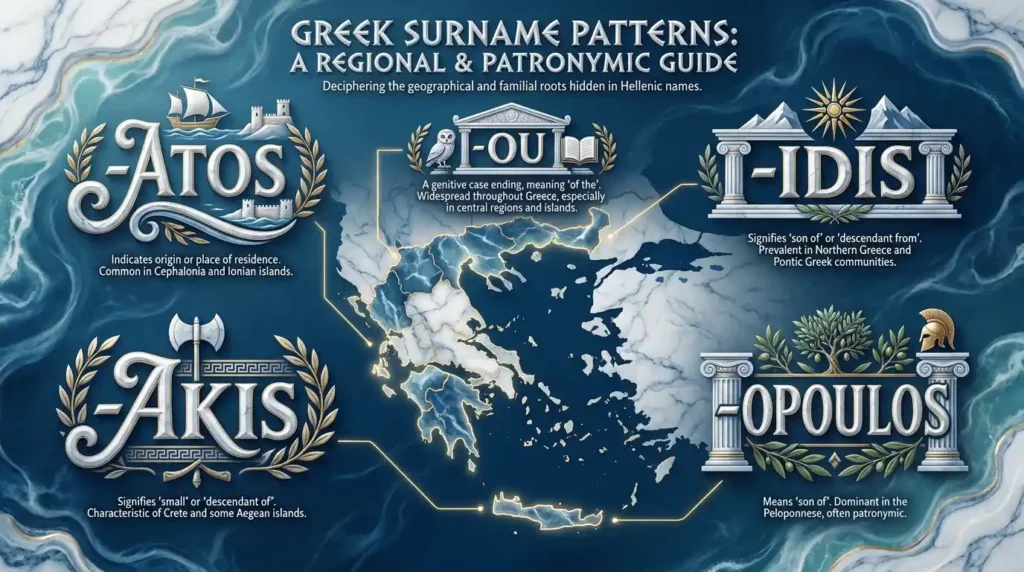
One of the best ways to understand Greek last names is to look at the ending.
Greek surnames are not random combinations of sounds. Many endings developed through linguistic, regional, and family naming traditions.
-opoulos: A Classic Greek Surname Ending
The ending -opoulos is strongly associated historically with the Peloponnese and has become widespread throughout Greece.
Examples include:
- Papadopoulos
- Angelopoulos
- Giannopoulos
- Nikolopoulos
- Alexopoulos
- Theodoropoulos
- Panagiotopoulos
- Stamatopoulos
The suffix has a patronymic function and is commonly understood in surname formation as indicating descent or “son of.” Its deeper linguistic history is connected to Byzantine Greek and ultimately Latin pullus.
Vibe: formal, unmistakably Greek, traditional, established.
-idis and -ides: Historic and Strong
The endings -idis and -ides are particularly important in Greek surname history.
They have long patronymic associations meaning approximately “son of” or “descendant of.” The ending has especially strong historical associations with Pontic and Asia Minor Greek communities, although surnames using it are now found throughout Greece and the diaspora.
Examples:
- Nikolaidis
- Ioannidis
- Petridis
- Dimitriadis
- Georgiadis
- Athanasiadis
Vibe: powerful, historical, masculine-leaning in English perception, and somewhat aristocratic.
-akis: A Strong Cretan Association
The ending -akis is strongly associated with Crete.
Examples include:
- Papadakis
- Theodorakis
- Androulakis
- Mitsotakis
The regional connection is useful, but it should not be treated as proof of ancestry. Migration means a surname associated with Crete can be found far beyond the island today.
Vibe: warm, energetic, distinctly Mediterranean.
-ou: A Feminine or Genitive Form
Greek surnames can appear in forms ending in -ou, particularly in feminine forms.
For example:
- Papadopoulos → Papadopoulou
- Georgios-related Georgiou
- Nikolaos-related Nikolaou
- Vasileiou
- Antoniou
In traditional Greek surname grammar, the -ou form can reflect the genitive case. Modern naming practice is more complex than simply labeling these forms “female surnames,” so context matters.
Vibe: flowing, elegant, softer in English-language perception.
-atos: An Island Connection
The ending -atos is particularly associated with Cephalonia/Kephalonia and the Ionian Islands.
Examples include:
- Marinatos
- Laskaratos
The Oxford Lexicon of Greek Personal Names specifically notes the influence of Italian, particularly Venetian, rule on surnames in places including Cephalonia, where -atos forms are prominent.
Vibe: romantic, island-inspired, literary.
Elegant Greek Last Names
Some Greek surnames have an especially polished sound. Their appeal comes from rhythm, vowels, length, and historical familiarity rather than from an objective definition of “elegant.”
Beautiful and Refined Choices
Georgiou — Smooth and understated. It works particularly well when you want a surname that sounds established without feeling overly long.
Nikolaou — Graceful and recognizable, with a flowing ending.
Vasileiou — Formal and almost regal in sound.
Papageorgiou — Longer and more ceremonial, making it excellent for a grand fictional family.
Konstantinou — Sophisticated and stately.
Triantafyllou — Particularly memorable because of its association with the Greek word for rose.
Marinatos — Has an unmistakable island and literary quality.
Laskaratos — Dramatic without sounding invented.
Elegant Surname Pairings
If you’re naming a fictional character, these combinations have different emotional textures:
| Full Name | Impression |
|---|---|
| Elena Georgiou | Elegant and contemporary |
| Sophia Nikolaou | Soft and sophisticated |
| Ariadne Vasileiou | Mythic and refined |
| Lydia Konstantinou | Literary and polished |
| Theo Papageorgiou | Classic and substantial |
| Alex Marinatos | Modern Mediterranean |
| Nico Theodorakis | Artistic and memorable |
These are creative combinations, not claims about specific real individuals.
Strong and Powerful Greek Last Names
Some surnames feel powerful because of their length, consonant patterns, historical associations, or connection with familiar Greek personal names.
Nikolaidis
Meaning: Patronymic surname from Nikolaos.
Vibe: Strong, traditional, confident.
Aesthetic: Historical / masculine / old-world.
Best for: A military character, historical protagonist, athlete, detective, or serious fictional family.
Dimitriadis
Derived from Dimitrios, Dimitriadis has a distinctly established Greek sound.
Vibe: Intelligent, dependable, traditional.
Karagiannis
Karagiannis has a sharper, more memorable rhythm than many longer Greek surnames.
Vibe: Bold, Mediterranean, confident.
Vasileiou
Its connection to Vasileios gives it a naturally formal impression.
Vibe: Regal, composed, elegant.
Papadopoulos
Despite being extremely common, Papadopoulos has tremendous cultural recognizability.
Vibe: Traditional, established, unmistakably Greek.
Soft, Romantic, and Beautiful Greek Last Names
Not every Greek surname needs to sound powerful.
Some have a softer rhythm that works beautifully for romantic characters, fantasy settings, contemporary fiction, or aesthetically styled usernames.
Triantafyllou
This is one of the most visually interesting choices because it connects with triantafyllo, “rose.”
Vibe: Floral, romantic, poetic.
Georgiou
The repeated vowel sounds create a gentle flow.
Vibe: Calm, elegant, understated.
Nikolaou
The ending gives the surname a smooth, lyrical quality.
Vibe: Sophisticated, warm, contemporary.
Angelopoulos
The connection with the given name Angelos gives it a naturally gentle association.
Vibe: Ethereal, literary, graceful.
Christodoulou
Long and formal, with strong Christian cultural associations.
Vibe: Spiritual, historic, ceremonial.
Greek Last Names With a Vintage Feel
Greek naming has deep historical layers, and some surnames sound particularly at home in historical fiction.
Consider:
- Papadopoulos
- Papadimitriou
- Papanikolaou
- Nikolaidis
- Dimitriadis
- Athanasiadis
- Konstantinou
- Theodoropoulos
- Metaxas
- Laskaratos
These names work especially well for stories set in the late 19th or early 20th century, historical family sagas, academic characters, or old Mediterranean settings.
The appeal is not that these surnames are “more authentic” than shorter modern names. Rather, their morphology and historical associations give them an older, established texture.
Greek Last Names With a Modern Luxury Vibe
If you’re choosing a surname for a fictional influencer, fashion character, celebrity persona, luxury brand character, or sophisticated online identity, shorter or rhythmically clean surnames can feel especially effective.
Modern-Looking Picks
Georgiou — Minimalist and polished.
Nikolaou — Smooth and fashionable.
Vasileiou — Formal luxury.
Marinatos — Mediterranean and artistic.
Laskaratos — Literary luxury.
Makris — Short and memorable.
Vrettos — Compact and distinctive.
Metaxas — Vintage sophistication.
A modern “luxury” impression is an aesthetic interpretation, not a historical property of the surname.
Greek Last Names by Regional Flavor
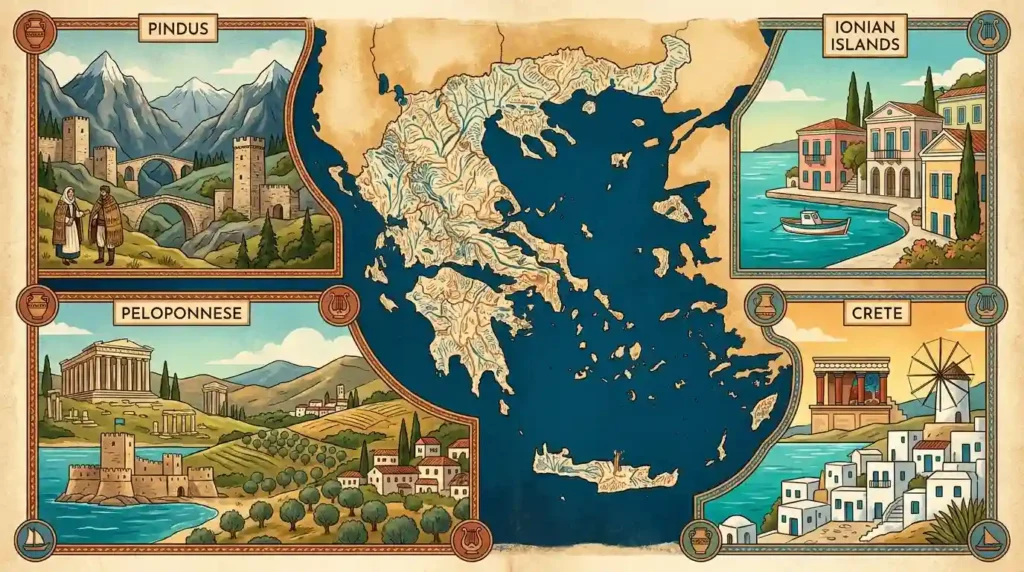
Greek surnames can preserve clues about regional history, although migration means these clues should never be treated as definitive ancestry evidence.
| Ending / Pattern | Regional Association | Examples |
|---|---|---|
| -opoulos | Peloponnese | Papadopoulos, Giannopoulos |
| -akis | Crete | Papadakis, Theodorakis |
| -akos / -eas | Mani | Various regional forms |
| -atos | Cephalonia | Marinatos, Laskaratos |
| -elis | Lesvos | Various -elis surnames |
| -oudis | Thrace / northern regions | Alexoudis |
| -idis | Strong historical association with Asia Minor/Pontic Greek communities | Nikolaidis, Ioannidis |
These are regional tendencies, not absolute rules. The same surname can appear across Greece and throughout the Greek diaspora.
Greek Last Names for Characters
A good fictional surname should do more than sound Greek. It should support the character’s identity.
For a Hero
Try:
- Nikolaidis
- Vasileiou
- Dimitriadis
- Georgiadis
- Theodorakis
These have a confident, established sound.
For a Mysterious Character
Try:
- Laskaratos
- Marinatos
- Nikolaidis
- Metaxas
- Konstantinou
Longer names can create a more dramatic visual presence on the page.
For a Romantic Character
Try:
- Georgiou
- Nikolaou
- Angelopoulos
- Triantafyllou
- Vasileiou
For a Historical Character
Try:
- Papadimitriou
- Papanikolaou
- Athanasiadis
- Theodoropoulos
- Laskaratos
For a Contemporary Character
Try:
- Makris
- Georgiou
- Nikolaou
- Vrettos
- Karagiannis
Greek Surnames for Baby Name Pairings
If you’re pairing a Greek surname with a first name, rhythm matters as much as meaning.
A long surname often pairs beautifully with a short first name:
- Nico Papadopoulos
- Theo Georgiou
- Eva Nikolaou
- Mia Vasileiou
- Leo Dimitriadis
A long first name can create a more formal combination with a shorter surname:
- Alexandros Makris
- Konstantinos Pappas
- Theodora Metaxas
A Simple Naming Rule
Say the entire name aloud three times.
If the first name and surname have the same number of syllables and similar endings, the combination can sometimes feel heavy. Contrast often creates better rhythm.
For example:
Leo Papadopoulos feels balanced because the short first name contrasts with the long surname.
Alexandros Papadopoulos feels more formal and ceremonial because both names are substantial.
Neither is objectively better—the right choice depends on the character or naming purpose.
Greek Last Names and Their Personality Vibes
Surname “personality” is subjective, but it can be useful when selecting a name for fiction, gaming, social media, or creative projects.
| Surname | Personality Vibe | Aesthetic |
|---|---|---|
| Papadopoulos | Traditional, dependable | Classic Greek |
| Nikolaidis | Strong, serious | Historic |
| Georgiou | Calm, polished | Minimalist |
| Vasileiou | Confident, composed | Regal |
| Triantafyllou | Romantic, artistic | Floral |
| Laskaratos | Intellectual, dramatic | Literary |
| Marinatos | Adventurous, artistic | Mediterranean |
| Makris | Direct, confident | Minimalist |
| Theodorakis | Creative, expressive | Artistic |
| Papadakis | Warm, approachable | Cretan |
| Konstantinou | Formal, sophisticated | Classic luxury |
| Metaxas | Vintage, authoritative | Old-world |
| Angelopoulos | Gentle, imaginative | Literary |
| Karagiannis | Energetic, bold | Contemporary Greek |
These descriptions are creative naming impressions, not claims that people with these surnames possess these personalities.
Greek Surname Meanings: Religious, Occupational, and Family Origins
Greek surnames come from several major naming sources.
Religious Surnames
The Papa- family is the most obvious example.
- Papadopoulos
- Papageorgiou
- Papadimitriou
- Papaioannou
- Papanikolaou
- Papakonstantinou
The repeated Papa- element reflects papas, “priest.”
Patronymic Surnames
These connect a family to an ancestor’s given name.
Examples include:
- Nikolaidis
- Petridis
- Dimitriadis
- Georgiadis
- Panagiotopoulos
- Theodoropoulos
The basic concept is similar to saying “descendant of Nikolaos” or “family of Dimitrios.”
Occupational Surnames
Some Greek family names arose from occupations or social roles.
Oikonomou, for example, comes from oikonomos, meaning steward or housekeeper. Metaxas has an occupational connection with silk weaving, while Petalas is traditionally associated with blacksmithing.
Descriptive Surnames
Other surnames developed from physical characteristics or descriptive terms.
Makris, for example, is associated with the Greek word for “long” and has historically functioned as a descriptive surname.
This is a reminder that Greek surnames are not exclusively patronymic.
Greek Surnames for Fantasy and Fiction
Greek-inspired surnames are especially useful in fantasy because Greek language and mythology already carry strong associations with gods, heroes, islands, philosophy, and ancient civilizations.
For a fantasy setting, consider:
- Laskaratos
- Theodorakis
- Nikolaidis
- Angelopoulos
- Vasileiou
- Konstantinou
- Marinatos
- Triantafyllou
- Dimitriadis
- Georgiadis
For a character inspired by Greek mythology, be careful not to imply that an ordinary modern surname is itself an ancient mythological name. Modern Greek surnames and ancient Greek names belong to related but different naming traditions.
That distinction can make fictional worldbuilding feel much more authentic.
Lucky Numbers, Colors, Stones, and Numerology
Traditional Greek surname meanings should not be confused with modern numerology.
There is no universal Greek cultural rule assigning a lucky number, gemstone, color, weekday, or zodiac sign to each surname. If you see such attributes attached to Greek surnames online, they are generally modern naming or numerology interpretations rather than established Greek surname etymology.
For creative naming purposes, however, you can use an optional symbolic layer.
| Surname | Modern Symbolic Number* | Color Vibe* | Gemstone Vibe* | Personality Aesthetic |
|---|---|---|---|---|
| Papadopoulos | 4 | Deep blue | Sapphire | Traditional |
| Georgiou | 6 | Ivory | Pearl | Elegant |
| Nikolaidis | 8 | Navy | Onyx | Powerful |
| Vasileiou | 1 | Gold | Topaz | Regal |
| Triantafyllou | 6 | Rose | Rose quartz | Romantic |
| Laskaratos | 7 | Burgundy | Garnet | Mysterious |
| Marinatos | 5 | Sea green | Aquamarine | Adventurous |
| Makris | 3 | Charcoal | Black agate | Minimalist |
*These are creative numerology/aesthetic associations, not documented Greek cultural attributes or historical facts.
If you’re creating a fictional character, this symbolic approach can be fun. If you’re researching genealogy, use the documented meaning and historical origin instead.
How to Choose the Right Greek Last Name
The best surname depends on why you’re choosing it.
For a Realistic Greek Character
Start with common names such as:
- Papadopoulos
- Georgiou
- Nikolaou
- Pappas
- Vasileiou
- Karagiannis
- Dimitriou
These immediately feel plausible and familiar.
For a Historical Character
Look for surnames whose structure fits the character’s regional and historical setting.
Consider:
- Papadimitriou
- Nikolaidis
- Dimitriadis
- Athanasiadis
- Laskaratos
- Metaxas
For a Modern Character
Choose a surname with clean rhythm:
- Georgiou
- Nikolaou
- Makris
- Vrettos
- Vasileiou
For a Fantasy Character
Choose based on sound first, then verify the surname’s actual cultural background.
Good options include:
- Laskaratos
- Angelopoulos
- Marinatos
- Theodorakis
- Triantafyllou
For a Baby
Prioritize pronunciation, spelling, family significance, and how the complete name sounds.
Don’t choose a surname solely because its online “lucky number” looks attractive. A name’s actual family or cultural meaning will usually be more valuable.
Greek Last Names vs. Greek-American Surnames
Greek surnames can change appearance when families move into English-speaking countries.
Immigration, transliteration, pronunciation differences, and attempts to make a surname easier for English speakers can produce spelling variations or shortened forms.
That means two members of the same extended family may sometimes appear under slightly different spellings in historical records.
This is particularly important for genealogy.
If you’re tracing a Greek family, search for:
- Different English spellings
- Transliteration variations
- Masculine and feminine surname forms
- Older Greek spellings
- Shortened diaspora forms
- Records from the family’s original region
A surname ending alone should not be treated as proof of a family’s exact place of origin.
FAQs About Common Greek Last Names
What is the most common Greek last name?
Papadopoulos is widely identified as the most common Greek surname. Current surname databases place it at number one in Greece, ahead of Papadopoulou and Papageorgiou.
What does Papadopoulos mean?
Papadopoulos is generally explained as “son of the priest,” combining papas, “priest,” with the patronymic -poulos suffix.
Why do so many Greek last names end in -opoulos?
The -opoulos ending is a common Greek patronymic surname formation historically associated with the Peloponnese and now widespread across Greece. It functions as an indicator of descent or family relationship.
What does -idis mean in Greek surnames?
The -idis/-ides ending has a long patronymic tradition and can indicate “son of” or “descendant of.” It has especially strong historical associations with Pontic and Asia Minor Greek communities.
Are Greek surnames different for men and women?
Traditionally, Greek surnames can have grammatical forms that differ by gender, particularly forms ending in -ou. For example, Papadopoulos has the feminine form Papadopoulou. Modern Greek naming practices have changed over time, so surname forms should be considered in their legal and family context.
What Greek surnames are associated with Crete?
Surnames ending in -akis are strongly associated with Crete. Examples include Papadakis, Theodorakis, Androulakis, and Mitsotakis. Migration means the ending is a clue rather than definitive proof of Cretan ancestry.
What are some elegant Greek last names?
Some aesthetically elegant choices include Georgiou, Nikolaou, Vasileiou, Konstantinou, Triantafyllou, Marinatos, and Laskaratos.
What Greek surname sounds the most powerful?
For a strong fictional impression, Nikolaidis, Dimitriadis, Vasileiou, Karagiannis, and Papadopoulos work particularly well. “Powerful,” however, is a subjective sound and style judgment rather than an objective property of a surname.
Are all Greek surnames derived from ancient Greek?
No. Greek surnames developed from multiple historical sources. They can reflect personal names, occupations, physical characteristics, geographical locations, religious roles, and linguistic influences from periods of Greek history involving Latin, Italian, Turkish, and other languages.
Can a Greek surname reveal where a family came from?
Sometimes it can provide a useful clue. Endings such as -akis, -opoulos, -atos, and -idis have regional or historical associations. But surnames travel through migration and marriage, so genealogy records are needed to establish ancestry with confidence.
Final Thoughts
Common Greek last names are fascinating because they often function like tiny pieces of family history.
Papadopoulos points toward a priestly ancestor and a famous patronymic pattern. Nikolaidis and Dimitriadis connect families to given names. -akis can suggest a Cretan connection, while -atos can evoke the surname traditions of Cephalonia.
But the most useful way to choose a Greek surname is to look beyond how exotic it sounds.
Ask what you need the name to communicate.
Do you want something traditional or modern?
Soft or commanding?
Romantic or mysterious?
Historically grounded or fantasy-friendly?
Short and memorable or long and ceremonial?
Once you understand the structure behind Greek family names, choosing one becomes much easier. Instead of picking a surname because it simply “sounds Greek,” you can choose one whose rhythm, history, cultural context, and emotional character genuinely fit the person or story behind it.