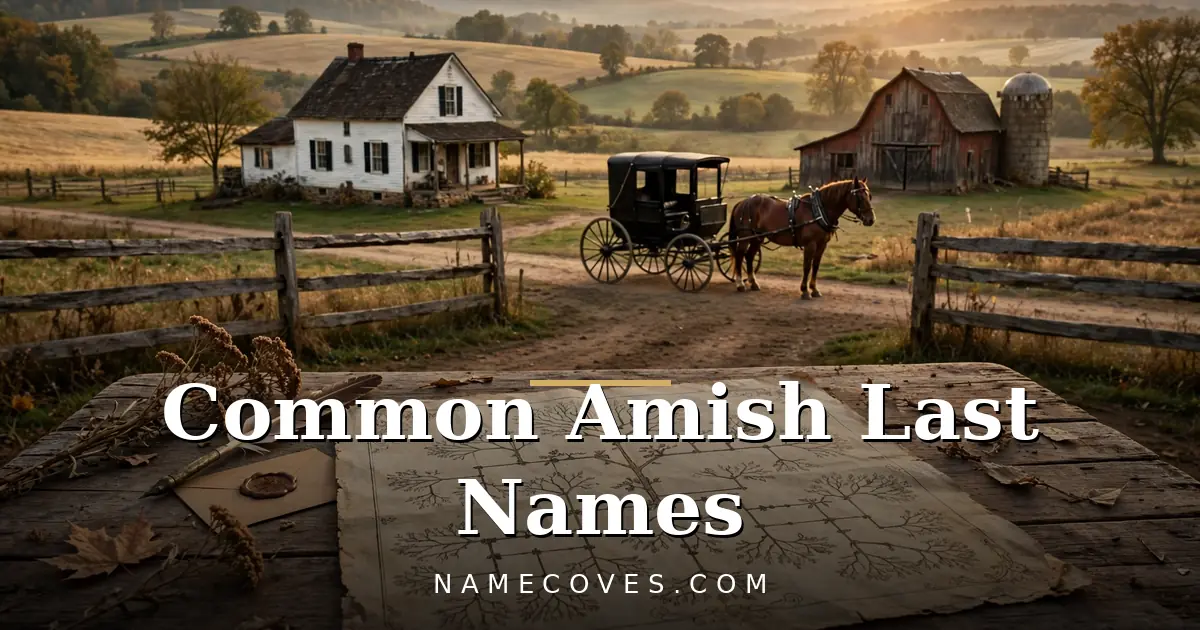
If you are searching for common Amish last names, you will quickly notice something fascinating: a relatively small group of surnames appears again and again across Amish communities in Pennsylvania, Indiana, Ohio, and other settlements.
Names such as Miller, Stoltzfus, Yoder, King, Fisher, Beiler, Lapp, Zook, and Schrock are not simply names that “sound Amish.” They are documented family names associated with Amish communities and, in many cases, with broader Anabaptist history.
For genealogy, historical fiction, character creation, or simply understanding Amish culture, these surnames offer a glimpse into centuries of European migration, family networks, language change, and community history.
One important distinction matters, though: there is no single Amish surname list that applies equally to every Amish settlement. A surname that is extremely common in Lancaster County may be much less common in Indiana, while some names are especially associated with Swiss-background Amish communities.
Featured Snippet: What Are the Most Common Amish Last Names?
The most recognizable common Amish surnames include Miller, Stoltzfus, Yoder, King, Fisher, Beiler, Lapp, Zook, Schrock, Hostetler, Troyer, Stutzman, Lehman, Gingerich, Beachy, and Swartzentruber.
Miller is described by Amish America as the most common Amish surname overall, while Stoltzfus is particularly prominent among the Pennsylvania Amish. Yoder is especially widespread in Midwestern Amish communities. Regional differences are important when interpreting how “common” a surname really is.
Common Amish Last Names at a Glance
|
Amish Last Name |
Regional Association |
General Character |
|---|---|---|
|
Miller |
Midwest and multiple settlements |
Familiar, traditional |
|
Stoltzfus |
Lancaster County, Pennsylvania |
Distinctive, historic |
|
Yoder |
Midwest and Pennsylvania |
Classic Amish |
|
King |
Lancaster County |
Strong, simple |
|
Fisher |
Lancaster County and related settlements |
Familiar, occupational |
|
Beiler |
Pennsylvania and Midwest |
Traditional, distinctive |
|
Lapp |
Lancaster County |
Short, recognizable |
|
Zook |
Pennsylvania and Midwest |
Compact, unusual |
|
Esh |
Lancaster County |
Short, historic |
|
Schrock |
Ohio, Indiana, Pennsylvania |
Distinctive, Germanic |
|
Hostetler |
Midwest and Pennsylvania |
Strong, heritage-rich |
|
Hochstetler |
Midwest/Pennsylvania |
Older Germanic form |
|
Troyer |
Midwest and Swiss-background communities |
Traditional |
|
Stutzman |
Ohio and other settlements |
Heritage-focused |
|
Lehman |
Northern Indiana and Pennsylvania |
Soft, established |
|
Gingerich |
Northern Indiana and Midwest |
Distinctive |
|
Beachy |
Pennsylvania and other settlements |
Gentle-sounding |
|
Swartzentruber |
Swiss-background communities |
Very distinctive |
|
Hershberger |
Midwest |
Strong Germanic character |
|
Bontrager |
Northern Indiana |
Regional, recognizable |
|
Wagler |
Southern Indiana and Ontario |
Swiss-background association |
|
Graber |
Swiss Amish communities |
Short, European |
|
Schwartz |
Swiss Amish communities |
Traditional Germanic |
|
Hilty |
Swiss Amish communities |
Compact |
|
Lengacher |
Swiss Amish communities |
Distinctive |
|
Wittmer |
Swiss Amish communities |
European, refined |
|
Burkholder |
Northern Indiana and Midwest |
Established surname |
|
Schlabach |
Indiana and Ohio |
Regional, distinctive |
|
Eash |
Northern Indiana |
Short, uncommon outside Amish contexts |
|
Lambright |
Indiana Amish communities |
Anglicized appearance |
The exact distribution varies by settlement and time period. Amish America identifies different surname clusters in Lancaster County, northern Indiana, the Midwest, and Swiss Amish communities.
The Most Common Amish Last Names
Miller
Miller is one of the clearest examples of a surname that is both widely familiar in the general American population and strongly represented among Amish families.
The German form is Müller, an occupational surname historically associated with a miller. Amish surname research notes that there were multiple unrelated Miller families in Europe, including Anabaptists in Switzerland, so people sharing the surname do not necessarily descend from one common Amish ancestor.
Meaning: Miller or mill worker Origin: German-speaking Europe Language: German/English Gender: Family surname Cultural relevance: Strong Amish association, particularly in Midwestern settlements Pronunciation: MIL-er Personality vibe: Familiar, grounded, practical Aesthetic: Traditional Americana, rural, understated Modern vs. classic: Strongly classic Nicknames: Usually based on the first name rather than the surname
For fictional characters, Miller works particularly well when you want a surname that feels authentic without immediately appearing exotic.
Stoltzfus
Stoltzfus is perhaps the surname most strongly associated with the Pennsylvania Amish, especially the Lancaster County Amish and related settlements.
Historical accounts trace the Amish and Mennonite Stoltzfus family to Nicholas Stoltzfus, who arrived in Philadelphia in 1766 from the German-speaking European region of Zweibrücken. The name is also sometimes written Stoltzfoos.
Meaning: Family surname with German-language roots; exact surname interpretation should not be confused with a modern English translation Origin: German-speaking Europe Language: German Cultural relevance: Especially strong in Pennsylvania Amish communities Gender: Family surname Personality vibe: Heritage-rich, serious, established Aesthetic: Historical, rustic, traditional Modern vs. classic: Strongly traditional Alternative spelling: Stoltzfoos
Among names on this list, Stoltzfus has one of the strongest immediate cultural associations with Amish Pennsylvania.
Yoder
Yoder is another highly recognizable Amish surname, especially in Midwestern communities.
Historical surname research connects Yoder with the Swiss family name Joder and with the Christian personal name Theodore. Amish America notes that Yoder is historically associated with Switzerland and has become widespread among Amish and Mennonite populations in North America.
Origin: Swiss/German-speaking Europe Language: German/Swiss German context Cultural relevance: Amish and Mennonite communities Gender: Family surname Personality vibe: Familiar, sturdy, traditional Aesthetic: Rural heritage, Americana Modern vs. classic: Classic Similar names: Joder, Yoder Pop-culture impression: Often immediately recognizable to American audiences as an Amish-associated surname
Yoder has an interesting naming advantage: it sounds natural in English while retaining a distinctly European heritage.
King
King is especially associated with the Lancaster County Amish.
Historical sources connect Amish Kings with German-speaking ancestors whose surname was König. The English form “King” developed from this German surname in North America.
Origin: German Original form: König Language: German/English Cultural relevance: Particularly Lancaster County Amish Gender: Family surname Personality vibe: Strong, confident, straightforward Aesthetic: Minimalist, classic, powerful Modern vs. classic: Classic but highly usable today Pronunciation: KING
Although “King” carries an obvious English meaning, its presence among Amish families has a documented German-language history.
Fisher
Fisher is another important Lancaster County Amish surname.
Historical research traces one prominent Fisher line to Christopher Fischer, who came from the Netherlands to America in the eighteenth century and later became associated with early Amish communities. Amish Fishers are particularly associated with Lancaster County and related settlements.
Meaning: Fisher; traditionally an occupational surname Origin: Germanic/Dutch European context Language: German/Dutch/English forms Cultural relevance: Strong Lancaster County association Gender: Family surname Personality vibe: Calm, practical, outdoorsy Aesthetic: Rustic, natural, traditional Modern vs. classic: Classic
The surname also has a useful literary quality because “Fisher” naturally evokes water, fishing, and rural landscapes even when those associations are modern rather than part of Amish surname history.
Beiler
Beiler is a particularly recognizable Amish surname, especially in Pennsylvania.
Historical forms include Beyeler, Byler, and Beyler, reflecting spelling changes across languages and regions. The name has Swiss origins and appears in Amish communities in Pennsylvania and the Midwest.
Origin: Swiss/German-speaking Europe Language: German/Swiss German Cultural relevance: Amish and Anabaptist communities Gender: Family surname Personality vibe: Traditional, quiet, distinctive Aesthetic: Heritage, countryside, historical Modern vs. classic: Traditional Related spellings: Byler, Beyler, Beyeler
Beiler is particularly useful for fictional naming when you want something that feels authentically regional rather than generically “old-fashioned.”
Lapp
Lapp is strongly associated with Lancaster County Amish families.
Amish surname histories distinguish between different historical Lapp lines, including an Amish family descended from Michael Lapp. The surname has also occurred among Mennonites, demonstrating how some family names cross Anabaptist communities.
Origin: European Language: Germanic/European surname tradition Cultural relevance: Lancaster County Amish Gender: Family surname Personality vibe: Short, quiet, memorable Aesthetic: Minimalist, rustic Modern vs. classic: Classic
Its short spelling makes Lapp visually striking and easy to remember.
Zook
Zook is one of the most recognizable short Amish surnames.
Historical accounts trace Zook families to Switzerland, particularly the canton of Bern, and connect early forms of the surname with Anabaptist history.
Origin: Swiss Language: German/Swiss German Cultural relevance: Amish and Mennonite communities Gender: Family surname Personality vibe: Compact, distinctive, traditional Aesthetic: Rustic minimalism Modern vs. classic: Classic but unusual to general audiences Similar visual style: Lapp, Esh, Eash
Zook is particularly effective for fictional characters because it is short enough to feel modern while retaining a strong historical identity.
Esh
Esh is another short surname associated with Amish communities, particularly in Pennsylvania.
It is closely related in appearance to forms such as Esch, and Amish sources identify Esh among the recurring Lancaster County surnames.
Origin: German-speaking European context Language: German/English-American forms Cultural relevance: Lancaster County Amish Gender: Family surname Personality vibe: Quiet, understated, traditional Aesthetic: Minimalist, vintage Modern vs. classic: Classic
Its simplicity gives it a surprisingly contemporary visual appearance.
Amish Last Names With Strong Germanic Character
Some surnames immediately communicate their Central European heritage through spelling and sound.
Schrock
Schrock is a common Amish surname with historical Swiss connections. Earlier Swiss forms include Schrag or Schraag.
It has a strong visual presence and a distinctly Germanic appearance.
Vibe: rugged, traditional, historical Aesthetic: Old-world, rural, heritage Similar names: Schrag, Shrock
Hostetler
Hostetler and related spellings such as Hochstetler and Hochstedler occur among Amish communities.
Vibe: deeply traditional, Germanic, genealogical Aesthetic: historical and old-world Related forms: Hochstetler, Hochstedler
The spelling variations are a good reminder that historical family names were not always standardized.
Troyer
Troyer is particularly associated with Midwestern and Swiss-background Amish communities.
Vibe: sturdy, rural, heritage-focused Aesthetic: traditional Americana Modern vs. classic: Classic
Stutzman
The Stutzman surname has a long Anabaptist history and is found among Amish families in several communities.
Vibe: established, serious, historical Aesthetic: old-world rural Modern vs. classic: Strongly classic
Historical accounts trace major Stutzman lines to European Anabaptist migration into North America.
Pennsylvania Amish Last Names
If your goal is specifically to find Lancaster County Amish last names, the list changes somewhat from the broader national picture.
Frequently occurring Lancaster-associated surnames include:
- Stoltzfus
- King
- Fisher
- Beiler
- Esh
- Lapp
- Zook
- Glick
- Riehl
- Smucker
- Petersheim
- Smoker
- Blank
- Kauffman
- Lantz
- Ebersole
- Dienner
- Yoder
A historical analysis of Amish marriages found a particularly concentrated surname pattern in Lancaster County. One study cited by the American Name Society found that Stoltzfus, King, and Beiler alone accounted for nearly half of the surnames in its sample, while another Lancaster County sample identified Stoltzfus, King, Beiler, Fisher, Lapp, Zook, and Esh among the seven most frequent surnames.
This concentration is one reason Amish surname research can be so interesting: a last name can sometimes provide clues about a family’s community or regional background, although it cannot establish an individual’s identity or religious affiliation by itself.
Indiana and Midwestern Amish Last Names
The Amish communities of Indiana and the broader Midwest have their own recognizable surname patterns.
Common names include:
- Miller
- Yoder
- Hershberger
- Hochstetler
- Troyer
- Schrock
- Bontrager
- Burkholder
- Lehman
- Lambright
- Gingerich
- Stutzman
- Wagler
- Eash
- Schlabach
Amish America notes that Miller and Yoder are particularly common in the Midwest, while northern Indiana has notable concentrations of names such as Bontrager, Burkholder, Lehman, and Lambright.
A northern Indiana Amish directory provides an especially vivid illustration: a single district contained numerous Bontrager, Lambright, Miller, and Yoder households alongside families named Eash, Gingerich, Hochstedler, Hostetler, Lehman, Schlabach, Stutzman, Wagler, Whetstone, and Wingard.
Swiss Amish Last Names
Not every Amish surname has the same geographical background.
Swiss Amish communities have their own surname patterns, with names such as:
- Schwartz
- Hilty
- Lengacher
- Graber
- Wittmer
- Wagler
- Swartzentruber
These names can have a noticeably different visual character from the surnames most people associate with Lancaster County.
Swartzentruber
Few Amish surnames look as immediately distinctive as Swartzentruber.
Historical research connects the name with Swiss-background Amish families and records older forms including Schwartzentraub. The surname became particularly associated with a conservative Amish church grouping, although the surname itself predates that association.
Vibe: highly traditional, old-world, unmistakable Aesthetic: historical, Swiss-German, genealogical Modern impression: rare and distinctive
Graber
Graber is found among Swiss Amish communities.
Vibe: concise, European, heritage-focused Aesthetic: minimalist old-world Modern impression: distinctive but easy to spell
Hilty
Hilty has a compact, European appearance and occurs among Swiss Amish families.
Vibe: gentle, understated, traditional Aesthetic: refined old-world
Lengacher
Lengacher is one of the more visually distinctive Swiss Amish surnames.
Vibe: strongly European and historical Aesthetic: old-world, genealogical, regional
Amish Surname Spellings and Variations
One of the most overlooked parts of Amish surname research is spelling variation.
Before modern standardized records, surnames could be written according to local pronunciation, language, or the preferences of the person recording the name.
Examples include:
|
Common Form |
Historical/Alternate Forms |
|---|---|
|
Stoltzfus |
Stoltzfoos |
|
Hostetler |
Hochstetler, Hochstedler |
|
Schrock |
Shrock |
|
Beiler |
Byler, Beyler, Beyeler |
|
Hershberger |
Herschberger, Harshberger |
|
Schlabach |
Slabach, Slabaugh, Slaubaugh |
|
Bontrager |
Bontreger, Borntrager, Borntreger |
|
Wagler |
Related European spellings |
|
Eash |
Related to earlier Germanic forms such as Oesch |
Amish America specifically documents several of these spelling families and notes that some surnames became more Anglicized after immigration to North America.
For genealogy, this is extremely important. Searching only one spelling can cause you to miss an entire branch of a family.
The Amish Surnames With the Strongest Traditional Feel
If you are choosing a surname for a fictional character and want the reader to immediately sense a traditional Amish or Pennsylvania Dutch setting, these names have particularly strong cultural associations:
Stoltzfus — deeply associated with Pennsylvania Amish heritage.
Yoder — familiar, traditional, and strongly associated with Amish and Mennonite communities.
Miller — extremely recognizable and historically widespread.
Beiler — distinctive and regionally appropriate.
Lapp — short, understated, and Lancaster-associated.
Zook — compact and unmistakable.
Schrock — visually Germanic and strongly traditional.
Hostetler — historical and old-world.
Troyer — sturdy and Midwestern.
Stutzman — genealogical and heritage-rich.
These are cultural impressions rather than official personality meanings. A surname does not inherently make a person quiet, strong, gentle, religious, wealthy, traditional, or conservative.
Amish Last Names With a Modern Minimalist Aesthetic
Interestingly, some traditional Amish surnames can work surprisingly well in modern naming aesthetics.
Short and Clean
- Esh
- Lapp
- Zook
- King
- Yoder
- Hilty
- Graber
These have short visual forms that work well for fictional characters, usernames, story characters, and minimalist brand concepts.
Distinctive and Memorable
- Stoltzfus
- Swartzentruber
- Lengacher
- Hochstetler
- Hershberger
- Bontrager
These feel more historical and regionally specific.
Familiar to English Speakers
- Miller
- King
- Fisher
- Lehman
- Yoder
- Beachy
These require less explanation in English-language fiction.
Choosing an Amish Last Name for a Character
If you are creating a fictional Amish character, the most useful question is not simply “Which surname sounds Amish?”
Instead, consider where the character comes from.
A Lancaster County character may be more naturally paired with names such as Stoltzfus, King, Fisher, Beiler, Lapp, Zook, or Esh.
A Midwestern character may fit names such as Miller, Yoder, Hershberger, Troyer, Schrock, Bontrager, Gingerich, or Stutzman.
A Swiss Amish background can suggest names such as Wagler, Graber, Schwartz, Hilty, Lengacher, or Wittmer.
This regional approach is more convincing than randomly attaching an Amish-associated surname to a character.
Do Amish Last Names Have Lucky Numbers, Colors, or Gemstones?
Traditional Amish surname research does not establish standard lucky numbers, lucky colors, gemstones, lucky days, or zodiac associations for surnames such as Miller, Stoltzfus, Yoder, or Beiler.
For that reason, these attributes should not be presented as authentic Amish traditions.
If you are using a surname for a fantasy character, game, story, or creative naming project, however, you can create symbolic associations separately.
For example:
|
Surname |
Historical Basis |
Creative Aesthetic Interpretation |
|---|---|---|
|
Miller |
Occupational European surname |
Earth, craftsmanship, practicality |
|
Stoltzfus |
Historic Amish family name |
Heritage, endurance, tradition |
|
Yoder |
Swiss/German surname tradition |
Rural strength, simplicity |
|
King |
German König lineage |
Authority, confidence |
|
Fisher |
Occupational surname |
Water, nature, patience |
|
Lapp |
Historic Amish surname |
Minimalism, quietness |
|
Zook |
Swiss Anabaptist history |
Compact, distinctive |
|
Schrock |
Swiss/German ancestry |
Rugged, old-world |
|
Beiler |
Swiss surname tradition |
Heritage, continuity |
|
Swartzentruber |
Swiss Amish history |
Deep tradition, historical atmosphere |
The second column is historical information. The final column is creative interpretation, not traditional Amish symbolism.
Personality Vibes of Popular Amish Surnames
Surname “personality” is subjective, but fictional writers often use sound and visual structure to create an impression.
|
Surname |
Emotional Vibe |
Visual Aesthetic |
|---|---|---|
|
Miller |
Warm, grounded |
Rustic classic |
|
Stoltzfus |
Serious, historic |
Pennsylvania Dutch |
|
Yoder |
Familiar, dependable |
Rural classic |
|
King |
Strong, direct |
Minimalist |
|
Fisher |
Calm, natural |
Countryside |
|
Beiler |
Quiet, traditional |
Heritage |
|
Lapp |
Reserved, understated |
Minimalist vintage |
|
Zook |
Distinctive, compact |
Rustic modern |
|
Schrock |
Rugged, sturdy |
Germanic vintage |
|
Hostetler |
Historic, established |
Old-world |
|
Troyer |
Practical, traditional |
Midwestern |
|
Stutzman |
Serious, heritage-rich |
Genealogical |
|
Lehman |
Soft, established |
Classic |
|
Beachy |
Gentle, memorable |
Rural vintage |
|
Swartzentruber |
Highly traditional |
Old-world Swiss |
These impressions come from phonetics, spelling, familiarity, and cultural associations—not from inherent characteristics of the families who carry the names.
Sibling Compatibility With Amish Surnames
Because Amish first names have historically included many Biblical and traditional Christian names, classic first names tend to pair naturally with these surnames.
For example:
Samuel Yoder John Miller Mary Stoltzfus Rebecca King Daniel Fisher Sarah Beiler David Lapp Elizabeth Zook
These combinations have a traditional sound because both the first names and surnames fit historical naming patterns found in Amish communities. Amish naming research also shows continued use of Biblical and traditional first names, although first-name patterns have changed over time.
For a more contemporary fictional character, a traditional surname can also contrast with a newer first name.
For example:
Elijah Miller Abigail Yoder Emma Stoltzfus Caleb Fisher Olivia Beiler
The result feels less strictly historical while still retaining a recognizable heritage surname.
Amish Names and Repeated Family Names
One fascinating feature of Amish communities is how frequently the same first-and-last-name combinations can occur.
Because the pool of surnames is relatively concentrated and traditional Biblical first names have historically been popular, several people in the same community can share identical names.
Amish communities therefore use practical ways of distinguishing individuals, including references to family relationships and nicknames. Amish America describes this as a genuine communication challenge within communities where surnames and first names repeat frequently.
This is an excellent detail for writers creating realistic Amish settings: a repeated name does not necessarily indicate a mistake.
Amish Last Names for Fiction and Storytelling
If your goal is character creation rather than genealogy, think about the atmosphere you want.
For a Pennsylvania Amish Character
Consider:
Stoltzfus, King, Fisher, Beiler, Lapp, Zook, Esh, Glick, Riehl
For a Midwestern Amish Character
Consider:
Miller, Yoder, Hershberger, Troyer, Schrock, Gingerich, Stutzman, Bontrager, Schlabach
For a Swiss Amish Character
Consider:
Wagler, Graber, Schwartz, Hilty, Lengacher, Wittmer, Swartzentruber
For a Historically Rich Character
Consider:
Stoltzfus, Hochstetler, Swartzentruber, Hershberger, Lengacher
For a Short, Memorable Character Name
Consider:
King, Esh, Lapp, Zook, Yoder, Hilty
Are Amish Last Names Religious Names?
Not necessarily.
Amish surnames often reflect European family history, occupations, places, personal names, and inherited family names. Many are shared with Mennonite communities and other German-speaking or Swiss-speaking populations.
A surname such as Miller or King therefore should not automatically be treated as proof that someone is Amish.
The Amish are part of the Anabaptist Christian tradition, but surnames themselves do not function as religious labels. Historical research also shows that some Amish-associated surnames occur across different Anabaptist communities.
Amish Surname Naming Guide
When evaluating an Amish last name, these are the most useful factors:
|
Factor |
What to Look For |
|---|---|
|
Historical authenticity |
Is the surname documented among Amish communities? |
|
Regional fit |
Does it match Pennsylvania, Indiana, Ohio, or Swiss Amish patterns? |
|
Spelling |
Are historical variants relevant? |
|
Cultural fit |
Does the name belong to Amish/Anabaptist history? |
|
Sound |
Does it feel natural beside the first name? |
|
Readability |
Will modern readers pronounce it reasonably? |
|
Character purpose |
Does it suit historical fiction or modern fiction? |
|
Uniqueness |
Is it recognizable without being overly common? |
For genealogy, regional history should take priority over aesthetic preference.
For fiction, you can prioritize sound and character atmosphere after establishing an appropriate regional background.
Frequently Asked Questions About Common Amish Last Names
What is the most common Amish last name?
Miller is identified by Amish America as the most common Amish surname overall, with particularly strong representation in Midwestern Amish communities. Stoltzfus is especially prominent among the Pennsylvania Amish.
What are common Pennsylvania Amish last names?
Common Pennsylvania Amish surnames include Stoltzfus, King, Fisher, Beiler, Esh, Lapp, Zook, Glick, Riehl, Smucker, Petersheim, Smoker, Blank, Kauffman, Lantz, Ebersole, and Dienner.
Is Yoder an Amish last name?
Yes. Yoder is a well-documented Amish and Mennonite surname with historical roots in Switzerland and strong representation in Midwestern Amish communities.
Is Miller an Amish last name?
Yes. Miller is one of the most common Amish surnames. The German form is Müller, and different Miller families may have separate ancestral lines.
Is Stoltzfus an Amish name?
Stoltzfus is one of the best-known Amish surnames and is particularly associated with Lancaster County, Pennsylvania, and related settlements. Stoltzfoos is an alternate spelling.
What Amish last names are common in Indiana?
Indiana Amish communities include surnames such as Miller, Yoder, Hershberger, Hochstetler, Troyer, Schrock, Bontrager, Lehman, Lambright, Gingerich, Stutzman, Wagler, and Schlabach. Exact concentrations vary by settlement.
What are Swiss Amish last names?
Swiss Amish surnames include Schwartz, Hilty, Lengacher, Graber, Wittmer, and Wagler. Swartzentruber is also associated with Swiss-background Amish communities.
Why do some Amish surnames have different spellings?
Historical surnames were recorded across different languages, dialects, and local spelling conventions. Immigration and Anglicization also produced new forms. Examples include Beiler/Byler, Stoltzfus/Stoltzfoos, and Hostetler/Hochstetler.
Do Amish surnames have special lucky numbers or gemstones?
There is no established Amish tradition assigning lucky numbers, colors, gemstones, zodiac signs, or lucky days to family surnames. Such associations are better treated as modern creative symbolism rather than cultural fact.
Can a surname prove that someone is Amish?
No. Many surnames associated with Amish communities are also found among Mennonites and other populations with German-speaking or Swiss ancestry. A surname alone cannot establish someone’s religion or Amish affiliation.
Final Thoughts
The most interesting thing about common Amish last names is that they are more than a collection of unusual spellings.
Names such as Miller, Stoltzfus, Yoder, King, Fisher, Beiler, Lapp, Zook, Schrock, and Hostetler carry traces of migration, language, family history, and regional identity.
For Pennsylvania Amish research, Stoltzfus, King, Fisher, Beiler, Lapp, Zook, and Esh are especially useful starting points. For Midwestern research, Miller, Yoder, Hershberger, Troyer, Schrock, Bontrager, and Stutzman become particularly relevant. Swiss Amish communities bring another layer of names such as Wagler, Graber, Hilty, Lengacher, Schwartz, and Wittmer.
If you are choosing a surname for a fictional character, the best approach is to combine regional authenticity with sound, readability, and character atmosphere. If you are researching a real family, however, historical records and community-specific genealogy should always take precedence over how “Amish” a surname sounds.