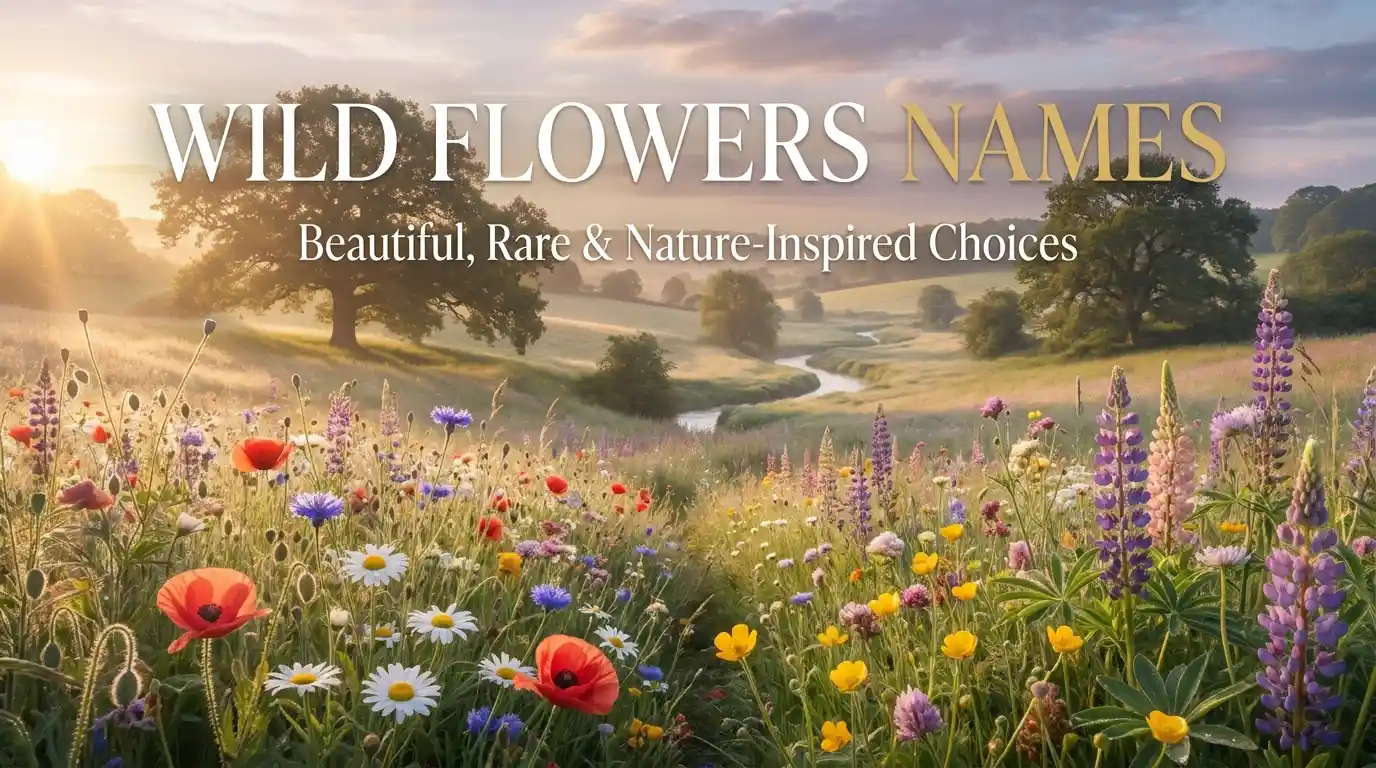
There is something wonderfully untamed about a wildflower. It does not need a perfect garden bed, a formal arrangement, or anyone’s permission to bloom. It simply appears, brightening a meadow, roadside, woodland edge, or forgotten patch of grass.
That is exactly why wild flowers names feel so appealing.
Names inspired by wildflowers can sound delicate without being fragile, earthy without feeling old-fashioned, and distinctive without becoming difficult to live with. A name like Daisy feels cheerful and familiar. Poppy feels spirited and artistic. Clover has a lucky, playful quality, while Bluebell feels distinctly storybook.
And the choices go far beyond the obvious.
This guide explores beautiful wildflower names, their origins and associations, the personalities they suggest, and the different aesthetics they fit. Whether you are choosing a baby name, pet name, character name, username, garden name, business name, or simply collecting nature-inspired names, there is something here for every mood.
Quick Answer
Some of the most appealing wildflower-inspired names include Daisy, Poppy, Clover, Bluebell, Primrose, Violet, Iris, Marigold, Heather, Holly, Rose, Willow, Fern, Flora, Lavender, Aster, Meadow, Briar, Clover, and Zinnia.
For a more unusual wildflower feel, consider Cowslip, Cornflower, Yarrow, Tansy, Sorrel, Rue, Linnea, Lupine, Anemone, Verbena, Camellia, or Calendula.
“Wildflower” is not one strict botanical category. The term commonly refers to flowers growing naturally or without deliberate cultivation in a particular setting. That means the exact list varies by region. Kew, for example, documents many native wildflowers in Britain and Ireland, while noting that common names can vary considerably from one place to another.
Best wildflower names by vibe
| Vibe | Names to Consider |
| Sweet & cheerful | Daisy, Poppy, Clover, Primrose |
| Elegant | Iris, Violet, Flora, Aster |
| Soft & feminine | Rose, Lily, Heather, Bluebell |
| Rare & unusual | Yarrow, Cowslip, Tansy, Sorrel |
| Cottagecore | Daisy, Primrose, Clover, Meadow |
| Dark botanical | Briar, Rue, Poppy, Nightshade |
| Vintage | Marigold, Violet, Flora, Rosemary |
| Fantasy-inspired | Bluebell, Aster, Anemone, Briar |
| Minimalist | Iris, Fern, Rose, Rue |
| Earthy | Fern, Heather, Clover, Meadow |
| Romantic | Rose, Violet, Primrose, Lavender |
| Modern | Poppy, Clover, Aster, Zinnia |
Why Wildflower Names Feel So Special
Wildflower names carry a different emotional atmosphere from conventional floral names.
A traditional flower name may immediately suggest a polished bouquet. A wildflower name often suggests freedom, individuality, countryside beauty, resilience, and natural charm.
That distinction matters when choosing a name.
Daisy feels sunny and approachable.
Violet feels thoughtful and literary.
Poppy feels energetic and creative.
Clover feels playful and optimistic.
Briar feels mysterious and slightly gothic.
Fern feels quiet, earthy, and minimalist.
There is also a fascinating cultural layer behind many wildflower names. Kew notes that the common names of wildflowers can preserve traces of folklore, history, local traditions, physical appearance, and traditional uses.
And flower symbolism has a long history. The “language of flowers,” or floriography, used flowers and their characteristics to communicate ideas such as friendship, remembrance, love, strength, and hope.
So a flower-inspired name can do more than sound pretty. It can quietly suggest a personality.
Beautiful Wild Flower Names
Here are some of the strongest choices if you want a name that feels recognizably floral while still having personality.
Daisy
Meaning/association: Day’s eye; associated with the flower’s appearance
Origin: English common name
Gender: Traditionally feminine
Pronunciation: DAY-zee
Vibe: Cheerful, innocent, sunny, friendly
Aesthetic: Cottagecore, vintage, pastoral
Nicknames: Dais, Daze
Daisy is one of those names that almost instantly creates an image. White petals, golden center, summer grass, and uncomplicated happiness.
It is familiar enough to be easy to pronounce but still carries a strong nature identity.
Best for: Someone looking for a warm, approachable wildflower name rather than an exotic one.
Poppy
Botanical association: Common or corn poppy, Papaver rhoeas
Gender: Traditionally feminine, but usable creatively
Pronunciation: POP-ee
Vibe: Bold, artistic, spirited, playful
Aesthetic: Vintage, British, whimsical
Nicknames: Pop, Pops
Poppy has much more energy than many floral names.
The common poppy is an annual wildflower associated with disturbed soil and is particularly recognizable for its vivid red flowers. It also became a major cultural symbol of remembrance after World War I.
That gives Poppy an interesting combination of brightness and emotional depth.
Clover
Meaning: Refers to clover plants
Gender: Unisex
Pronunciation: KLOH-ver
Vibe: Lucky, playful, earthy
Aesthetic: Cottagecore, nature, whimsical
Nicknames: Clo, Clove
Clover feels less like a formal flower name and more like a little piece of countryside.
Its strongest emotional association is luck, making it especially attractive for a character, pet, username, or baby name with an optimistic meaning.
Social impression: Friendly, unusual, memorable without sounding invented.
Bluebell
Origin: English common flower name
Gender: Feminine/creative unisex
Vibe: Delicate, magical, woodland, romantic
Aesthetic: Cottagecore, fairycore, storybook
Nicknames: Blue, Bella, Bell
Bluebell feels almost fictional.
It brings to mind woodland paths, spring mornings, old English gardens, and fairy-tale illustrations. It is more distinctive than Daisy or Rose, although its length makes it better suited to a nickname, character, pet, or creative identity than to someone seeking an ultra-minimal name.
Primrose
Origin: From the flower name; related to “first rose” in popular interpretation
Gender: Traditionally feminine
Vibe: Vintage, gentle, refined
Aesthetic: Cottagecore, vintage, literary
Nicknames: Prim, Rosie, Rose
Primrose has a beautiful old-fashioned quality without feeling completely dated.
It works particularly well if you like names such as Florence, Beatrice, Violet, or Rosemary and want something slightly less expected.
Violet
Origin: Flower name, ultimately connected with the violet plant and its historical naming traditions
Gender: Traditionally feminine
Vibe: Elegant, intelligent, artistic
Aesthetic: Vintage, literary, romantic
Nicknames: Vi, Vivi, Lettie
Violet is one of the strongest choices for someone who wants nature + sophistication.
It does not sound overly whimsical. Instead, it has a polished, almost literary personality.
Iris
Origin: Greek; also the name of a flower genus
Gender: Traditionally feminine
Vibe: Elegant, artistic, distinctive
Aesthetic: Minimalist, classical, botanical
Nicknames: Irie
Iris is especially interesting because it works simultaneously as a floral name and a classical name.
Its connection to Greek mythology also gives it a deeper cultural layer than many modern nature names. The result is a name that feels botanical without being overly “flower-like.”
Marigold
Origin: English flower name
Gender: Traditionally feminine
Vibe: Golden, warm, vintage, joyful
Aesthetic: Vintage, cottagecore, maximalist
Nicknames: Mari, Goldie, Gold
Marigold feels like sunlight in name form.
It is longer and more distinctive than Daisy, but Goldie gives it an easy nickname. It is particularly appealing for parents who love vintage names that have returned to contemporary style.
Heather
Origin: English/Scottish plant name
Gender: Traditionally feminine
Vibe: Calm, natural, grounded
Aesthetic: Rustic, vintage, outdoorsy
Heather feels quieter than Poppy or Daisy.
Its strength is its understated quality. It suggests hillsides, purple flowers, cool air, and open landscapes rather than cultivated gardens.
Aster
Origin: Greek aster, “star”
Gender: Unisex/modern
Vibe: Celestial, intelligent, delicate
Aesthetic: Minimalist, botanical, celestial
Nicknames: Asti
Aster is one of the best choices if you want a name that connects flowers and stars.
Its botanical name has a particularly attractive meaning because the flower head is associated with a star-like shape. Kew’s botanical resources similarly document the Greek roots used in plant nomenclature, illustrating how botanical names can preserve visual and linguistic history.
Rare and Unusual Wild Flower Names
If Daisy and Poppy feel too familiar, these names have more personality and botanical intrigue.
| Name | Botanical/Floral Association | Overall Vibe |
| Yarrow | Achillea millefolium | Ancient, herbal, strong |
| Cowslip | Primula veris | Whimsical, vintage |
| Tansy | Tanacetum | Quirky, bright, old-world |
| Sorrel | Sorrel plants | Earthy, unusual |
| Cornflower | Centaurea cyanus | Blue, romantic, pastoral |
| Lupine | Lupinus | Wild, dramatic, colorful |
| Anemone | Anemone | Elegant, mythic |
| Verbena | Verbena | Botanical, sophisticated |
| Calendula | Calendula | Golden, classical |
| Zinnia | Zinnia | Colorful, modern |
| Celandine | Flowering plant name | Medieval, lyrical |
| Scabiosa | Scabiosa | Dramatic, botanical |
| Betony | Betonica | Medieval, earthy |
| Corncockle | Agrostemma githago | Rustic, whimsical |
| Musk Mallow | Malva moschata | Soft, romantic |
Kew’s wildflower resources include plants such as betony, cornflower, cowslip, musk mallow, corncockle, yarrow, wild marjoram, and wild thyme, demonstrating just how rich the vocabulary of wildflower names can be.
Yarrow
Yarrow is particularly strong for a character, pet, fantasy identity, or unusual nature-inspired name.
Its scientific name, Achillea millefolium, connects it to Achilles in classical tradition. Kew also records folklore surrounding yarrow and its historical reputation as a wound-healing plant.
Vibe: Warrior-poet, herbalist, woodland healer.
Cornflower
Cornflower has a wonderfully visual identity because of its intense blue flowers.
Its botanical name, Centaurea cyanus, also has fascinating classical associations. Kew discusses both the centaur Chiron and the origin of “cyan” in connection with the flower’s traditional stories.
Vibe: Romantic, artistic, blue-toned, European meadow.
Cowslip
Cowslip is quirky rather than conventionally pretty.
Kew notes that its common name is thought to derive from an Old English term associated with cow dung, while the plant itself produces delicate nodding yellow flowers.
That contrast makes it a fascinating choice for fictional characters, fantasy worlds, or someone who wants a genuinely unusual botanical word.
Soft and Feminine Wildflower Names
For a softer, more romantic naming style, these are especially appealing:
- Daisy
- Violet
- Rose
- Primrose
- Bluebell
- Lavender
- Heather
- Flora
- Lily
- Iris
- Marigold
- Poppy
- Anemone
- Clover
- Magnolia
Softest choices: Daisy, Bluebell, Primrose
Most elegant: Iris, Violet, Flora
Most romantic: Rose, Lavender, Primrose
Most whimsical: Clover, Poppy, Bluebell
The important distinction is that “soft” does not necessarily mean childish. Violet and Iris, for example, can feel sophisticated and adult, while Daisy and Bluebell lean more playful and youthful.
Dark, Gothic and Mysterious Wild Flower Names
Wildflowers do not have to mean sunshine and cottage gardens.
Some botanical names have a darker, more mysterious atmosphere:
- Briar
- Rue
- Poppy
- Belladonna
- Nightshade
- Hemlock
- Thorn
- Foxglove
- Blackthorn
- Mandrake
- Yarrow
- Anemone
These names work particularly well for fantasy characters, gothic usernames, gaming identities, fictional kingdoms, witchy aesthetics, and dark-academia projects.
Briar
Briar is arguably one of the strongest modern nature names for a darker aesthetic.
It suggests tangled hedges, enchanted forests, thorns, and fairy tales. Its association with Sleeping Beauty through Briar Rose gives it a strong literary and pop-culture resonance without requiring the full name Rose.
Vibe: Enchanted forest + gothic romance.
Foxglove
Foxglove is striking because the word itself feels mysterious.
The tall flower spikes and unusual bell-shaped flowers make it visually memorable. It sounds much more like a fantasy character than an everyday floral name.
Best use: Fiction, fantasy, gaming, creative projects, or usernames.
Vintage Wildflower Names
If you love names that sound as though they belong in an old novel, try:
- Violet
- Flora
- Primrose
- Marigold
- Rosemary
- Lavender
- Iris
- Rose
- Heather
- Holly
- Della
- Daisy
Vintage flower names have benefited from a broader revival of old-fashioned naming styles. Their appeal comes partly from familiarity: they feel established rather than artificially created.
Flora is especially interesting because it is both a personal name and a word associated with plant life generally.
Marigold feels warm and nostalgic.
Violet feels literary.
Primrose feels distinctly old-world.
Rosemary gives you both a floral association and a classic personal name with nickname possibilities such as Rose or Romy.
Cottagecore and Fairycore Wildflower Names
The visual language of TikTok and Pinterest has made botanical aesthetics particularly powerful in naming culture. Cottagecore favors pastoral simplicity, handmade textures, gardens, baking, countryside imagery, and nostalgic femininity, while fairycore leans more magical and woodland-inspired.
For cottagecore, consider:
- Daisy
- Clover
- Primrose
- Marigold
- Lavender
- Rose
- Heather
- Meadow
- Poppy
For fairycore, consider:
- Bluebell
- Briar
- Aster
- Fern
- Willow
- Clover
- Anemone
- Foxglove
- Flora
For dark cottagecore, try:
- Briar
- Rue
- Poppy
- Foxglove
- Yarrow
- Nightshade
- Thorn
These categories are aesthetic interpretations rather than botanical classifications. They describe the emotional and visual impression a name creates.
Wildflower Names With Strong Symbolism
Some flowers have unusually powerful cultural associations.
| Name | Common Symbolic Association | Emotional Impression |
| Poppy | Remembrance, hope | Brave, emotional |
| Forget-Me-Not | Memory, remembrance | Tender, sentimental |
| Daffodil | Renewal, optimism | Joyful, resilient |
| Cornflower | Classical healing stories | Romantic, artistic |
| Cowslip | Folklore, beauty | Secretive, whimsical |
| Yarrow | Healing traditions | Strong, protective |
| Aster | Star imagery | Celestial, refined |
| Daisy | Innocence, simplicity | Cheerful, pure |
| Clover | Luck | Playful, optimistic |
| Violet | Modesty, beauty in floral symbolism | Quiet, elegant |
Symbolism should always be treated carefully. Flower meanings can differ across historical periods and cultures, so they are better understood as associations rather than universal definitions.
For example, Kew records the corn poppy’s modern remembrance symbolism alongside older agricultural and fertility associations.
Similarly, Kew notes the wild daffodil’s association with rebirth and strength, while its literary identity was strengthened by William Wordsworth’s famous poem inspired by daffodils near Ullswater.
Wildflower Names for Girls
If you specifically want feminine wildflower names, this is a strong shortlist:
- Daisy
- Violet
- Poppy
- Iris
- Primrose
- Marigold
- Flora
- Heather
- Bluebell
- Rose
- Lavender
- Holly
- Rosemary
- Anemone
- Zinnia
- Aster
- Clover
- Magnolia
- Celandine
- Linnea
Most elegant
Violet, Iris, Flora, Rose
Most unusual
Celandine, Bluebell, Anemone, Zinnia
Most playful
Daisy, Poppy, Clover
Most vintage
Primrose, Marigold, Rosemary, Violet
Gender-Neutral Wildflower Names
If you prefer names that do not feel strongly gendered, consider:
- Aster
- Clover
- Rowan
- Briar
- Sage
- Fern
- Meadow
- River
- Linden
- Sorrel
- Wren
- Reed
- Juniper
- Moss
Not all of these are technically wildflowers. Some are plants, trees, herbs, or broader nature names. That distinction is useful if your priority is the wild botanical aesthetic rather than strict flower classification.
Wildflower Names for Pets
Flower names are especially good for pets because they can be cute without sounding overly childish.
For a female dog or cat
- Daisy
- Poppy
- Clover
- Violet
- Bluebell
- Primrose
- Rosie
- Marigold
- Iris
- Fern
For a male or gender-neutral pet
- Clover
- Aster
- Briar
- Moss
- Sage
- Yarrow
- Rowan
- Basil
- Sorrel
- Lupine
For a tiny pet
Clover, Daisy, Poppy, Bluebell
For a large or dramatic pet
Briar, Yarrow, Lupine, Foxglove
For a black cat
Nightshade, Briar, Rue, Poppy, Belladonna
Wildflower Names for Characters
Wildflower names become particularly powerful in fiction because readers instinctively build visual associations around them.
Heroine names
Violet, Iris, Primrose, Flora, Aster
These suggest intelligence, grace, sensitivity, or classical beauty.
Fierce heroine names
Briar, Poppy, Yarrow, Zinnia
These feel more energetic and independent.
Fantasy character names
Bluebell, Anemone, Celandine, Foxglove, Aster
Witchy character names
Rue, Nightshade, Belladonna, Foxglove, Yarrow
Cottagecore character names
Daisy, Clover, Primrose, Marigold, Flora
A useful trick in character naming is to match the flower’s visual personality with the character’s role. A gentle healer named Yarrow feels very different from a cheerful protagonist named Daisy.
Wildflower Names and Their Personality Vibes
A name’s literal meaning is only part of its identity. Sound, length, cultural familiarity, and visual associations also affect how people perceive it.
| Name | Personality Vibe | Social Impression |
| Daisy | Sunny, kind, playful | Approachable |
| Poppy | Bold, creative, energetic | Memorable |
| Violet | Intelligent, elegant, artistic | Sophisticated |
| Iris | Calm, classical, distinctive | Refined |
| Clover | Optimistic, quirky | Friendly |
| Briar | Independent, mysterious | Edgy |
| Aster | Thoughtful, celestial | Modern |
| Primrose | Gentle, traditional | Romantic |
| Marigold | Warm, expressive | Cheerful |
| Fern | Quiet, grounded | Minimalist |
| Bluebell | Imaginative, delicate | Whimsical |
| Yarrow | Strong, unusual | Adventurous |
These personality descriptions are modern aesthetic interpretations, not claims that a person with the name will possess those traits.
Choosing the Right Wildflower Name
The best name is not necessarily the rarest one.
Start by deciding what you want the name to communicate.
Choose Daisy if…
You want something friendly, bright, recognizable, and uncomplicated.
Choose Poppy if…
You want something energetic, artistic, vintage, and memorable.
Choose Violet if…
You want elegance with a literary feeling.
Choose Clover if…
You want a name that feels lucky, playful, natural, and slightly unusual.
Choose Iris if…
You want something short, classical, botanical, and sophisticated.
Choose Briar if…
You prefer a mysterious, romantic, slightly gothic nature aesthetic.
Choose Aster if…
You want something modern, gender-flexible, floral, and subtly celestial.
Choose Primrose if…
You love vintage, romantic, storybook names with nickname potential.
Lucky Numbers, Colors, Gemstones and Numerology
Some naming websites attach lucky numbers, colors, gemstones, weekdays, zodiac signs, or numerology profiles to flower names.
These can be fun as symbolic naming tools, but they are not scientifically established properties of a name or flower.
For creative naming purposes, you could use an aesthetic system like this:
| Name | Symbolic Color | Gemstone Vibe | Number Association* |
| Daisy | White/Gold | Moonstone | 3 |
| Poppy | Scarlet | Ruby | 5 |
| Violet | Purple | Amethyst | 7 |
| Clover | Green | Jade | 4 |
| Iris | Blue/Purple | Sapphire | 9 |
| Aster | Lavender | Amethyst | 7 |
| Briar | Deep Red | Garnet | 8 |
| Primrose | Soft Yellow | Citrine | 6 |
*These are creative numerology associations, not factual botanical or scientific attributes.
For astrology, the same principle applies. There is no scientifically verified zodiac sign inherently belonging to a particular flower name. If you use zodiac associations in naming, treat them as an aesthetic or spiritual framework rather than an objective fact.
Modern vs. Classic Wildflower Names
One of the easiest ways to narrow your list is to decide whether you want the name to feel established or unusual.
Classic
- Rose
- Daisy
- Violet
- Iris
- Heather
- Holly
These are easy to recognize and generally straightforward to pronounce.
Vintage revival
- Primrose
- Marigold
- Flora
- Rosemary
- Lavender
These feel old-fashioned but increasingly fresh again.
Modern botanical
- Aster
- Clover
- Meadow
- Briar
- Fern
These feel more contemporary and aesthetic-driven.
Rare botanical
- Yarrow
- Cowslip
- Celandine
- Scabiosa
- Corncockle
- Anemone
These are better choices if uniqueness matters more than immediate familiarity.
Wildflower Names in Literature, Myth and Culture
Flowers have always been powerful storytelling devices.
William Wordsworth’s famous poem about daffodils helped cement the flower’s literary identity, while Greek and Roman mythology contributed stories around flowers such as the narcissus and poppy.
The poppy is another excellent example of how a simple flower can accumulate layers of meaning. It has connections to agriculture, ancient mythology, sleep, remembrance, wartime memory, and hope.
That makes floral names especially useful for fiction.
A character called Violet can evoke literary elegance.
A character called Briar can evoke fairy tales.
A character called Yarrow can suggest an herbalist or healer.
A character called Poppy can feel artistic and lively.
A character called Aster can subtly introduce celestial imagery.
The name does some storytelling before the character even speaks.
Best Wildflower Names at a Glance
If you want a final shortlist rather than hundreds of possibilities, start here:
Top 10 overall
- Violet — elegant and literary
- Daisy — cheerful and timeless
- Poppy — bold and artistic
- Iris — refined and classical
- Clover — playful and lucky
- Aster — modern and celestial
- Primrose — romantic and vintage
- Briar — mysterious and distinctive
- Marigold — warm and nostalgic
- Bluebell — whimsical and storybook
Top 5 rare choices
Yarrow, Celandine, Anemone, Cowslip, Cornflower
Top 5 modern choices
Aster, Clover, Briar, Meadow, Zinnia
Top 5 cottagecore choices
Daisy, Primrose, Clover, Marigold, Bluebell
Top 5 dark botanical choices
Briar, Rue, Foxglove, Nightshade, Poppy
Frequently Asked Questions About Wild Flower Names
What are the most popular wildflower names?
Daisy, Poppy, Violet, Iris, Rose, Heather, Holly, and Clover are among the most recognizable flower or nature-inspired choices. Popularity varies by country, generation, and whether you mean a traditional personal name or a newer botanical naming trend.
What is a rare wildflower name?
Names such as Yarrow, Celandine, Cowslip, Corncockle, Scabiosa, and Anemone feel considerably rarer and more botanical than familiar names such as Daisy or Rose.
What is a good wildflower name for a girl?
Violet, Daisy, Poppy, Iris, Primrose, Flora, Marigold, and Bluebell are excellent options. Violet and Iris are particularly good if you want a floral name that feels sophisticated rather than overly whimsical.
What wildflower name means love?
There is no single universal flower-name meaning “love.” Floral symbolism varies between cultures and historical periods. Flowers including roses and violets have longstanding associations with love and affection, while other flowers may represent memory, friendship, remembrance, or devotion.
What is a cute wildflower name?
Daisy, Poppy, Clover, Bluebell, Primrose, and Buttercup have especially cute and playful personalities.
What is a good dark flower name?
Briar, Nightshade, Foxglove, Rue, Belladonna, and Poppy work well for darker botanical or gothic aesthetics.
Are wildflower names good baby names?
Yes, if you choose according to your preferred level of familiarity. Daisy, Violet, Iris, Rose, Poppy, and Flora are relatively easy to recognize, while Yarrow, Cowslip, or Foxglove are much more unconventional.
Are all flower names actually wildflowers?
No. “Wildflower” is a broad everyday term rather than a single botanical category. A flower can be cultivated, native, naturalized, or found growing without deliberate cultivation. Regional definitions also matter. Kew emphasizes that wildflower common names can vary by location and that a single plant may have multiple common names.
Can wildflower names be gender-neutral?
Absolutely. Aster, Clover, Briar, Fern, Sage, Meadow, Sorrel, and Rowan can work particularly well for a gender-neutral nature aesthetic. Some are plants rather than technically wildflowers, so use them if the broader botanical feeling matters more than strict classification.
Which wildflower names have the best nicknames?
Primrose can become Prim or Rosie, Marigold can become Mari or Goldie, Violet can become Vi or Vivi, and Bluebell can become Blue or Bell. Names with natural nickname options are useful when you want something distinctive without committing to a very unusual everyday form.
Final Thoughts
The best wildflower names do more than sound beautiful. They create a tiny world around themselves.
Daisy gives you sunlight and simplicity.
Poppy gives you color and confidence.
Violet gives you elegance and quiet depth.
Clover gives you luck and playfulness.
Iris gives you classical beauty.
Aster gives you flowers and stars.
Briar gives you thorns, forests, and fairy tales.
Yarrow gives you something ancient and unexpected.
If you are choosing a name for a person, pet, character, username, garden, or creative project, think beyond the dictionary definition. Ask how the name sounds when spoken, looks when written, feels beside a surname, fits with sibling names, and changes as the person or project grows.
That is where a beautiful flower name becomes the right name.
And perhaps that is the most appealing thing about wildflowers themselves: they do not all bloom in the same way. Some are delicate. Some are vivid. Some are strange. Some are almost forgotten. But each has its own place.










1 thought on “Wild Flowers Names: Beautiful, Rare & Nature-Inspired Choices”